
Systems guides
Sub-slab, sub-membrane, drain tile, passive and wall-based systems — how each works and what it costs to install.
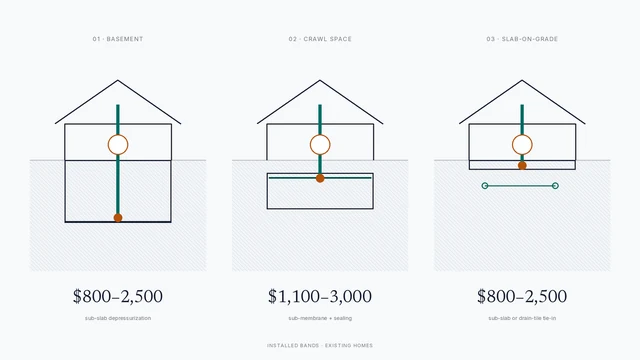
The system a house needs is decided by its foundation. A basement or slab gets sub-slab depressurization, a crawl space gets sub-membrane depressurization, and a hollow-block wall can be drawn down through its own cavities. Mixed foundations usually need more than one suction point — which is why the quote for a house with a basement and a crawl-space wing is not the same as the quote next door.
Sub-slab depressurization
The default. A core through the slab, a small suction pit in the soil beneath, PVC pipe to a fan, and a vent above the roofline. Installed band: $800–$2,500. It works on basements and slab-on-grade floors, and it is the system most bids describe.
Sub-membrane depressurization
A crawl space has to be covered before it can be depressurized. A reinforced vapor barrier is sealed to the walls and piers, then a pipe draws from beneath the membrane. Installed band: $1,100–$3,000. An unsealed membrane is the most common reason a crawl-space system underperforms.
Drain-tile and sump-pit tie-ins
Slab-on-grade houses often have perimeter drain tile and a sump pit. If the pit can be sealed with a gasketed lid, it can become the suction point: $800–$2,500. An open pit is a hole in the pressure boundary and cannot be used without a lid.
Block-wall depressurization
Hollow concrete-block walls form a ready-made suction field. The installer seals the top of the wall and draws from the cores: $1,000–$3,000. It avoids a slab core and keeps the pipe out of the living space.
Passive systems and activation
New construction can include a passive system — gas-permeable layer, vapor barrier, sealed vent pipe, junction box — for $500–$1,500. It relies on stack effect instead of a fan. If a test after occupancy reads at or above 4 pCi/L, adding a fan costs $300–$900 and converts it to an active system.
How the choice is made
The foundation decides the family of system; the site visit decides the details: how many suction points, where the pipe runs, whether the roof penetration is straightforward, and whether the electrical panel has capacity. A bid that names no suction-point count is a price, not a design.
Read the full foundation guide →
Frequently asked questions
What system works for a basement?
Active sub-slab depressurization: a pipe through the slab with a fan drawing soil gas to a roof vent. Installed cost is typically $800–$2,500.
How do you mitigate radon in a crawl space?
Sub-membrane depressurization: a sealed vapor barrier over the dirt floor, with a pipe and fan drawing from beneath it. Typically $1,100–$3,000 installed.
Can a passive system be upgraded later?
Yes. If the passive pipe was installed correctly, adding a fan costs $300–$900 and turns it into an active system without opening the floor.
All systems guides
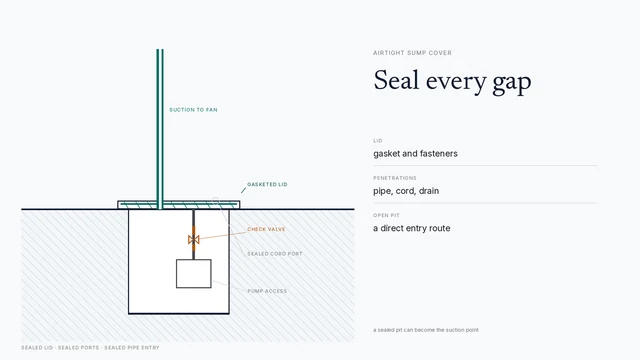
Airtight sump pit covers: fit, seals and pump access
A gasketed lid, sealed penetrations and a check valve turn an open sump pit from a radon entry into a sealed point. How to measure and what a bad lid costs.
Read the guide →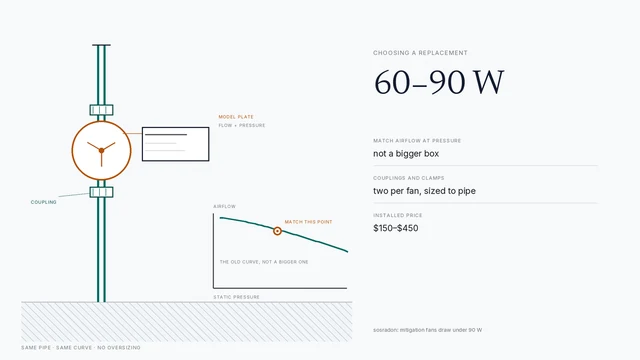
How to choose a replacement radon fan
Match the original fan's airflow at static pressure instead of buying a bigger box. Read the plate, size the couplings, check watts and warranty, then retest.
Read the guide →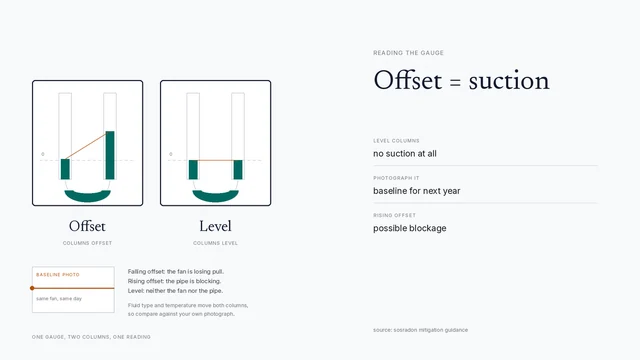
How to read a radon manometer
Two fluid columns, one height difference. What an offset means, what level means, why to photograph the baseline, and what a falling or rising offset tells you.
Read the guide →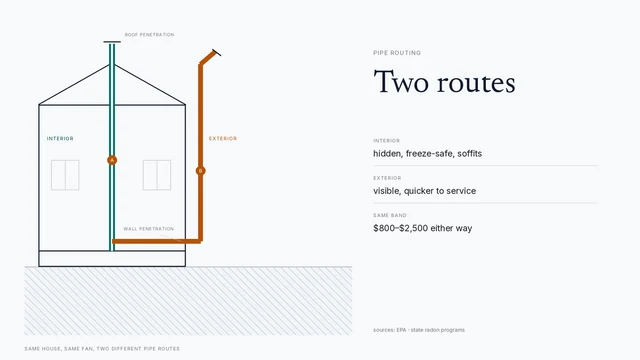
Interior vs exterior radon pipe routing
One route hides the pipe inside the house, the other runs it up an outside wall. How freeze risk, roof penetrations, access and cost decide which fits.
Read the guide →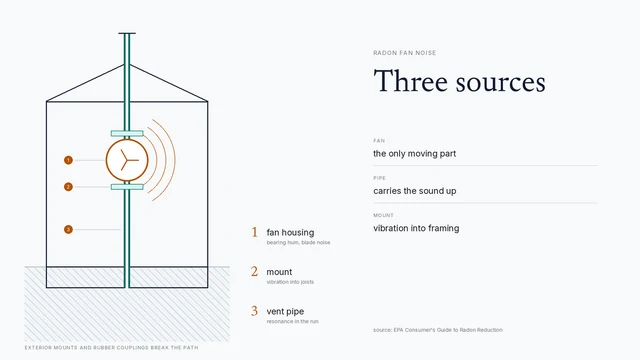
Radon fan noise: where it comes from and how to cut it
Fan noise travels through three paths: the housing, the vent pipe and the mount. What rubber couplings and isolation mounts fix, and what a louder fan means.
Read the guide →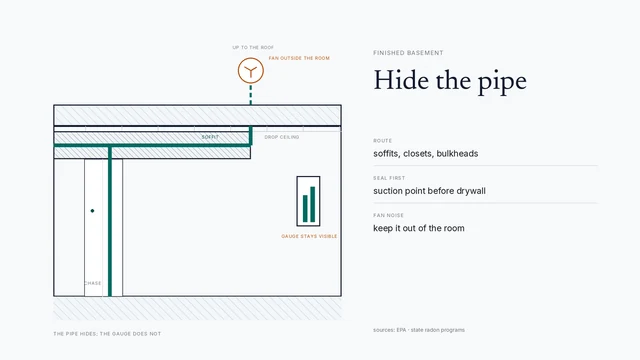
A radon system in a finished basement
Soffits, closets and bulkheads hide the pipe; the suction point still has to be sealed and the gauge still has to be readable. What finishing changes.
Read the guide →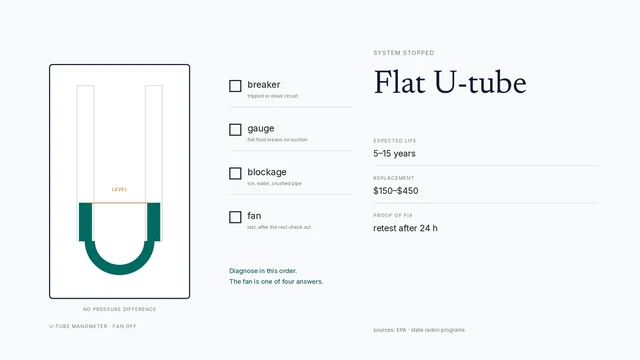
Signs a radon system has stopped working
A flat U-tube, a grinding fan, ice in the pipe, a tripped breaker or a rising retest. The order to check them in, and when the fan is the last suspect.
Read the guide →