
Compare guides
System against system and state against state, priced on installed cost, running cost and years of service.
Comparisons are only useful when the numbers are comparable. Every table on this site puts installed cost, running cost and the work included side by side, so a cheaper system that needs a second suction point does not look cheaper than it is. Start with the two that decide most projects: sub-slab against sub-membrane, and a DIY test against a certified one.
System against system
| Sub-slab (basement/slab) | Sub-membrane (crawl) | |
|---|---|---|
| Installed band | $800–$2,500 | $1,100–$3,000 |
| Suction field | Soil under the slab | Soil under a sealed membrane |
| Running cost | About $127/yr at 80 W | About $127/yr at 80 W |
| Common failure | Too few suction points | Unsealed membrane |
Fan size against running cost
| Fan power | Annual kWh | Cost at 18.16¢/kWh |
|---|---|---|
| 60 W | 526 | About $95 |
| 80 W | 701 | About $127 |
| 90 W | 788 | About $143 |
EPA budgets $50–$200 a year for fan operation. The difference between a small and a large fan is smaller than the difference between one electricity rate and another, which is why the rate you pay matters more than the fan badge.
DIY test against certified test
| DIY short-term kit | Certified measurement | |
|---|---|---|
| Cost | $15–$45 | $150–$250 |
| Paper trail | Lab report | Chain of custody, signed report |
| Accepted at closing | Usually not | Yes |
| Best use | First look, post-install check | Real estate, mitigation baseline |
What a comparison cannot settle
Which contractor is competent, whether the roof penetration is easy, and how the soil will behave under suction. Those are site facts. A comparison can tell you what a fair band looks like; it cannot tell you which bid is honest. Ask for the suction-point count, the fan model and the post-install test in writing, and the two questions answer themselves.
Frequently asked questions
Which system costs the least?
A passive system in new construction, at $500–$1,500 with no fan. Among retrofit systems, sub-slab depressurization is the least expensive at $800–$2,500.
Does my state's zone affect the price?
Not directly. The foundation sets the band. Zone 1 counties simply have more homes above the action level, so there is more testing and mitigation activity and usually more contractors competing.
Is a more expensive fan worth it?
Only if the system needs more pressure or the house is larger. For a typical single-point basement system, the standard 60–90 W fan is right, and the running-cost difference between models is a few dollars a month.
All compare guides
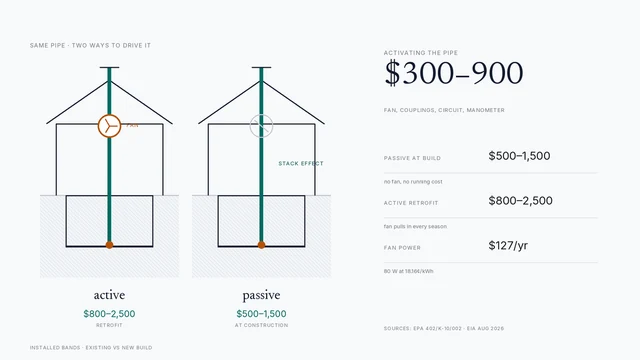
Active vs passive radon system: cost and when each works
A passive system costs $500–$1,500 at construction, an active retrofit $800–$2,500, and adding a fan to an existing pipe $300–$900. Which one you need.
Read the guide →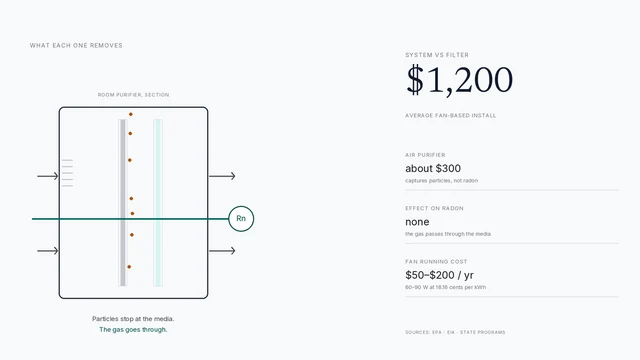
Radon mitigation vs air purifier: what works
An air purifier filters particles; radon is a gas that passes straight through. What HEPA and carbon media catch, and why a $1,200 system beats a $300 unit.
Read the guide →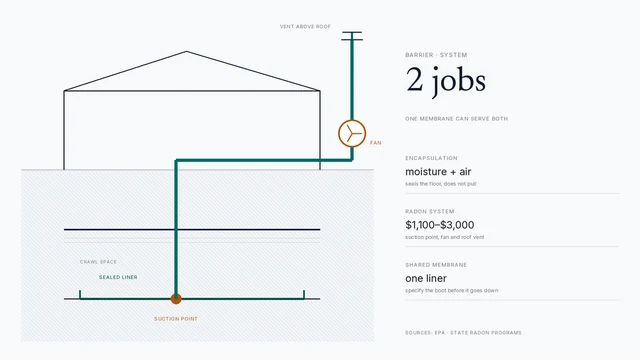
Radon mitigation vs crawl space encapsulation
Encapsulation seals a crawl space against moisture and soil gas. It is not a radon system. Sub-membrane depressurization is, and the two can share one membrane.
Read the guide →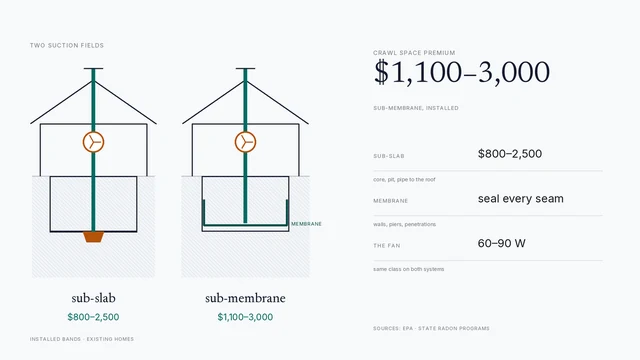
Sub-slab vs sub-membrane depressurization
Sub-slab covers basements and slabs at $800–$2,500; sub-membrane covers crawl spaces at $1,100–$3,000. Suction fields, sealing and the failure modes.
Read the guide →