Interior vs exterior radon pipe routing
One route hides the pipe inside the house, the other runs it up an outside wall. How freeze risk, roof penetrations, access and cost decide which fits.
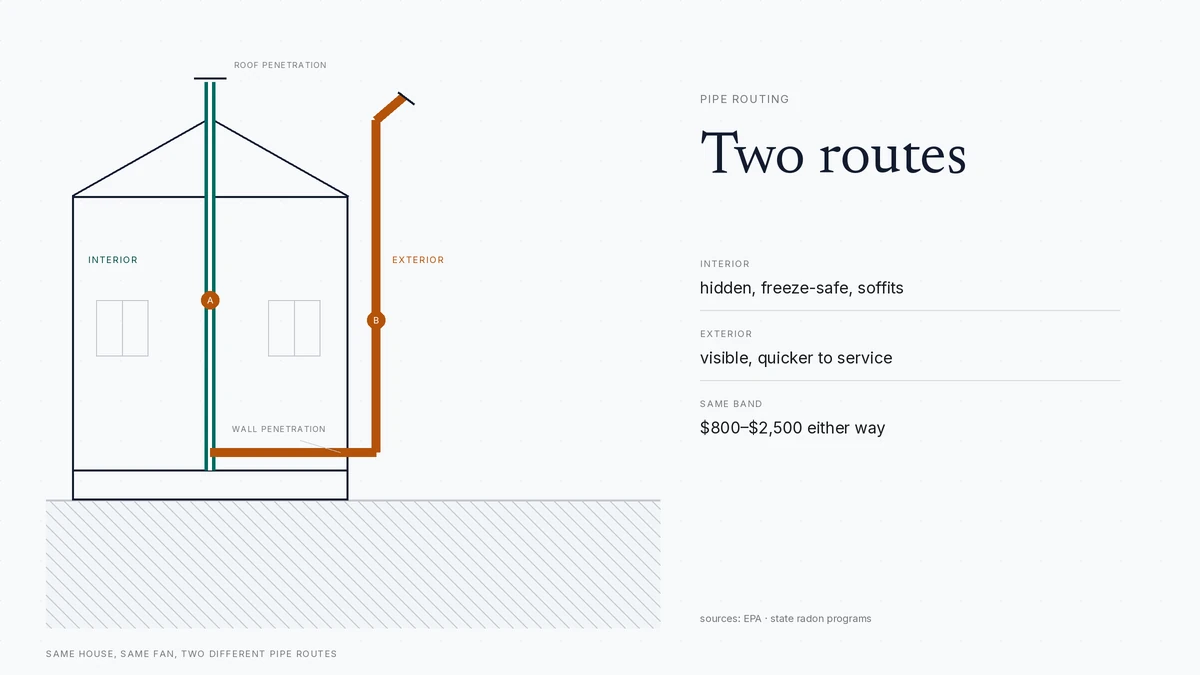
Interior routing runs the radon pipe up through a chase or soffit and out the roof; exterior routing exits the wall and climbs the outside face. Interior hides the pipe and resists freezing but costs more in finished space. Exterior is cheaper, visible and exposed to weather.
- Interior route
- Hidden, freeze-safe, more patching
- Exterior route
- Visible, cheaper, weather-exposed
- Both sit inside
- $800–$2,500 installed
- Decided by
- Foundation, climate, finishes
Some links on this page are affiliate links.If you buy through them we may earn a commission at no extra cost to you. We do not accept payment for rankings. Read the full disclosure.
| Interior routing | Exterior routing | |
|---|---|---|
| Where the pipe runs | Chase, closet, soffit, then the roof | Through the foundation wall, up the outside face |
| Freeze risk | Low inside the thermal envelope | Higher at low points and at the fan |
| Penetration | Roof flashing and interior framing | Wall penetration and a roof or eave exit |
| Repair work | Drywall, paint, fireblocking | Exterior sealant and paint |
| Service access | Indoors, at eye level in a basement | A ladder, weather permitting |
| Cost within the band | Toward the top in finished space | Toward the bottom on a simple wall |
Interior and exterior radon pipe routing are the two ways a mitigation system gets from the suction point to the roof: up through the house inside a chase, closet or soffit, or out through the foundation wall and up the outside face. Both move the same air with the same fan. They differ in what the pipe costs to install, what it looks like, and what happens to it in February.
What the two routes look like
An interior route starts at the suction point, rises through the basement or crawl space, passes through the floor structure and continues to the roof inside a framed chase or an existing void. The fan usually sits in the attic, the garage or the basement. The only exterior penetration is at the roof.
An exterior route leaves the building through the rim joist or the foundation wall above grade, turns upward and runs against the siding to a point above the eave, where it terminates or crosses the roof edge. The fan is typically mounted on the outside wall, often near the top of the run.
The fan follows the route. Interior runs put it where a service visit does not need a ladder, which is why basement and attic placements dominate. Exterior runs put it on the wall, high enough to be out of casual reach and low enough to be climbed to.
Both are ordinary. Neither is a shortcut, and neither is automatically better. The foundation-type guide explains where the suction point sits in each foundation, which is the first constraint on the route.
Freeze risk
A mitigation system moves moist air out of the soil, and moisture condenses inside the pipe. Where that water collects, it freezes. An interior run inside the thermal envelope stays warm enough that the condensate drains or evaporates; an exterior run in a cold climate does not.
The vulnerable points are the same on every exterior job: a low horizontal section where water pools, the fan housing itself, and the termination where warm moist air meets cold outside air. Ice at the termination narrows the outlet, the fan works against more resistance, and the gauge climbs — a pattern the manometer guide covers.
Interior routing is not automatically safe. A long horizontal run through a cold crawl space or an unheated garage behaves like an exterior run, and a run that sags between supports collects water wherever the low point is.
Roof versus wall penetration
Every system needs one penetration that leaves the building envelope, and the choice determines what has to be sealed and what can leak later.
An interior route usually exits through the roof, which means flashing, a boot and a seal that has to survive snow and sun. A bad roof penetration is a leak into the attic, and it is the part of the job most likely to be blamed later when a stain appears on a ceiling.
An exterior route often exits through the wall above grade and terminates above the roofline without cutting the roof at all. That avoids roof flashing entirely, which is one reason exterior runs are common on complex roofs. The trade is a wall penetration that has to be sealed and flashed, plus a pipe that is exposed to weather for its whole length.
Maintenance access
A fan is a wear item with a 5 to 15 year service life. Where it sits decides how easy the replacement is.
An interior fan in a basement is at eye level and reachable in a minute. An interior fan in an attic is reachable through a hatch, which is fine until the hatch is behind stored boxes. An exterior fan is reachable with a ladder, weather permitting, and that is usually the fastest service of the three.
The pipe matters too. Interior runs that pass behind drywall make a future repair a demolition job; runs in a chase with an access panel do not. Exterior runs are accessible along their whole length, which is their quiet advantage. Ask where the fan will sit and how it will be reached in ten years, when the ladder is older and the shrubs are taller.
Appearance and the resale file
An exterior pipe is visible from the driveway and from the neighbor’s kitchen. On some houses that is unremarkable; on a front elevation with painted siding it is the first thing a buyer asks about.
An interior route disappears, at the cost of patching and paint. Neither choice changes what the system does, and neither changes the reading on a test. What does change a sale is documentation: a label with the model, the install date and the post-install result, plus a photograph of the route taken before the wall closed. The full cost breakdown explains why that paperwork is part of a competent job rather than an extra.
Cost inside the same band
EPA’s band for a fan-based sub-slab system is $800–$2,500, and routing moves a job within it rather than outside it. Exterior routing on a simple wall tends toward the bottom: fewer hours, less repair, no chase. Interior routing in finished space tends toward the top, because the pipe has to be framed in, fireblocked, patched and painted.
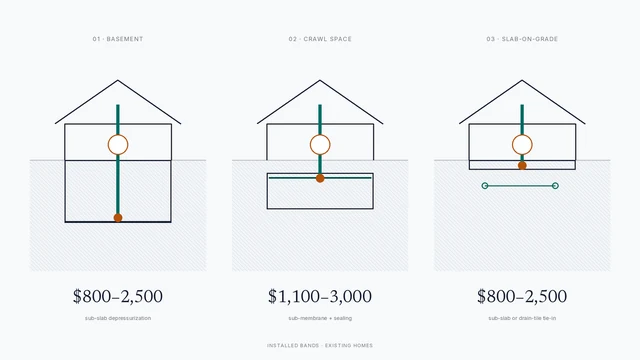
A crawl-space system, at $1,100–$3,000, adds a membrane and sealing regardless of route. A block-wall system, at $1,000–$3,000, adds the block-wall tie-in. In all three, the route is a secondary cost next to the suction point and the sealing work.
The number to compare between bids is not the total alone. Ask what each quote includes for patching, paint, fireblocking and the roof penetration. Two quotes that differ by a few hundred dollars often differ by whether the wall gets closed properly.
Why the choice is house-specific
Four things decide it: the foundation, the climate, the finishes and the roof.
A house with an unfinished basement and a simple gable roof can take either route cheaply. A finished basement with a low ceiling pushes the pipe into soffits and bulkheads, which usually favors the exterior. A cold climate pushes the fan and the run inside. A roof with valleys, dormers and skylights makes a roof penetration expensive and an exterior climb attractive. A historic district or a strict exterior palette can rule out the visible pipe entirely.
The systems guide covers how the fan, the pipe and the suction point are sized together, which matters more to performance than the route does. Routing is the part of the job a homeowner sees every day; sizing is the part that decides whether the radon number falls. Get the sizing right, then pick the route the house can actually accept, and put the choice and the reason in the file with the install paperwork.
How to do it
- Find the suction point firstThe route starts where the pipe leaves the slab or the crawl-space membrane. Everything downstream is decided by that location and by what sits above it.
- Map the obstaclesNote finished ceilings, closets, soffits, plumbing walls and the roof geometry. A route that avoids all four is cheaper than one that fights them.
- Check the climateIn a freezing climate, keep the run and the fan inside the thermal envelope where possible, and check any exterior low point for condensate.
- Confirm the termination heightThe vent has to clear the roofline and stay away from windows, doors and air intakes. That constraint applies to both routes and often decides the last few feet.
- Price the repair, not just the pipeAsk each bid what it includes for patching, paint and fireblocking. An interior quote without a repair line is a quote that will grow.
- Photograph the routeBefore the wall closes, photograph the pipe path and the fan. The next owner and the next contractor will both want to know where it runs.
Frequently asked questions
Is an exterior radon pipe as good as an interior one?
It moves the same air with the same fan. The difference is exposure: an exterior run is visible, takes weather and can freeze at a low point or at the fan in a cold climate. Interior runs stay inside the thermal envelope, which is why cold-climate installers often prefer them despite the patching.
Does an exterior radon pipe need to go above the roof?
The vent has to discharge high enough that the gas does not re-enter the house through windows, doors or air intakes. In practice that means above the roofline, even when the run itself stays on the outside wall. Terminating at the soffit puts the outlet beside the attic vents.
Can the radon fan be outside?
Yes, exterior-rated fans are common and are usually mounted on the outside wall or above the roofline. They are easier to service with a ladder and keep noise out of the living space, but they face weather and frost, and the wall they mount on can carry vibration into the room behind it.
Why is interior routing more expensive?
Because it passes through finished space. A chase through a closet, a soffit in a basement or a run through a garage ceiling all need framing, patching, paint and often a fireblock. The pipe and the fan cost the same either way; the difference is the repair around them.
Will an exterior pipe freeze in winter?
It can. The system moves moist soil air, and condensate collects at low points and at the fan. An exterior run in freezing weather can ice at the termination or stall an exterior fan. Interior runs are warmer, but they are not immune: a long horizontal section in a cold crawl space behaves like an exterior run.
Which route is better for resale?
Neither, on its own. What buyers respond to is a system with a label, a model number, a post-install test and a clean installation. A visible exterior pipe with documentation reads as normal infrastructure; a hidden interior pipe with no paperwork reads as a mystery.
Sources
Some links are affiliate links.If you buy through them we may earn a commission at no extra cost to you. We do not accept payment for rankings. Read the full disclosure.