Airtight sump pit covers: fit, seals and pump access
A gasketed lid, sealed penetrations and a check valve turn an open sump pit from a radon entry into a sealed point. How to measure and what a bad lid costs.
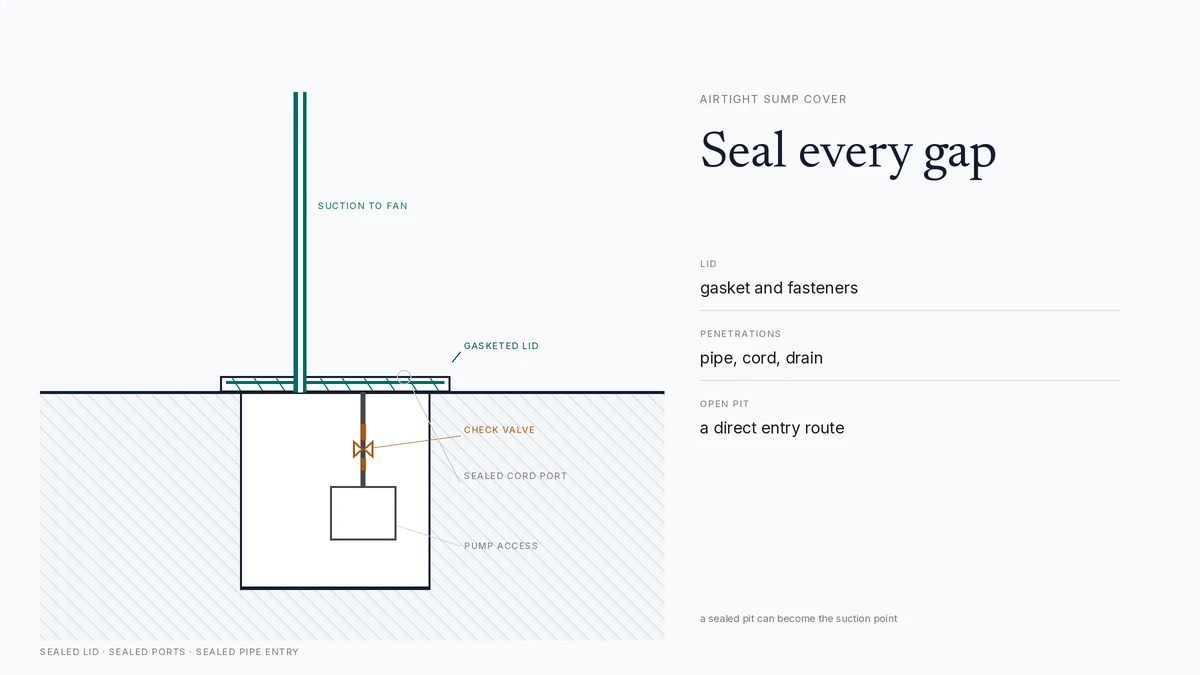
An airtight sump pit cover is a gasketed lid that seals a sump basin so soil gas cannot rise through it. It needs a compressible gasket, sealed penetrations, a check valve on the discharge and room to service the pump. A poor fit traps the float, which is worse than no lid.
- What it seals
- The pit and its penetrations
- Required parts
- Gasket, sealant, check valve
- Drain tile system
- $800–$2,500 installed
- Fails when
- It traps the pump or float
Some links on this page are affiliate links.If you buy through them we may earn a commission at no extra cost to you. We do not accept payment for rankings. Read the full disclosure.
| Airtight cover | Open or loose lid | |
|---|---|---|
| Radon path | Closed at the lid and at every penetration | Direct route from drain tile to basement air |
| Suction | The pit can serve as a suction point | Draws room air instead of soil gas |
| Moisture | Contained; the pump still lifts water | Evaporates into the basement |
| Pump service | Access hatch, float and cord clear | Easy, which is the only advantage |
| Failure mode | A bad fit traps the float or cord | Nothing fails; it simply does not seal |
An airtight sump pit cover is a gasketed lid that seals a basement sump basin so soil gas cannot rise through it into the house. It closes what is often the largest unsealed opening in a basement floor: a pit connected to drain tile, with a pump discharge, a power cord and sometimes a floor drain all passing through the same opening.
What the cover actually does
A sump pit is a hole in the slab, and under the slab is soil. Drain tile runs into that hole, which means the pit is connected to the same gravel bed and pore space that radon moves through. With an open lid, the pit is a chimney: soil gas moves up the tile, into the basin and out into the basement air, driven by the small pressure differences a heated house creates.
A cover breaks that path. It does not treat the soil and it does not reduce the radon concentration in the ground. It removes an opening, which is a different job — and on a house that already has a mitigation system, it removes a leak that can quietly short-circuit the suction.
The pressure that drives that flow is small and constant. A warm house pulls air upward through every available path, a furnace or dryer makes it worse for a few minutes at a time, and the pit is the path of least resistance for gas sitting under the slab. That is why an open pit in a basement with elevated radon is a predictable problem rather than an occasional one.
The lid and its gasket
The lid has to compress a gasket against a flat surface. That is the whole mechanism. A rigid lid resting on a rough concrete rim leaks at the gap, and a lid held down by gravity alone lifts under suction.
Look for three things. A compressible gasket, not a foam strip that has already taken a set. Fasteners that pull the lid down evenly, not two screws on opposite corners. And a rim in good enough condition to seal against; a crumbling basin lip needs a repair collar before any lid will hold.
Pipe, cord and drain penetrations
Every hole in the lid is a leak unless it is sealed. The discharge pipe needs a grommet or a bulkhead fitting sized to the pipe. The pump cord needs a sealed cord grip, not a notch cut with a knife. Any drain tile inlet needs its own seal.
This is where most installations fail. A lid with a good gasket and three open penetrations is a lid that does not seal, and the leak is invisible until someone puts a manometer on the system and finds the suction is pulling room air through the pit instead of soil gas from under the slab.
The check valve
The check valve belongs on the discharge line, above the lid. It does two things: it stops water in the riser from draining back into the basin after the pump shuts off, and it stops air from moving down that line into the pit.
On a sealed pit that has been tied into a mitigation system, the second job matters as much as the first. The fan is holding the pit under vacuum; without a check valve, the discharge line is a path from the basement into the pit, and the fan spends part of its capacity pulling conditioned air.
Pump access
A pump that cannot be reached is a pump that will not be maintained. The cover needs a way in: a bolted lid that comes off, a hinged hatch with its own gasket, or a split lid that lets one half lift clear.
Check the float before the lid goes down. A float that sits against the basin wall because the lid’s underside is too low will hang, and a hung float means a pump that never runs. Check the cord too; a cord pinched between lid and rim is a short waiting to happen.
An open pit is a radon entry
EPA’s guidance on mitigation treats sump openings as a priority sealing point for exactly this reason. The pit is connected to the soil, it sits inside the conditioned space, and in many basements it is the only place where that connection is open to the air.
The foundation-type guide explains how drain-tile systems compare with sub-slab and block-wall work. A drain-tile system is usually in the same $800–$2,500 band as sub-slab, and it lives or dies on how well the pit is sealed.
A sealed pit can become the suction point
When the pit is connected to drain tile that runs under the slab, sealing it turns the pit into a suction point for free. The fan draws from the basin, the vacuum spreads along the tile, and the system depressurizes the same gravel bed the radon was using. No core through the slab, no second hole.
That only works if the lid holds. A leaking lid, an unsealed cord or a missing check valve gives the fan an easier path, and the suction never reaches the far end of the tile. The systems guide covers how a suction field is meant to spread and what limits it.
Fit and measurement
Measure before ordering. The inside dimensions of the basin at the rim, the width of the flat landing the lid sits on, the outside diameter of the discharge pipe, and the position of the cord and any drain inlet. Photograph the pit with a tape measure in the frame.
Then check the rim. A basin with no lip cannot hold a fastened lid, and a lid that only rests in place cannot be made airtight with sealant alone. Some pits need a collar cast or bolted on first, and that is a job for someone who has done it before.
Sealant is a backup, not the seal. A bead of compatible sealant around a gasket helps on a rough rim; a bed of sealant with no gasket cracks out within a season. Ask what the lid is designed to compress against and fit that, rather than filling a gap with adhesive.
Why a cheap lid can be worse than none
A lid that seals the pit but does not fit it creates a new failure. It presses on the float, so the pump stops cycling. It pinches the cord at the rim. It sits so low that the pump cannot be lifted out without cutting the discharge. In each case the radon path is closed and the water path is blocked, and a flooded basement is a worse outcome than the gas the lid was meant to stop.
The DIY guide covers what a homeowner can reasonably fit and where the job turns into plumbing. A lid on a pit with a working pump, a clear float and a serviceable hatch is an improvement. A lid that traps the pump is a problem you will discover during a storm.
How to do it
- Measure the basinInside dimensions at the rim, the width of the landing, the pipe and cord positions. Photograph the pit with a tape measure in frame so a supplier can check the fit.
- Check the rimA lid needs a flat surface and a way to fasten down. A basin with no lip or a crumbling rim needs a repair collar before any gasket will hold.
- Seal the penetrationsDischarge pipe, cord and any drain inlet each need a grommet or sealant. A lid with three open holes is not airtight, whatever the label says.
- Fit the check valveMount it above the lid on the discharge so water cannot drain back and the fan cannot pull air down the line. Confirm it can be opened for service.
- Clear the float and cordBefore fastening the lid, move the float through its full travel and route the cord clear of the rim. A lid that pins either one will fail at the worst moment.
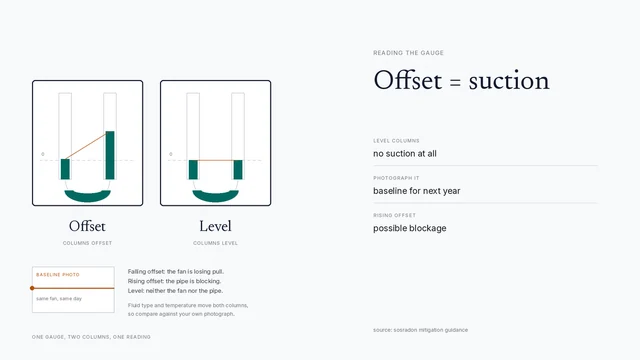
- Test the sealWith the system running, check the lid joint and each penetration by hand and with the manometer. A drop in the offset after fitting points at a leak you just created.
Frequently asked questions
Do I need an airtight cover on my sump pit?
If the pit connects to drain tile or sits in a basement with elevated radon, yes. An open pit is a direct path from the soil under the slab into the living space, and it is often the largest unsealed opening in the floor. A gasketed lid closes it and, on many systems, turns the pit into a usable suction point.
Can a sump pit be used as a radon suction point?
Often, yes, when the pit is connected to drain tile that runs under the slab. The mitigator seals the lid and draws from the pit, which depressurizes the tile rather than coring a new hole. It only works if the lid, the penetrations and the discharge line are sealed, because a leaky lid short-circuits the suction.
What is the check valve for?
It stops water in the discharge line from draining back into the pit, and on a sealed system it stops the fan from pulling air down that line. Without it, a sealed pit tied into the mitigation system can draw from the wrong place. It belongs above the lid, on the discharge, and it needs to be serviceable.
How do I measure for a new lid?
Measure the inside dimensions of the basin at the rim, the width of the flat landing the lid sits on, and the position and diameter of the discharge pipe, the cord and any drain tile inlet. Note whether the rim has a lip the lid can fasten to. A lid that only rests on the rim cannot be made airtight.
Why would a cheap lid be worse than no lid?
Because it seals the pit without fitting it. A lid that presses on the float, pinches the cord or blocks the pump from being lifted turns a serviceable pump into a stuck one, and a failed pump floods the basement. Sealing is only an improvement when the pump can still be reached and still works.
Does a sealed pit need to be vented?
It needs to be connected to the mitigation system, not left as a sealed box. On a drain-tile system the pit becomes part of the suction field. On a pit with no system, a sealed lid alone traps moisture and does nothing about the soil gas beneath it; the system is what moves the gas.
Sources
Some links are affiliate links.If you buy through them we may earn a commission at no extra cost to you. We do not accept payment for rankings. Read the full disclosure.