Signs a radon system has stopped working
A flat U-tube, a grinding fan, ice in the pipe, a tripped breaker or a rising retest. The order to check them in, and when the fan is the last suspect.
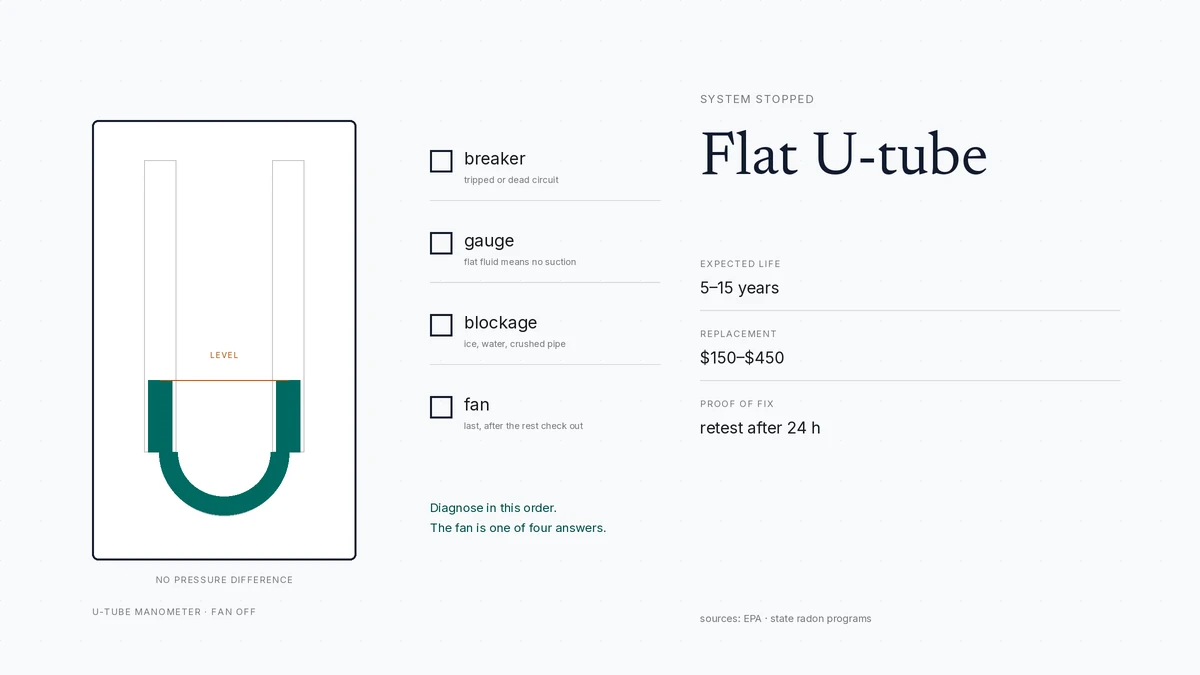
The clearest sign a radon system stopped working is a U-tube manometer with level fluid while the fan is powered. Grinding, ice in the pipe, a tripped breaker and a rising retest are the other signals. Check the gauge, the breaker, the pipe and then the fan, in that order.
- First indicator
- Level U-tube fluid
- Typical fan life
- 5–15 years
- Replacement
- $150–$450
- Proof of repair
- Retest after 24 hours
Some links on this page are affiliate links.If you buy through them we may earn a commission at no extra cost to you. We do not accept payment for rankings. Read the full disclosure.
| Symptom | Most likely cause | |
|---|---|---|
| Level fluid, breaker on | Blocked pipe, slipped coupling or dead fan | Check the run, then the couplings, then the fan |
| Grinding or clicking | Bearing wear or debris on the impeller | Fan replacement, $150–$450 installed |
| Water or ice in the pipe | Condensate at a low point or at the vent | Clear the run, check the fan turns |
| Breaker trips again after reset | Seized motor or a fault in the circuit | Stop resetting it, call an electrician or mitigator |
| Retest at or above 4 pCi/L | System not moving enough soil gas | Diagnose the system, not just the fan |
A radon system has stopped working when the U-tube manometer shows level fluid while the fan is powered, or when a retest comes back at or above 4 pCi/L. The gauge is the system’s only built-in indicator, and it reports suction rather than radon. Everything else — grinding, frost, a tripped breaker, the fan’s age — narrows down why the suction stopped.
Read the gauge before anything else
The U-tube is a clear tube with two fluid columns, mounted on the vent pipe. While the fan runs, pressure pushes one column down and the other up. The height difference is the suction. Level columns mean the fan is not moving air, and that is the one unambiguous failure signal a system gives you. The manometer guide explains how to read it and what to record.
A flat gauge has four common causes and only one of them is the fan: a tripped breaker, a blocked or iced pipe, a coupling that has slipped off, or water in a low point of the run. Reading the gauge is the start of the diagnosis, not the end of it.
Do not only note whether the fluid moved. Note where it sat. The height of the offset on a healthy system is the reference for every later check, and a gauge that has drifted down by half with the fan still running is telling you something a yes-or-no reading would miss. Photograph it with the fan running and keep the picture with the system paperwork.
Grinding, clicking and a hum that changes pitch
Bearing wear sounds like a grind or a whine that shifts as the motor warms. It is present every time the fan runs and it gets worse over months. Clicking is different: something is striking, usually debris on the impeller or a blade touching the housing. A hum that changes pitch points at the motor under load rather than at the air.
Any of these shortens the fan’s life rather than ending it instantly. The practical question is whether to replace now or watch it, and past ten years on EPA’s 5 to 15 year window the answer is usually now, before a January failure.
Ice and water in the pipe
Mitigation systems move moist soil air, and moisture condenses inside the pipe. It collects at low points, in sagging runs and at the fan housing. In freezing weather that water becomes ice, and ice at the termination or in a horizontal run can block the pipe or stall the impeller.
Water in the housing is worse than ice in the pipe. A stalled fan with a wet motor is on its way to failing, and restarting it repeatedly does the rest. A gurgle at startup, or a fan that sounds like it is moving water rather than air, is the audible version of the same problem — and it usually means the low point of the run is below the fan.
A tripped breaker
A breaker that has tripped explains a silent fan completely. Reset it once and watch the gauge. If the offset returns, the trip was a one-off and the system is running.
If it trips again, stop. A motor that draws locked-rotor current will keep tripping the breaker, and a repeated reset cycle is how a cheap fan failure becomes an electrical fault. A dead circuit is also possible, and that is an electrician’s job rather than a mitigator’s.
Frost on the vent
Frost on the vent pipe above the roof, or ice at the termination, is a visible sign that moist air is leaving the system and freezing at the outlet. It matters because the same process can close the outlet. An iced vent turns the fan into a compressor working against a blocked pipe.
The gauge reads that condition differently from a dead fan: with a blockage on the discharge side, the offset rises rather than falls. If your fluid has climbed and stayed there, look at the vent before you look at the motor.
A rising retest
The slowest signal is also the most important. A retest at or above 4 pCi/L on a system that is running means the system is not moving enough soil gas, whatever the fan is doing. It can be a tired fan, a leaking slab joint, a suction point that never held, or a change in the house such as a new furnace or a finished room.
One test does not separate those. Run it properly — closed-house conditions for 12 hours before and during, a short-term kit for 2 to 4 days — then compare it with the post-install result. The testing section covers the method.
Fan age and the 5–15 year window
Every fan has a date on its plate. EPA describes a typical service life of 5 to 15 years, and a unit running continuously in a cold climate tends to land in the lower half. A fan at year twelve that has started to grind is not a mystery; it is a part at the end of its service life.
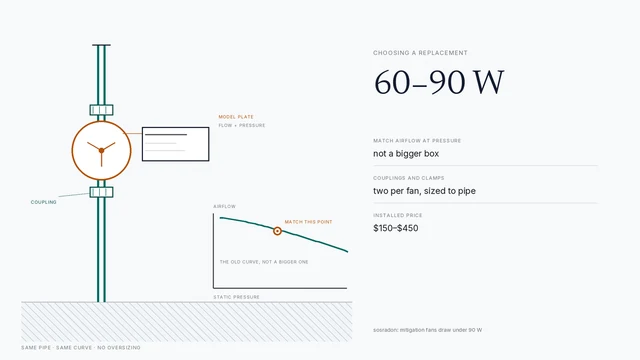
Replacing on your own schedule is cheaper than replacing after a failure, because you are not paying for an emergency call or a retest you did not plan. The replacement cost page sets out the $150–$450 band and what a quote should include.
The diagnostic order
Work in this sequence, cheapest and most likely first:
- Gauge. Level or offset. If it is offset, the fan is pulling and the problem is elsewhere.
- Breaker. Reset once. If it trips again, stop.
- Blockage. Ice at the vent, water at a low point, a crushed section, a slipped coupling.
- Fan. Feel the housing. No vibration with power on means a dead or seized motor.
That order resolves most flat gauges before anyone opens a toolbox. Skipping to the fan is how a $150–$450 part gets replaced on a system whose actual fault was a coupling that had worked loose. It also explains the bill: a contractor who arrives with a fan and no gauge is charging you for a part he has already decided to sell.
When to call a mitigator
Call when the gauge stays flat after the breaker and a visual check, when ice or water cannot be cleared without cutting pipe, when the fan is dead or the housing is wet, or when a proper retest is still at or above 4 pCi/L. Pipe changes, new suction points and diagnostic work on a system that never performed belong to someone with a manometer, a smoke pencil and a certified credential — NRPP, or a state license where one exists.
Everything else is a phone call and a part. The systems guide explains how the components fit together, so the conversation with a contractor starts from the same diagram.
How to do it
- Read the U-tubeLevel fluid with the fan powered means no suction. Note where the level sits and photograph it, because the height is the baseline for every future check.
- Check the breakerA tripped breaker explains a silent fan and costs nothing to test. If it trips again after the reset, stop and get the circuit and the motor checked.
- Walk the pipe for blockageLook for ice at the vent, water at a low point, a crushed section, or a coupling that has slipped. A blocked run shows as a rising offset on the gauge, not a flat one.
- Confirm the fan is turningPut a hand on the housing. A running fan vibrates. A fan that hums without moving air has a seized or broken impeller and needs replacing.
- Retest after the repairRun a short-term test once the system has operated for at least 24 hours. Below 2 pCi/L is the target; at or above 4 pCi/L the system needs diagnosis.
- Log the resultWrite the date, the model and the test result on the system label. Retest every two years, and after any major renovation or HVAC change.
Frequently asked questions
How do I know if my radon system is working?
Read the U-tube manometer on the vent pipe. While the fan runs, the fluid in the two columns sits at different heights, and that offset is the suction. Level columns mean the fan is not moving air. The gauge reports pressure, not radon, so a working gauge still needs a retest every two years.
What does a flat manometer mean?
No pressure difference across the fan. The causes are a tripped breaker, a blocked or iced pipe, a coupling that has slipped off, water sitting in a low point of the run, or a failed fan. Work through them in that order, because three of the five cost nothing to fix.
Can a radon fan run but not pull air?
Yes. A blocked pipe or a disconnected coupling leaves the motor turning with no suction at the slab. The gauge shows it: the offset falls toward level, or rises sharply if the blockage is downstream of the fan. Noise alone will not tell you, because a fan working against a blockage can sound normal or quieter.
Why did my radon system stop in winter?
Condensation freezes. Moisture in the vent pipe collects at low points or at the termination, and in freezing weather it can block the run or stall the impeller. Frost on the vent is the visible warning. Clear the ice, check the low point, and confirm the fan turns freely before restoring power.
How long do radon fans last?
EPA describes a typical service life of 5 to 15 years. A fan running continuously in a cold climate tends to land in the lower half. Past ten years, budget for the $150–$450 replacement rather than waiting for it to fail in January, when the ice and the queue for a contractor are both worst.
When should I call a mitigator instead of fixing it myself?
Call when the gauge stays flat after a breaker reset and a visual check, when water or ice cannot be cleared without cutting pipe, when the fan is dead or the housing is wet, or when a retest after at least 24 hours of operation is still at or above 4 pCi/L. Pipe changes and suction-point work are not homeowner jobs.
Sources
Some links are affiliate links.If you buy through them we may earn a commission at no extra cost to you. We do not accept payment for rankings. Read the full disclosure.