
DIY guides
What a homeowner can legitimately measure or build themselves — and the EPA warnings about the rest.
Radon is one of the few home-health problems a homeowner can legitimately test for without a licence. Mitigation is the part that needs a professional — not because the pipe is complicated, but because a badly designed system can move radon around a house instead of out of it. Here is the honest line between the two.
What you can do yourself
Test. A short-term kit ($15–$45) or long-term kit ($20–$50) is designed for homeowner use. Follow the closed-house protocol and the placement diagram, and send the device to the lab. How each test works →
Seal obvious openings. Caulk foundation cracks, seal the slab-to-wall seam, and fit a gasketed lid to an open sump pit. EPA is clear that sealing alone rarely brings a house below 4 pCi/L, but it is a sensible supplement and it makes any future system work better.
Keep the house ventilated while you wait. Opening windows and running an HRV or ERV can lower the level temporarily. It is not a fix, and it is not a substitute for mitigation, but it reduces exposure during the weeks between a test and an install.
Radon-resistant new construction
If you are building, the passive system goes in before the slab: a gas-permeable layer, a vapor barrier, a sealed vent pipe through the roof, and a junction box for a future fan. Cost at construction: $500–$1,500. Adding the fan later is $300–$900. EPA publishes model standards for this, and several states and local codes require it in designated counties.
What you should not do
Do not install your own fan and pipe and call it mitigated. A system has to be sized to the soil, sealed at every penetration, vented above the roofline, and verified with a test. A fan pulling from an unsealed pit can increase radon entry elsewhere in the house. EPA does not recommend DIY mitigation, and the money saved is small next to the cost of doing it twice.
When to call a professional
Any reading at or above 4 pCi/L. Any reading between 2 and 4 pCi/L if you want to pursue “as low as reasonably achievable.” Any real-estate transaction, where a certified measurement is the document that counts. And any time a DIY result is ambiguous, because a $150 certified test is cheaper than a $1,200 system you did not need.
What a professional should give you
NRPP certification or a state licence, a written design with a suction-point count, a named fan model, a permit where required, and a post-install test that shows the level dropped. If any of those is missing, the bid is not finished.
Frequently asked questions
Can I seal my foundation to reduce radon?
Sealing cracks and openings can reduce entry, but EPA says it rarely brings a house below 4 pCi/L on its own. Treat it as a supplement to a system, not a replacement.
Can I install my own radon pipe through the roof?
EPA does not recommend it. The system has to match the soil and the foundation, and a poor design can make indoor levels worse. Use a certified or licensed mitigator.
Is a DIY test good enough to decide on a system?
For a first look, yes. If the result is at or above 4 pCi/L, confirm with a certified measurement before committing to a mitigation contract.
All diy guides
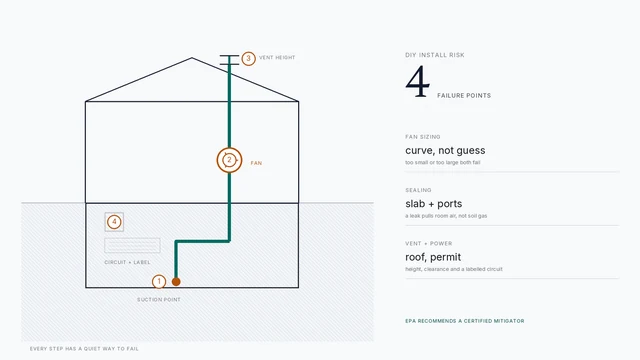
Can you install a radon system yourself?
EPA recommends a certified mitigator. What DIY installs get wrong: fan sizing, leaks, vent location, electrical, permits. Plus the steps worth doing yourself.
Read the guide →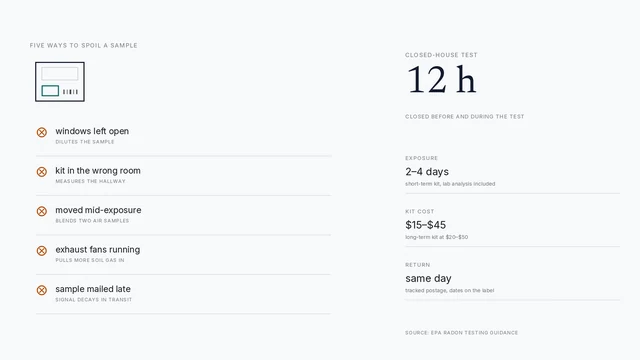
DIY radon testing mistakes that skew results
Windows left open, a kit in the wrong room, a test moved mid-week, a late mail drop. The mistakes that turn a $30 kit into a number you cannot trust.
Read the guide →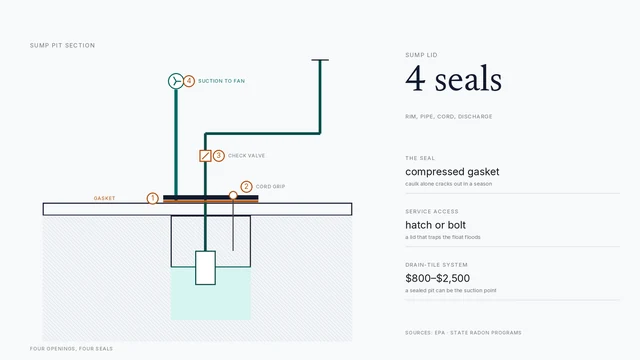
How to seal a sump pit lid: gasket, caulk, valve
A gasketed lid, sealed penetrations and a check valve stop soil gas rising through the pit. How to measure the basin, seal the pipe and keep the pump working.
Read the guide →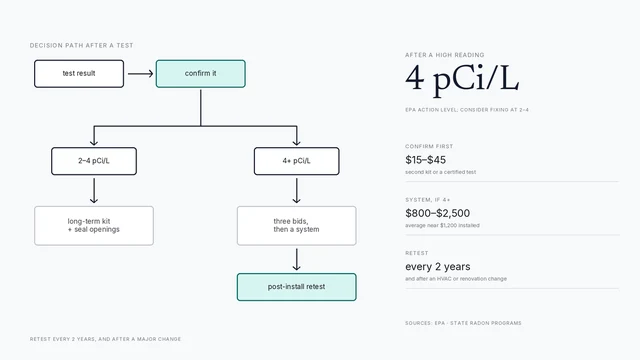
What to do after a high radon test result
A high reading is a starting point, not an emergency. Confirm the number, treat 2–4 pCi/L differently from 4+, get three bids, then retest after the install.
Read the guide →