How to read a radon manometer
Two fluid columns, one height difference. What an offset means, what level means, why to photograph the baseline, and what a falling or rising offset tells you.
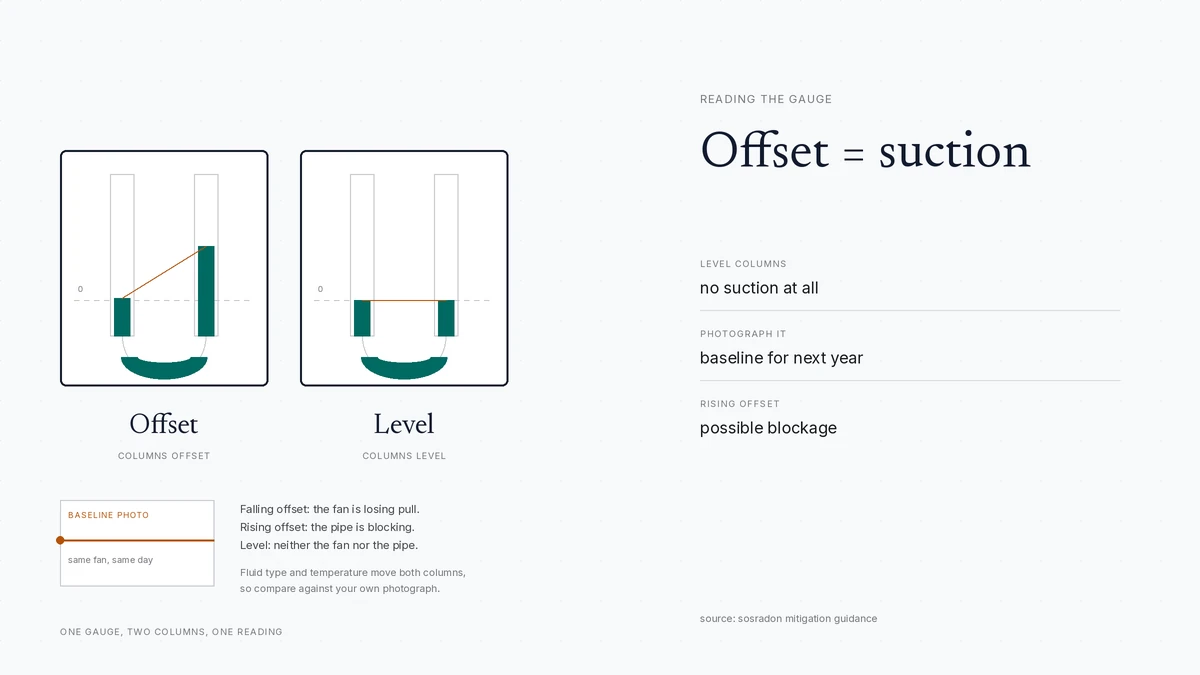
A radon manometer is a U-tube on the vent pipe with fluid in two columns. When the fan runs, one column drops and the other rises; the height difference is the suction. Level columns mean no suction. Photograph the healthy offset so later readings have a baseline.
- What it measures
- Pressure, not radon
- Offset
- Suction is present
- Level fluid
- No suction
- Reading cadence
- Monthly glance, yearly photo
Some links on this page are affiliate links.If you buy through them we may earn a commission at no extra cost to you. We do not accept payment for rankings. Read the full disclosure.
| What you see | What it means | |
|---|---|---|
| Steady offset, same as baseline | Fan running, pipe clear, system behaving | No action beyond the two-year retest |
| Offset smaller than baseline | Fan losing pull or leaking at a joint | Check couplings, then the fan |
| Offset larger than baseline | Added resistance downstream | Check the vent, the pipe and any ice |
| Columns level | No pressure difference at all | Breaker, blockage, coupling, then fan |
| Fluid gone from the gauge | Evaporation or a blown-out fill | Refill to the mark, then re-baseline |
A radon manometer is the U-shaped gauge mounted on the vent pipe that shows whether the fan is pulling suction. It holds fluid in two connected columns. While the fan runs, the pressure difference pushes one column down and the other up, and the height difference between them is the reading. Level columns mean the system is not pulling at all.
Two columns, one reading
The gauge is a single tube bent into a U, half filled with fluid. One leg is open to the room; the other is connected to the vent pipe. When the fan creates a partial vacuum in the pipe, the fluid is pushed toward the open side: the pipe-side column rises, the room-side column falls, and the difference between the two surfaces is the pressure the fan is holding.
Read both surfaces. A gauge that shows a low left column and a high right column is not “half full” — it is holding a difference, and that difference is the whole point of the instrument. Some units carry a printed scale; many are plain tubes with a reference mark. Either way, the reading is the gap.
Where the gauge is tapped matters as much as what it reads. A gauge connected between the suction point and the fan shows the vacuum the system holds under the slab, which is the number that describes performance. A gauge connected above the fan shows the pressure the fan pushes toward the roof. Both are legitimate, but they answer different questions, and a gauge that was moved during a repair can read backwards against its own baseline.
Offset means suction
An offset is the normal, healthy state. It says the fan is running, the pipe is connected, and the system is holding pressure against the slab. It says nothing about how much radon is in the house, and nothing about whether the suction reaches every part of the foundation.
The height of the offset is a property of your system: the fan model, the pipe run, the soil and the fluid all shape it. That is why the same gauge reads differently in two houses, and why a figure borrowed from a neighbor is useless as a target.
Level means no suction
Level columns are the failure signal. The fan may be powered and silent, powered and noisy, or the breaker may be off entirely; the gauge does not distinguish. It reports one fact: there is no pressure difference across it.
That narrows the fault to a short list — breaker, blockage, coupling, fan — and the failure-signs guide walks through them in order of cost. The important part is not to jump to the fan. A slipped coupling and a dead motor look identical on the gauge.
A gauge that has lost its fluid reads level too, and that is the one false alarm worth knowing. If the columns look empty or the tube is stained but dry, the instrument has failed rather than the system. Refill to the mark with the specified fluid before drawing any conclusion about the fan.
Photograph the baseline
A gauge reading only means something compared with an earlier one. Photograph the manometer with the fan running, close enough that both fluid surfaces and any reference mark are visible, and keep the image with the system paperwork.
The photograph does two jobs. It protects you from a contractor who reads the gauge and declares it low without knowing what it looked like last year. And it gives you a baseline for the seasonal drift that every gauge shows, so you can tell normal movement from a real change. Date the file, and take it again whenever the fan is replaced or the pipe is altered.
Temperature and fluid type
The fluid expands and contracts with temperature, and so does the air in the pipe. A gauge in an unheated garage reads differently in February than in July, and a gauge near a hot flue moves too. A small seasonal shift is expected.
Fluid type matters more than most owners realize. Gauges are filled with a specific fluid, and topping one up with water or with the wrong dye changes both the density and the surface tension, which changes the reading. Evaporated fluid also leaves a residue that stains the tube and makes the surfaces hard to see. When the level drops, refill to the mark with the specified fluid, then treat the new offset as a new baseline.
What a falling offset means
A smaller offset than the baseline means the fan is producing less pressure difference. The usual causes are a fan that is slowing down, a coupling that has begun to leak, or a joint that was never fully seated. A fan with a worn bearing can still turn and still make noise while moving less air.
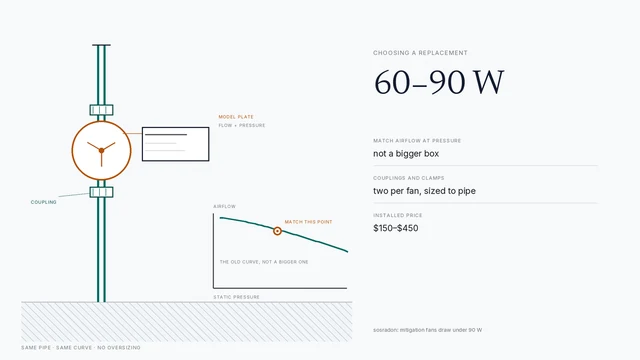
Check the couplings by hand first. They are the cheapest part in the chain and the most common cause of a gradual loss. If the joints are sound and the offset is still lower than it was, the fan is the next suspect, and the replacement cost page covers the $150–$450 range.
What a rising offset can mean
A larger offset looks like good news and usually is not. With an unchanged fan, more pressure difference means more resistance on the discharge side: ice at the vent, a crushed section of pipe, a bird nest in the termination, or a valve that has been closed by accident.
The fan is working harder to push the same air through a smaller opening, and it is moving less soil gas while doing it. Clear the blockage, then confirm the offset returns to the baseline. If it does not, the fan has been running against that restriction long enough to be worth a closer look.
What the gauge cannot tell you
The manometer measures pressure. It does not measure radon, and a healthy offset does not prove the system is protecting the house. A system can hold perfect suction at the slab and still leave a bedroom at 4 pCi/L because the suction never reaches the far corner of the foundation, or because a return duct is pulling soil gas into the living space.
That is why the retest exists. Run a short-term test after at least 24 hours of operation, then every two years or after a major renovation or HVAC change. A system with a single suction point in one corner of a large basement can hold a healthy offset while the far side of the slab stays at atmospheric pressure. The gauge sits on the pipe, and the pipe only knows about the air that reaches it.
The testing section covers the method and the closed-house conditions, and the systems guide explains what a mitigator checks when the gauge looks fine and the number does not.
How to do it
- Find the gaugeIt is a clear U-tube clipped to the vent pipe, usually near the fan or at eye level in the basement. Some carry a printed scale; many are a plain tube with a reference mark.
- Read both columnsNote the height of the fluid on each side, not just whether they differ. The difference is the reading, and each side moves in the opposite direction.
- Photograph itTake one picture with the fan running and the gauge in frame. That image becomes the baseline for every future comparison, including one made by a contractor.
- Compare, do not judgeA reading only means something next to the baseline. A system that always sat low is fine; one that dropped by half since last year is not.
- Act on a changeA falling offset points at the fan or a leaking joint. A rising offset points at a blockage. Level points at the whole chain, starting with the breaker.
- Confirm with a retestPressure is not radon. After any repair, run a short-term test once the system has operated for at least 24 hours.
Frequently asked questions
What should a radon manometer read?
It should show a steady offset between the two fluid columns while the fan runs. The exact height depends on the fan, the pipe and the fluid, so the number that matters is the one your system showed when it was commissioned. Compare against that, not against a figure from another house.
Is level fluid always a system failure?
Yes, if the fan is powered. Level columns mean no pressure difference across the fan, which means no suction at the slab. The cause can be a tripped breaker, a blocked pipe, a slipped coupling or a dead fan, but the reading itself is unambiguous.
Why does my gauge change with the weather?
Both the fluid and the air in the pipe respond to temperature. Cold weather can raise or lower the reading slightly depending on where the gauge sits, and a gauge in an unheated space moves more than one indoors. Small seasonal drift is normal; a step change is not.
What if the fluid in my manometer disappeared?
The gauge has lost its fluid, usually through evaporation over years or from being overfilled and blown out. A gauge with no fluid reads nothing at all and looks like a failure. Refill it to the marked level with the fluid the manufacturer specifies, then compare the new offset with your baseline photograph.
Does a higher reading mean better suction?
Not necessarily. A rising offset with an unchanged fan usually means added resistance downstream — a blockage, ice at the vent or a crushed section of pipe. More pressure across the fan is the fan working harder against something, not the system pulling more soil gas.
How often should I look at the manometer?
A glance once a month catches a dead fan before a season passes, and a photograph once a year gives you a record to compare against. The formal check is the retest every two years, or after a major renovation or HVAC change, which measures radon rather than pressure.
Sources
Some links are affiliate links.If you buy through them we may earn a commission at no extra cost to you. We do not accept payment for rankings. Read the full disclosure.