
EPA Zones guides
EPA Radon Zone 1, 2 and 3 by county — predicted levels, what Zone 1 means for cost, and where the data comes from.
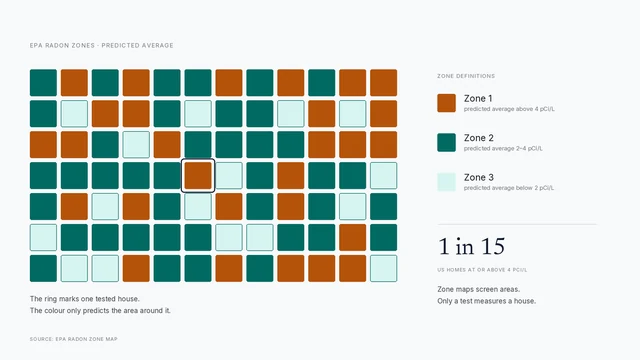
EPA radon zones divide the country's counties into three categories by predicted average indoor radon. They are a screening tool for areas, not a measurement of any house. The distinction matters because two neighbours on the same street can sit in the same zone and read 1.2 and 8.4 pCi/L.
The three definitions
| Zone | Predicted county average | What it means |
|---|---|---|
| Zone 1 | Above 4 pCi/L | Highest risk; test with priority |
| Zone 2 | 2–4 pCi/L | Moderate; test before buying or building |
| Zone 3 | Below 2 pCi/L | Lowest predicted risk; still test |
How the map is built
EPA combines indoor radon measurements, geological information about radon-bearing rock and soil, and aerial radioactivity survey data. Each county gets a single label. The current county map was published in 2024 and is available as a national map, state maps and a downloadable file.
What a zone cannot tell you
Whether your house is above 4 pCi/L. Zones summarise a county; houses differ by foundation, slab condition, soil contact and pressure. EPA's guidance is to test every home regardless of zone. A low zone is a reason to expect a good result, never a reason to skip the test.
Using the zone in a decision
Treat it as a prior. In Zone 1, test before you buy or before you finish a basement, and budget for mitigation if the reading is high. In Zone 2, a long-term test is usually the better spend than a quick retest. In Zone 3, test on the normal schedule and retest after major renovations. The zone shifts your urgency; the test sets your action.
What the zone does to cost
Nothing directly. A system costs what the foundation requires, not what the map says. What the zone changes is how many houses around you need systems, which affects how many certified contractors and testing programs operate locally.
Frequently asked questions
What are the three EPA radon zones?
Zone 1: predicted average above 4 pCi/L. Zone 2: predicted average between 2 and 4 pCi/L. Zone 3: predicted average below 2 pCi/L.
Does Zone 1 mean my house has high radon?
No. Zone 1 means the county's predicted average is above the action level, so the odds are higher. Many Zone 1 homes test below 2 pCi/L and some Zone 3 homes test above 4.
Can I skip testing in Zone 3?
No. EPA says every home should be tested. County predictions smooth over local geology, and a single house can beat the average in either direction.
All epa zones guides
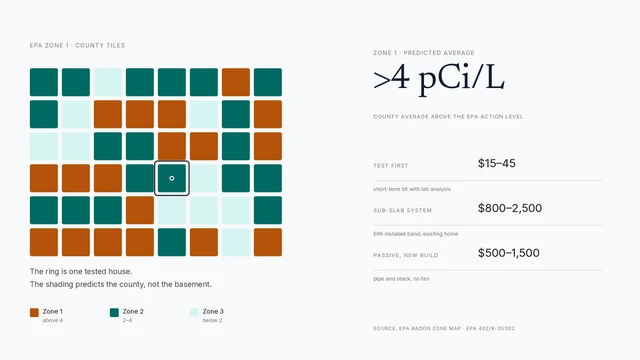
Radon Zone 1: what to do in a high-risk county
Zone 1 counties are predicted above 4 pCi/L. Test priority, how often mitigation is really needed, the $800–$2,500 sub-slab band and passive new builds.
Read the guide →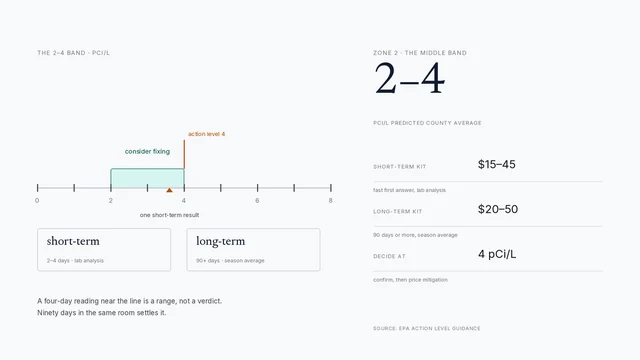
Radon Zone 2 explained: the 2–4 pCi/L middle band
Zone 2 counties are predicted at 2–4 pCi/L, where the advice gets soft. Long-term testing, when to fix, and reading a short-term result near the line.
Read the guide →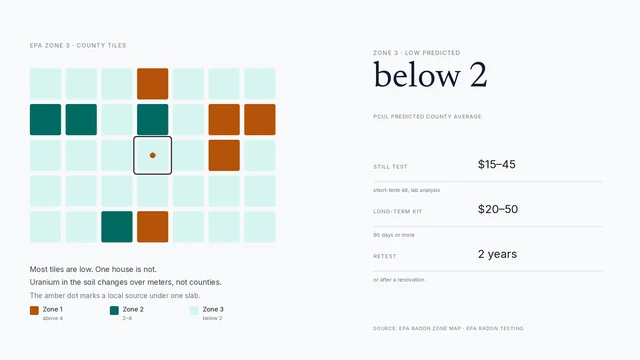
Radon Zone 3: why low-risk counties still need a test
Zone 3 counties are predicted below 2 pCi/L. Why low risk is not no risk, how local geology beats the county average, and the two-year retest habit.
Read the guide →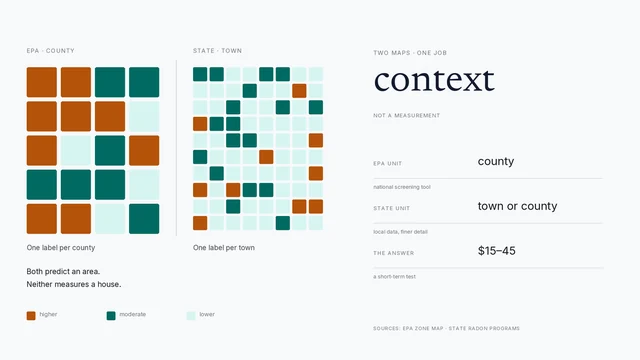
State radon maps vs the EPA county map
State programs refine the EPA county map with local data and often show towns. Neither is a house test. How to use both without overreading either.
Read the guide →