How to choose a radon mitigation system by foundation type
Basement, crawl space, slab-on-grade or block wall: what each radon system does, what it costs, and how to tell which one your house needs.
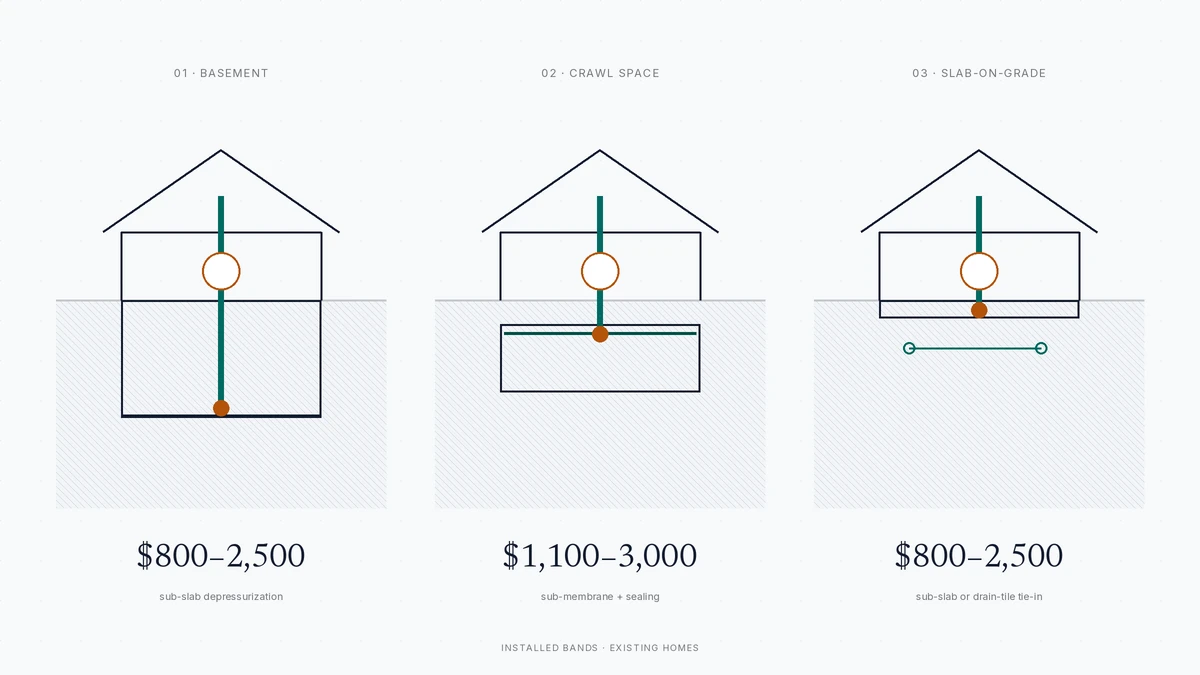
Basement or slab: sub-slab depressurization. Crawl space: sub-membrane. Hollow-block wall: draw from the wall cavities. Mixed foundations often need two suction points, and a passive system can be activated later with a fan.
- Basement / slab
- Sub-slab, $800–$2,500
- Crawl space
- Sub-membrane, $1,100–$3,000
- Block wall
- $1,000–$3,000
- Passive to active
- $300–$900 for the fan
Some links on this page are affiliate links.If you buy through them we may earn a commission at no extra cost to you. We do not accept payment for rankings. Read the full disclosure.
| Basement / slab-on-grade | Crawl space | |
|---|---|---|
| Suction field | Soil directly beneath the slab | Soil beneath a sealed membrane |
| First step | Core the slab at a corner or near the sump | Lay and seal a continuous vapor barrier |
| Installed band | $800–$2,500 | $1,100–$3,000 |
| Common failure | Too few suction points in a divided slab | Unsealed membrane pulling room air |
The right radon system is the one that can pull air from the soil under your particular foundation and keep pulling it. Everything else — fan brand, pipe color, where the vent exits — is detail. There are four foundation cases worth knowing, and most houses are one of them, or two of them joined together. If you are still deciding whether to spend the money at all, start with the cost guide.
The short answer
Basement or slab-on-grade: sub-slab depressurization, $800–$2,500. Crawl space: sub-membrane depressurization, $1,100–$3,000. Hollow-block wall: block-wall depressurization, $1,000–$3,000. New construction: a passive system at $500–$1,500, activated later with a fan for $300–$900. If the house has more than one foundation type, the plan usually needs more than one suction point.
Basement: sub-slab depressurization
This is the most common system in the country and the one most bids describe. The installer cores a hole through the basement slab, usually near a corner or beside the sump, removes a small amount of soil to create a suction pit, and runs PVC from that pit up through the house to a fan and out above the roof.
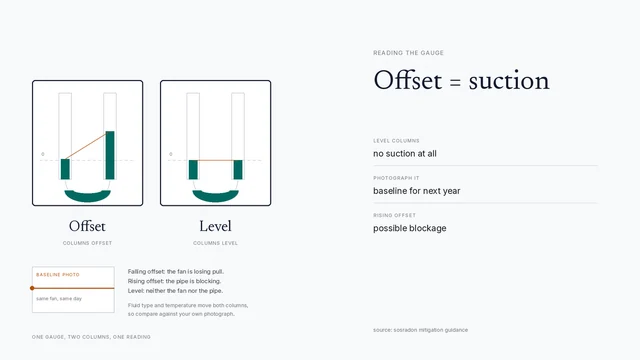
The fan creates a slight negative pressure under the slab. Soil gas that would otherwise enter through cracks, joints and the slab-to-wall seam is drawn into the pipe instead. A U-tube manometer on the pipe shows the pressure difference, which is how you know the system is still working months later.
Two details separate a good install from a marginal one. The suction point should be sealed airtight where the pipe meets the slab, and the slab should be tested for communication — a second point is added if the first cannot draw from the far side of a footing. A finished basement does not change the principle, only the routing.
Crawl space: sub-membrane depressurization
A crawl space cannot be depressurized until the soil is covered. The installer lays a reinforced vapor barrier over the dirt, seals it to the foundation walls and piers, seals the seams, and then draws air from beneath the membrane through a pipe and fan.
The membrane is the system. If it is torn, unsealed at the edges, or interrupted by a pier that was boxed out badly, the fan pulls conditioned air from the crawl space instead of soil gas, and the radon reading does not move. That is why a crawl-space bid should include the membrane as a line item, not as an afterthought.
Expect $1,100–$3,000 installed. The work is more material-intensive than a basement job and often harder to access, which is why the band sits above the sub-slab figure.
Slab-on-grade: drain tile, sump, or a new point
A slab-on-grade house has no basement to work in, but it often has perimeter drain tile and a sump pit. If those exist and the pit can be sealed, the system can tie into the drainage network and use it as a suction field. That is the least invasive option and usually lands inside the $800–$2,500 band.
If there is no drain tile, the installer cores through the slab from inside the house and creates a suction point the same way a basement system would. The pipe then runs up through a closet or along an exterior wall. The cost is similar; the disruption is not.
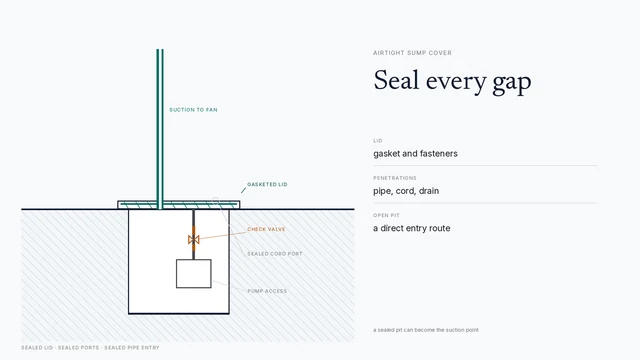
A sump pit only works as a suction point when it has a gasketed, airtight lid. An open pit is a hole in the pressure boundary. Some contractors will not warranty a system tied to a pit they did not seal, which is a fair position.
Block-wall and mixed foundations
Older homes sometimes sit on hollow concrete-block walls. Those cavities form a ready-made suction field: the installer seals the top of the wall, draws from the block cores, and vents above the roof. The system stays out of the living space and avoids a slab core, which is why it is popular in tight basements. The band is roughly $1,000–$3,000.
Mixed foundations are the expensive case. A house with a main basement and a crawl-space addition may need one system with two suction points, or two separate systems with two fans. The price is not double, but it is not the single-foundation band either. Ask the contractor to draw the suction plan before quoting.
Passive systems and adding a fan later
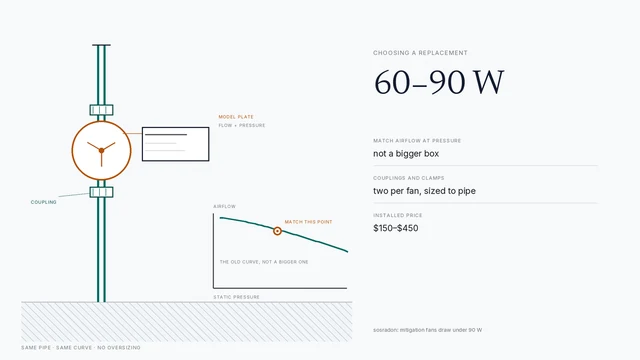
New construction can include a passive radon system: a gas-permeable layer under the slab, a vapor barrier, a sealed vent pipe through the roof, and a junction box for a future fan. It relies on stack effect and wind, not electricity, and costs $500–$1,500 at construction.
Passive systems reduce radon but do not guarantee a result. EPA’s guidance is to test after occupancy. If the reading is at or above 4 pCi/L — here is how to test it properly — a fan is added to the existing pipe, typically $300–$900, and the system becomes active. That is far cheaper than retrofitting a system into a finished house, which is the argument for building passive in the first place.
Massachusetts is the best-known example of a code that requires radon-resistant construction in designated counties; local codes elsewhere do the same. If you are building, ask the builder whether the passive system is in the plans before the slab is poured.
Sump pits and what they change
A sump pit is not a radon system. It is a hole through the slab, and if it is open, it is an entry point. Sealing it with a gasketed lid is one of the cheapest radon improvements a homeowner can make, and it is a prerequisite for using the pit as a suction point.
If the pit is sealed and tied into the system, the installer must also account for the sump pump’s discharge and any backup system. A lid that cannot be removed for service is a bad lid. The right answer is a sealed lid with a removable, gasketed access panel.
What a contractor needs to see
A site visit should record the foundation types, the slab condition, the presence of drain tile or a sump, the location of footings that divide the slab, and the route the pipe will take. It should also check the electrical panel and the roof penetration.
If a bid arrives without a suction-point count or a fan model, it is not a design. It is a price. The EPA zone map is useful context here: it tells you how likely a system is to be needed, not what it should cost. Those are different things, and only one of them can be compared with another bid.
Costs by foundation type
The table above the article compares basement and crawl space. For the full set, the bands are: sub-slab $800–$2,500, sub-membrane $1,100–$3,000, drain-tile or sump tie-in $800–$2,500, block-wall $1,000–$3,000, passive new construction $500–$1,500, and fan activation $300–$900.
Those are installed bands for existing homes, drawn from EPA’s published figure and from state radon program and EPA-partner material where EPA publishes no separate number. They are not quotes. The only way to get a real number is a site visit and a written bid that names the work.
The decision, in one paragraph
If you have a basement or a slab, ask for sub-slab depressurization and confirm the suction-point count. If you have a crawl space, ask for sub-membrane and read the membrane specification. If you have both, expect two points. If you are building, ask for a passive system now. And whatever the foundation, test before you buy and test after the system runs. The test is the only part of the project that tells you the truth.
How to do it
- Identify every foundation type in the houseWalk the lowest level. A full basement, a crawl-space wing and a slab addition can all exist in one house, and each one changes the suction plan.
- Look for drain tile and a sump pitA sump with a sealed lid can become a suction point. Record the pit diameter, lid condition and whether the tile drains to daylight.
- Decide interior or exterior routingInterior pipework hides the system but crosses the house; exterior routing is faster but needs weatherproofing. The choice affects cost and appearance, not effectiveness.
- Get a site-specific designA bid should name the number of suction points and the fan model, not just a price. The design follows the foundation, not the other way around.
- Verify with a post-install testAfter the system runs for at least 24 hours, a short-term test confirms the reading has dropped, usually below 2 pCi/L.
Frequently asked questions
What radon system works for a basement?
Active sub-slab depressurization is the standard answer. A core is drilled through the slab, a small pit is excavated under it, and a PVC pipe carries soil gas to a fan that vents above the roofline. EPA's installed band is $800–$2,500 for a fan-based system in an existing home.
How do you mitigate radon in a crawl space?
Sub-membrane depressurization: a reinforced vapor barrier is sealed to the walls and piers, and a pipe draws air from beneath the membrane. The membrane must be continuous and the seams sealed, or the fan pulls room air instead of soil gas. Expect $1,100–$3,000 installed.
Can a slab-on-grade house have a radon system?
Yes. If the house has perimeter drain tile or a sump pit, the system can often tie into it. If not, the installer cores through the slab and creates a suction point directly under the floor. Either way the installed band is roughly $800–$2,500.
What is a passive radon system?
A passive system is built into new construction: a gas-permeable layer under the slab, a vapor barrier, and a vent pipe that relies on stack effect instead of a fan. It costs $500–$1,500 at construction. If a test later shows high radon, adding a fan converts it to active for about $300–$900.
Can a sump pit be used for radon suction?
Only if the pit can be made airtight. A sealed, gasketed lid turns the pit into a suction point. An open or leaky pit short-circuits the system and can actually make radon entry worse, so a dedicated suction point is used instead.
Do I need a different system for a block foundation?
Hollow concrete-block walls can be depressurized by drawing from inside the wall cavities, which keeps the system out of the living space and avoids a slab core. It is a recognized approach, typically $1,000–$3,000 installed, and it is chosen when the block is exposed in a basement or crawl space.
Sources
Some links are affiliate links.If you buy through them we may earn a commission at no extra cost to you. We do not accept payment for rankings. Read the full disclosure.