How to choose a replacement radon fan
Match the original fan's airflow at static pressure instead of buying a bigger box. Read the plate, size the couplings, check watts and warranty, then retest.
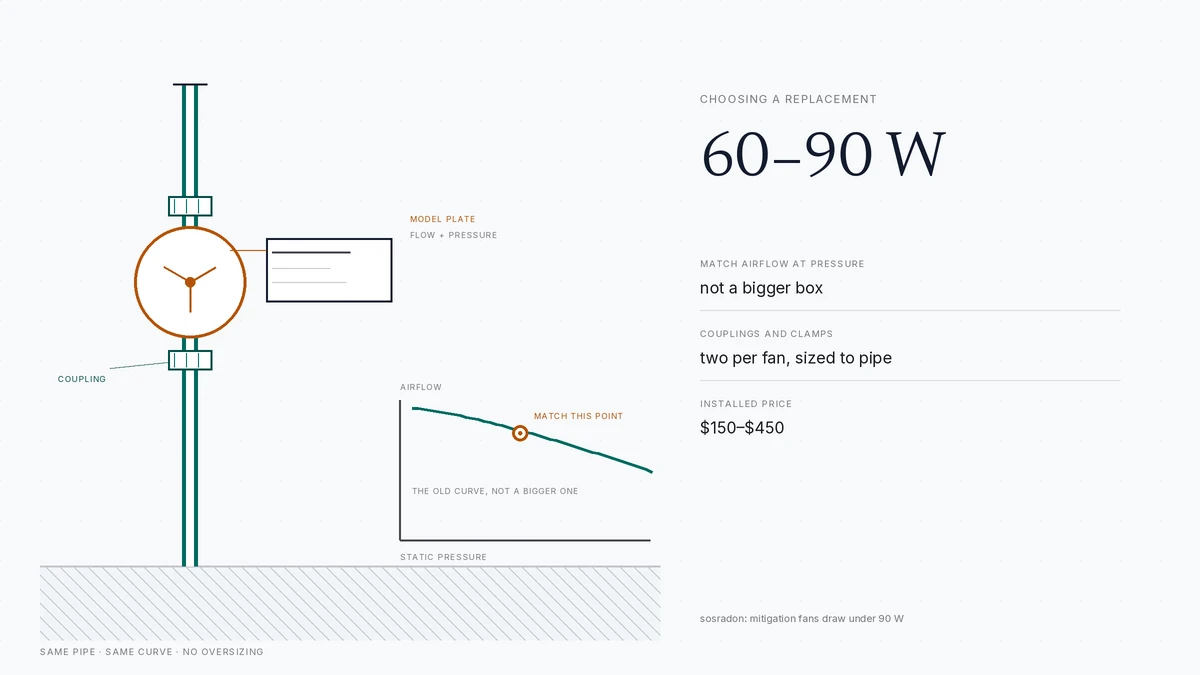
Choose a replacement radon fan by matching the airflow the original model produced at the system's static pressure, not by buying a larger fan. Read the model plate and system label, match the pipe and coupling size, confirm the 60–90 W draw. Installed: $150–$450.
- The number that matters
- Airflow at static pressure
- Fan draw
- 60–90 W
- Installed price
- $150–$450
- Service life
- 5–15 years
Some links on this page are affiliate links.If you buy through them we may earn a commission at no extra cost to you. We do not accept payment for rankings. Read the full disclosure.
| Match the original curve | Upsize the fan | |
|---|---|---|
| What is compared | Airflow at the system's static pressure | Watts or physical size |
| Effect on suction | Same as the system was designed for | More suction than the slab and pipe need |
| Noise | Unchanged from the original | Louder at the housing and in the pipe |
| Running cost | About $127 a year at 80 W | Higher, and outside EPA's $50–$200 budget |
| When it is right | The old fan worked until it wore out | A measured shortfall on a long or tight run |
A replacement radon fan is the inline fan that keeps suction on a mitigation system after the original motor wears out. Choosing one is a matching exercise: the new unit has to reproduce the airflow the old model delivered against the same pipe, the same suction point and the same slab. It is not an upgrade, and the largest fan on the shelf is usually the wrong answer.
Read the plate before you open a catalog
Two labels carry the decision. The fan housing has a plate with the model number, the serial number and the electrical rating. The system label, usually taped to the vent pipe near the fan or fixed at the suction point, repeats the model and adds the install date and the contractor.
Photograph both. A supplier can cross-reference a model number in a minute. Without one, the conversation starts with guesswork and ends with a fan chosen by eye.
If the labels are gone, measure instead of guessing. Record the pipe’s outside diameter, the gap between the two rubber couplings, whether the fan sits indoors or outdoors, and whether the housing is mounted vertically or at an angle. Those four facts narrow the field to a handful of models, and any one of them can be confirmed against a published curve.
Airflow at static pressure is the number that matters
A radon fan is specified on a curve, not on a single figure. The curve plots airflow against static pressure — the resistance created by the pipe run, the elbows, the suction point and the material under the slab. At zero pressure the fan moves its maximum air. At its maximum pressure it moves none. The system settles somewhere in the middle, where the fan curve crosses the resistance curve of the pipe.
That crossing point is what you are replacing. Two fans can draw identical wattage and sit at very different places on their curves: one is built for high flow through open aggregate, the other for high pressure through tight clay or a long, elbow-heavy run. Buying on watts, or on the size of the carton, ignores the only comparison that predicts what the system will do.
If the old fan worked until it failed, ask for the model that superseded it. If it is discontinued, ask for the current fan whose published curve passes through the same flow and pressure. “Close enough” without the curve is a guess with a warranty attached.
Match the physical fit
Three dimensions decide whether the job is a swap or a rebuild. The fan’s spigots have to match the pipe diameter the system already uses, because a step in pipe size changes both airflow and noise. The housing has to fit the space, including clearance to tighten both clamps. And the unit has to be rated for where it sits: an outdoor housing on an exterior wall, an indoor unit in a basement or attic.
The two flexible rubber couplings are part of the fit. They absorb vibration, allow a small misalignment and isolate the fan from the pipe. Replace them with the fan rather than reusing rubber that has hardened, and confirm the clamps are sized to the coupling rather than close enough.
If the replacement is longer than the original, the pipe has to be cut or extended. That turns a swap into a modification, adds a joint, and moves the price toward the top of the band.
Wattage, noise and the cost of oversizing
Residential mitigation fans draw 60–90 W. A like-for-like replacement keeps the electricity bill where it was: at the August 2026 US average of 18.16 cents per kWh, an 80 W fan running continuously uses about 701 kWh a year and costs roughly $127. EPA budgets $50–$200 a year for operating cost, and the calculator runs the arithmetic at your own rate.
An oversized fan costs more in three ways. It draws more watts for suction the slab does not need. It runs louder, because a larger impeller moves more air and pushes more sound into the pipe — the noise page traces where that sound travels. And it can over-depressurize the basement, which matters in a house with a naturally drafted water heater or furnace, where the fan and the chimney compete for air.
Noise is the symptom homeowners notice first, and it is usually the cheapest to avoid: same curve, same mount, new rubber.
When a high-capacity fan is justified
A larger fan is the right call in a few specific cases. A long horizontal run with several elbows adds resistance a standard fan cannot overcome. Tight soil, or a membrane over a crawl space with little open area beneath it, behaves the same way. One fan serving two suction points has to move roughly twice the air. And a system that has already lost a fan to a reading that never came down may have been under-fanned from the start.
In each case the justification is a measured curve, not a hunch. Ask for the flow at the pressure the system actually runs at, and ask what the extra wattage costs per year. An installer who cannot produce the curve is selling size, not performance.
Warranty and service life
The fan warranty comes from the manufacturer and the labor warranty from the installer. They are rarely the same length, and some manufacturers count from the date stamped on the fan plate rather than the day it went in. Get both in writing and note the start dates before the old unit leaves the house.
EPA describes a typical service life of 5 to 15 years. A fan that fails at year four is a warranty conversation. One that fails at year fourteen is end of life, and the only question left is which model goes back in. Keep the receipt and the model number; a buyer will ask for both.
What the installation should include
A proper swap covers the fan, two couplings with clamps, a manometer check with fluid top-up, and disposal of the old unit. The airflow arrow on the housing points away from the house. The joints at both spigots are seated and clamped, not pushed on dry.
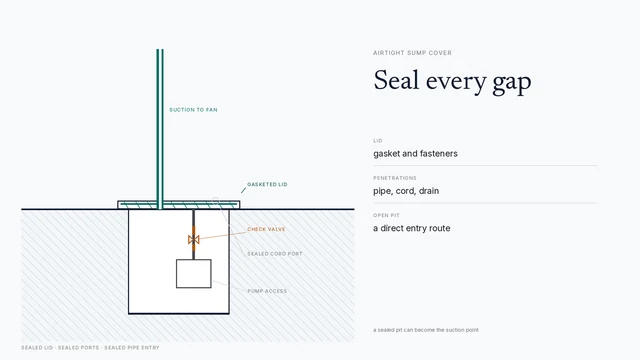
On an interior run, opening the pipe briefly creates a path from the soil into the basement. Do that work with the house aired and get the new fan on promptly. If the run has a low point where condensate collects, check it while the system is open, and clear it before the new fan starts pulling water into the housing.
Prove it with the gauge and a retest
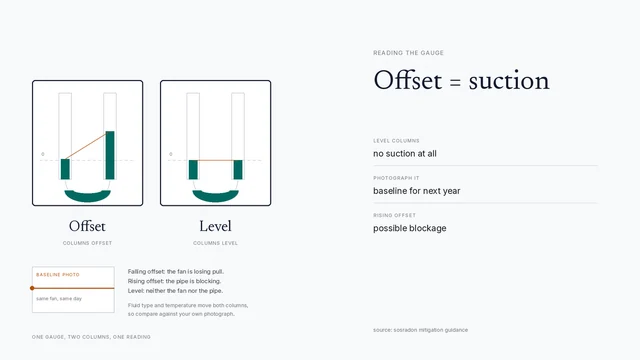
Restore power and watch the U-tube. It should show an offset within a minute or two. A flat gauge means a coupling is leaking, the fan is running backwards, or the pipe is blocked — and the answer is not another fan. The failure-signs guide walks through that order.
Then test. Run a short-term test after at least 24 hours of operation; testing covers placement and closed-house conditions. Below 2 pCi/L is the target. At or above 4 pCi/L with an intact pipe, the fan was not the problem, and the systems guide explains what to check next.
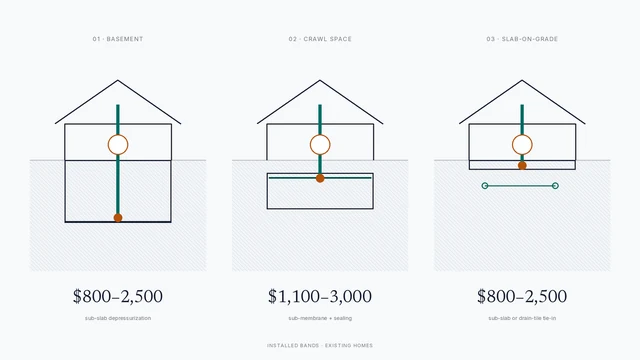
Write the date, the model and the result on the system label. The swap runs $150–$450, near $300 typical, against $800–$2,500 for a new system; the replacement cost page sets out where inside that band a job lands.
How to do it
- Photograph both labelsShoot the fan plate and the system label on the pipe. Model, serial and install date are what a supplier needs to cross-reference the right replacement.
- Record the pipe and the couplingsNote the pipe diameter, the gap between the two rubber couplings and whether the fan sits indoors or outdoors. These decide whether the job is a swap or a modification.
- Ask for the curve, not the wattageRequest the airflow at the pressure the system runs at. A fan that matches the old model's point on the curve is the correct replacement, whatever its box size.
- Compare fan and labor separatelyA quote should name the model, the fan price, the labor price and whether couplings, clamps and a post-swap test are included. A quote without a model cannot be compared.
- Watch the gauge after power returnsThe U-tube should show an offset within a minute or two. A flat gauge means a leaking coupling, a reversed fan or a blocked pipe, not a bad new fan.
- Retest and write it downRun a short-term test after at least 24 hours of operation, then record the model, the date and the result on the system label for the next owner.
Frequently asked questions
Can I replace a radon fan with a bigger one?
No. A fan is selected where its airflow curve crosses the resistance of the pipe and suction point, and a larger unit moves that crossing to a place the system does not need. It draws more watts, runs louder and can over-depressurize the basement, which competes with a naturally drafted water heater or furnace for combustion air.
Where do I find the model number?
Two places. The plate on the fan housing carries the model, serial and electrical rating. The system label taped to the vent pipe or fixed at the suction point records the model, install date and contractor. Photograph both before calling a supplier, because a model number is what turns a guess into a quote.
What if the original fan model is discontinued?
Ask for the current fan whose published curve passes through the same airflow and pressure point as the old one. Wattage alone does not identify a match: two fans can draw the same power and sit at very different points on their curves. Do not accept a verbal assurance without the curve.
Do I need new couplings with a new fan?
Usually yes. The two flexible rubber couplings and their clamps are the wear items on the connection, and old rubber hardens and loses its grip on the spigot. They also isolate vibration, which is why replacing them with the fan keeps the system as quiet as it was.
Will a replacement fan fix a high radon reading?
Only if the fan was the problem. If a short-term retest after at least 24 hours of operation still reads at or above 4 pCi/L with an intact pipe and a working fan, the fault is in the system — an undersized suction point, a leaking slab joint or a blocked run — and another fan will not fix it.
How much does a replacement fan cost installed?
The swap runs $150–$450, with most jobs near $300, because the pipe, suction point, circuit and roof penetration all stay in place. A full system is $800–$2,500, averaging near $1,200. The fan itself is the larger part of a replacement bill; labor is a short visit.
Sources
Some links are affiliate links.If you buy through them we may earn a commission at no extra cost to you. We do not accept payment for rankings. Read the full disclosure.