Radon fan noise: where it comes from and how to cut it
Fan noise travels through three paths: the housing, the vent pipe and the mount. What rubber couplings and isolation mounts fix, and what a louder fan means.
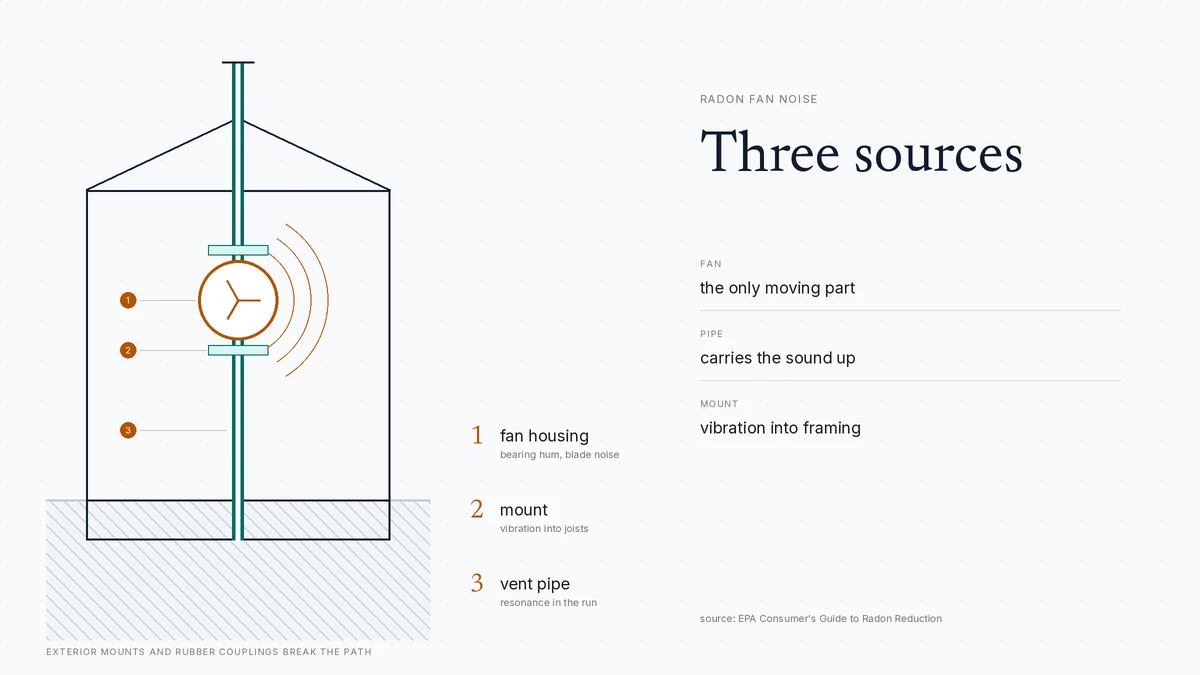
Radon fan noise comes from three places: the housing, the vent pipe, and the mount passing vibration into framing. Rubber couplings and isolation mounts break those paths. A louder fan is not a stronger fan, and noise never proves the system is pulling.
- Noise sources
- Fan, pipe, mount
- Cheapest fix
- Rubber couplings and clamps
- Fan draw
- 60–90 W
- Replacement
- $150–$450
Some links on this page are affiliate links.If you buy through them we may earn a commission at no extra cost to you. We do not accept payment for rankings. Read the full disclosure.
| What you hear | What fixes it | |
|---|---|---|
| Grind or whine from the housing | Bearing wear, present every time the fan runs | Fan replacement, $150–$450 installed |
| Rattle or knock at the pipe | Loose clamp or pipe touching framing | Re-seat the coupling, add clearance |
| Low hum in the room above | Vibration through rigid strapping | Isolation mounts and flexible couplings |
| Steady tone at the vent outlet | Air moving, normal for the model | Move the termination away from windows |
| Sound that shifts with weather | Expansion, ice or a settling mount | Check the mount and the low point of the run |
Radon fan noise is sound produced by three parts of a mitigation system working together: the fan housing and its bearings, the vent pipe that carries the sound through the house, and the mount that passes vibration into the framing. Treating it as one problem leads to the wrong fix — usually a new fan on the same rigid mount, which sounds exactly like the old one.
Where the sound starts
A mitigation fan sits on a pipe that runs from the soil to the roof. That pipe is a solid connection between the fan and every room it passes through, and the mount is a solid connection between the fan and the floor structure. Sound leaves the fan through both. Which path dominates decides what you hear and where.
The diagnostic is simple: listen at the fan, at the nearest exposed section of pipe, and in the room above. If the noise is loudest at the housing and fades with distance, the fan is the source. If the pipe hums along its length and the room above is the worst place in the house, the pipe is carrying it. If the floor above the fan buzzes while the pipe is quiet, the mount is the problem.
When the noise started matters as much as where it is. Sound that appeared the week after a repair points at the part that was changed. Sound that arrived with the first cold snap points at expansion, ice or a mount that has shifted. Sound that has grown over a year or two points at bearings. None of those three call for the same response.
The fan housing
Two noises come from the fan itself. The first is normal: a steady tone from the impeller moving air, constant in pitch, present whenever the system runs. It changes little from day to day and is the sound the system was designed around.
The second is wear. Bearings that are going produce a grind, a whine or a hum that shifts pitch as the fan warms up. It is there every time the motor runs and it gets worse over months, not hours. A fan in that condition is on its way out, and EPA’s typical service life of 5 to 15 years is the frame for deciding whether to replace it now or wait. The replacement cost page covers the $150–$450 band.
A third possibility is debris. A leaf, a piece of tape or a wasp nest on the impeller makes an uneven, throbbing sound that is not steady and not quite a grind. That is a fan-off, inspect, fan-on job.
The pipe is a speaker
A vent pipe is a tube full of moving air with hard walls, and it radiates sound along its whole length. Long straight runs are worse than short ones, and a run that passes through a closet, a wall cavity or a ceiling void acts like a duct leading into the room beside it. Elbows change the character of the sound rather than removing it.
This is why wrapping a short section of pipe rarely helps. The sound is inside the pipe, not on it, and the exposed sections still radiate. What does help is breaking the mechanical path at the fan, which is where the couplings come in, and keeping the run away from rooms where the noise matters.
The vent termination matters too. A fan that exhausts just outside a bedroom window is audible in that room on a still night, and moving the termination a few feet along the roof changes the experience more than any part you can buy.
Mounting and vibration
Rigid strapping is standard practice and usually correct: the pipe has to be held. The problem starts when the pipe is clamped hard against a joist, a stud or a wall, so that every vibration in the fan passes straight into the structure. The floor above then becomes a large, flat speaker.
Check the contact points by hand. Anywhere the pipe touches framing is a path. A short piece of resilient material between the pipe and the structure, or a strap that holds without crushing, reduces the transfer without letting the pipe move.
The fan’s own bracket matters more. A fan bolted directly to a joist transmits everything into the floor. A fan hung on flexible mounts, or fixed to a bracket that does not touch framing, transmits almost nothing.
Rubber couplings and isolation mounts
The two flexible couplings on either side of the fan do two jobs: they seal the joint and they decouple the fan from the pipe. As the rubber ages it hardens, and a hardened coupling passes vibration the way a rigid one would. Replacing both couplings and their clamps is inexpensive, and on a system that has become noisy over several years it is often the only part needed.
Isolation mounts work on the same principle at the bracket. Neither part makes a worn bearing quiet, and neither fixes an oversized fan. They remove paths; they do not remove sources.
Interior or exterior placement
An exterior fan takes the source out of the living space. It also puts it on a wall, and a wall is a large panel that can carry vibration into the room behind it. Exterior units are typically rated for weather and mounted above the frost line, which matters in a cold climate where ice can stall an impeller.
An interior fan in a basement or attic is easier to service and protected from weather, but its noise is inside the house, and its pipe passes through occupied rooms on the way to the roof. Placement is a trade between service access, frost and where the sound lands. The systems guide covers how the two routes differ.
Why a louder fan is not a better fan
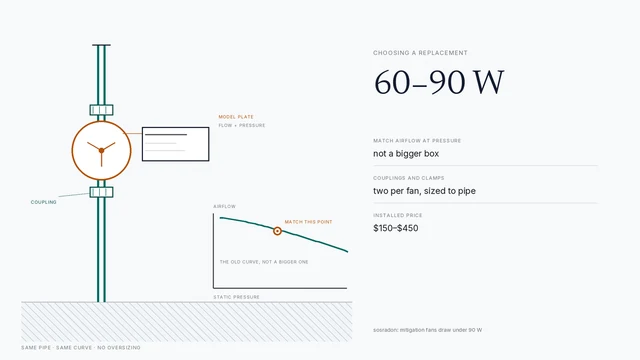
Noise follows airflow. A larger impeller moving more air makes more sound at the housing and pushes more of it into the pipe, so an oversized fan is usually the loudest unit in the house while delivering suction the slab does not need. It also draws more watts: residential fans run 60–90 W, and a bigger motor moves that figure up.
This is the most common cause of a system that got louder after a repair. The old fan failed, someone installed the next size up to be safe, and the noise started the same week. The fan selection guide explains how to match the original curve instead.
What noise does and does not indicate
Noise indicates that the motor is turning, and its character indicates what is wearing or touching. It does not indicate suction. A fan with a blocked pipe can run quieter because it is moving less air, and a fan that has stopped is silent — which is easy to mistake for “it finally quieted down”.
The U-tube manometer is the only built-in indicator of whether the system is pulling. Read it whenever the sound changes, and read it again after any repair. If the offset is gone, the noise question is secondary. If the offset is unchanged and the noise is new, the fan or its mounting is the place to look, and the failure signs list the other symptoms that belong in the same check.
How to do it
- Listen at three placesStand at the fan, at the nearest exposed pipe and in the room above. The loudest point tells you which path is carrying the sound into the house.
- Check the clamps firstA loose clamp on a rubber coupling is the most common rattle and costs nothing to fix. Tighten both, then listen again before spending anything.
- Look for contactRun a hand along the pipe where it passes framing, a joist or a wall. Any point where the pipe touches the structure passes vibration straight into it.
- Replace the couplingsOld rubber hardens and stops absorbing vibration. New couplings and clamps on both spigots are a small part and the single biggest reduction in pipe-borne noise.
- Isolate the mountA fan bolted to a joist turns the floor above into a speaker. Flexible mounts or a bracket that does not touch framing break that path without moving the fan.
- Confirm the fan still pullsAfter any change, read the U-tube. It should show the same offset as before. A quieter system that reads level has been disconnected, not improved.
Frequently asked questions
Why is my radon fan suddenly loud?
A change in sound points to wear or contact rather than design. Bearing wear produces a grind or a whine that shifts pitch. A loose clamp or a pipe resting against framing produces a rattle or a knock that comes and goes with vibration. Debris on the impeller produces a steady uneven hum. Start at the clamps, then the mount, then the fan.
Will rubber couplings make a radon fan quieter?
They remove one path. The two flexible couplings stop vibration travelling from the fan housing into the pipe, which is where most of the sound in the rooms above originates. They will not silence a worn bearing or a fan that is simply oversized for the pipe, because those noises start before the coupling.
Should the radon fan be inside or outside the house?
Both are common. An exterior fan takes the noise source out of the living space but can transmit vibration into the wall it is mounted on, and it has to be rated for weather and frost. An interior fan in a basement or attic is easier to service, but its noise is inside the house and its pipe run passes through occupied rooms.
Is a louder fan a stronger fan?
No. Noise tracks airflow and motor speed, so an oversized fan is usually the loudest one in the house while delivering more suction than the slab needs. Fan performance is set by airflow at a given static pressure, and a bigger impeller moves more air and makes more noise doing it.
Can I just turn the fan down or insulate the pipe?
Wrapping the pipe changes little, because the sound travels inside it and radiates from every exposed section. Turning a fan down is not an option on fixed-speed residential units. The effective fixes are flexible couplings, isolation mounts, moving the fan, or replacing an oversized fan with one that matches the system.
Does a quiet radon fan mean the system stopped?
No. Noise tells you the motor is turning, not that it is moving air. A blocked pipe can make a fan quieter by reducing its load, and a dead fan is silent. The U-tube manometer is the only indicator of suction; check it before you draw any conclusion from sound.
Sources
Some links are affiliate links.If you buy through them we may earn a commission at no extra cost to you. We do not accept payment for rankings. Read the full disclosure.