Store-bought vs professional radon test: what you get
A kit costs $15–$45, a certified measurement $150–$250. What the extra money buys, when a kit is enough and when a closing needs a signed report.
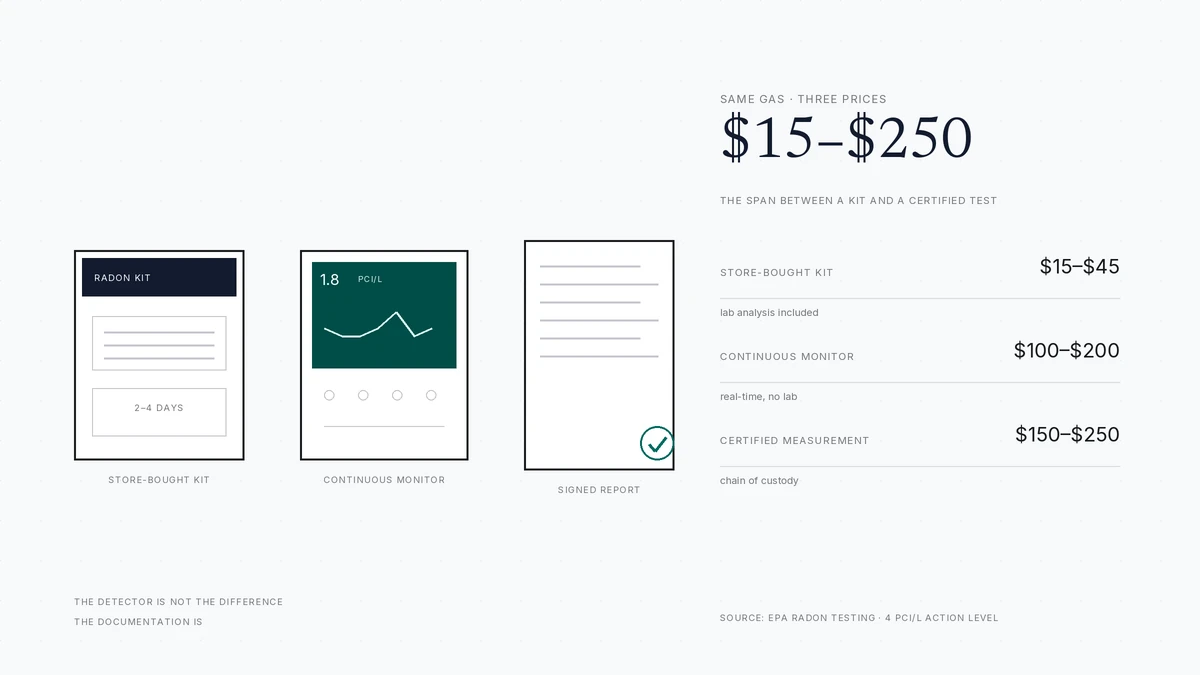
A store-bought kit costs $15–$45 with lab analysis; a certified measurement costs $150–$250. The detector is often similar, but the professional brings a calibration record, verified closed-house conditions, chain of custody and a signed report a buyer or lender will accept.
- Store-bought kit
- $15–$45
- Certified measurement
- $150–$250
- Continuous monitor
- $100–$200
- EPA action level
- 4 pCi/L
Some links on this page are affiliate links.If you buy through them we may earn a commission at no extra cost to you. We do not accept payment for rankings. Read the full disclosure.
| Store-bought kit | Certified measurement | |
|---|---|---|
| Cost | $15–$45 | $150–$250 |
| Who runs it | You, following the printed instructions | NRPP-certified or state-licensed tester |
| Closed-house conditions | Self-enforced, undocumented | Verified and recorded by the tester |
| Paper trail | A lab result, usually by email | Chain of custody and a signed report |
| Accepted at a closing | Usually not | Yes, where the state or lender requires it |
| Best use | A first look at your own house | A sale, a mitigation decision, a warranty claim |
A store-bought radon kit and a certified professional measurement can use the same detector chemistry and report the same unit, picocuries per liter. What separates them is price and paperwork: $15–$45 for a kit you place yourself, $150–$250 for a trained tester who controls the conditions and signs the result. The question is not which device is better. It is who will read the number.
Three prices, one gas
| Option | Cost | What you get |
|---|---|---|
| Store-bought short-term kit | $15–$45 | Detector, mailer and lab analysis |
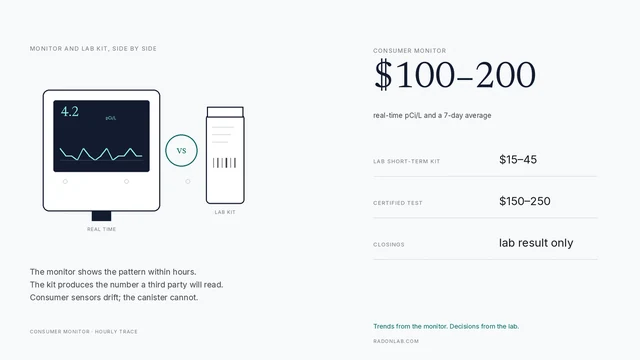
| Continuous monitor | $100–$200 | Real-time pCi/L and an hourly chart |
| Certified measurement | $150–$250 | Calibrated device, chain of custody, signed report |
The kit and monitor guide covers how each device works and what it can and cannot see. This page is about choosing between them.
What a store-bought kit actually is
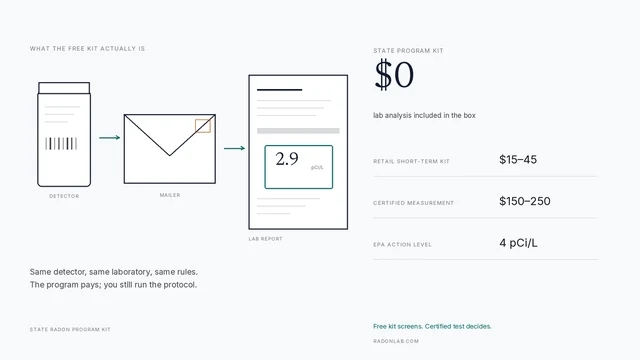
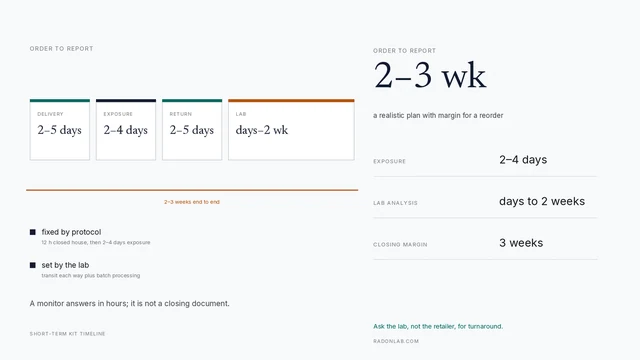
A short-term kit is a sealed detector, usually a charcoal canister, plus a return envelope and a lab fee bundled into the purchase price. You open it, place it, leave it for two to four days, seal it and mail it. The lab emails a number in pCi/L, typically within a week.
These are real instruments, not toys. Kits sold through state radon programs use devices that appear on EPA’s list, and EPA states that properly used test devices give practical, affordable and reliable results. The weak point is not the detector. It is placement and closed-house conditions, both of which depend on the person holding the box.
What the extra money buys
Six things separate a $30 kit from a $200 measurement, and none of them is a better sensor.
- A calibration record. A professional’s continuous monitor carries a calibration date and certificate. A charcoal canister cannot, because it is used once and analyzed.
- Chain of custody. Who placed the device, at what time, on which floor, and who retrieved it. Documented, dated, signed.
- Verified conditions. The tester confirms the house was closed for 12 hours before and during the test, and records the weather and any deviation.
- Correct placement. Lowest lived-in level, breathing height, away from exterior walls, drafts and bathrooms.
- A report someone else will accept. A buyer, a lender, a relocation company, an attorney. That document is the product.
- A second device or a longer record when the first result looks wrong. Spikes, tampering and unusual hourly patterns get caught before they become a closing problem.
That is what the extra money buys: not accuracy in the abstract, but a result that survives being questioned.
The closed-house rule applies to both
The protocol does not change with the price of the device. EPA calls for closed-house conditions starting 12 hours before the test and continuing through it. Windows and exterior doors stay closed, and fans that exhaust air or draw in outside air stay off. Most short-term devices need a minimum of 48 hours. The device sits in the lowest level the house is used at, at breathing height, at least 20 inches off the floor.
Most disappointing kit results are protocol failures rather than bad detectors: a device next to a sliding door, a bathroom fan left running, a test cut short because guests arrived. A certified tester removes those variables by being in the room and writing down what happened.
When a kit is enough
A kit is the right tool in five situations. You own the house and want a first number. There is no deadline attached. You are screening before a 90-day long-term test. You want a rough check that an existing system is still working. Or your state program sells kits below retail and the budget is genuinely tight.
The economics are hard to argue with. Spending $30 tells you whether the $1,200 conversation is on the table at all. EPA’s action level is 4 pCi/L, and the zone map can tell you whether your county runs high, but only a test of your own house produces your number.
When a certified test is required
Four situations call for a certified measurement.
- A sale or purchase. The report is the deliverable. A buyer’s lender may require a certified tester, and a kit result is usually not accepted in a transaction.
- A mitigation decision. Before committing $800–$2,500 to a system, confirm the level with a certified measurement or a second test. The install cost guide assumes the number is real.
- Post-mitigation verification. If an installer guarantees a level, the test that proves it should come from someone with no stake in the answer.
- Any number a third party will rely on. A landlord, employer, school or insurer.
No state requires a radon test at the point of sale. Several require disclosure of known results, including Illinois, Minnesota, New Jersey, Pennsylvania and Iowa. That is a different obligation, and it is exactly why an existing certified report has value at listing time.
Where licensing changes the answer
Ohio, Florida, New Jersey, Pennsylvania, Illinois and Iowa license or certify radon professionals through their state radon programs. In those states the tester’s credential can be checked against a public list, and the $150–$250 price includes the compliance cost behind it. Elsewhere, NRPP certification is the credential to ask for.
Ask for the number before you book, whether it is a state license or an NRPP ID, and check it against the issuing body’s directory. A tester who cannot produce one is selling a kit result at a professional price. The state cost breakdown shows how the price band shifts by region and program.
Monitors: useful, not a document
A continuous monitor at $100–$200 logs hourly readings and draws a graph of the past week. It is the best tool for answering a different question: is the system still working, and did the level move after the fan was replaced? It also catches short spikes that a two-day canister averages away.
What it does not do is serve as a transaction document. EPA does not recommend consumer monitors for real-estate transactions or as the sole basis for a mitigation decision. The Minnesota Department of Health goes further and says consumer digital monitors are not recommended for real-estate decisions at all. Treat the monitor as a diagnostic instrument, not as the report.
The five-minute decision
If a closing date, a lender or an attorney is involved, book the certified test and skip the kit. If you simply want to know whether your house has a problem, buy the kit, follow the protocol exactly, and put the savings toward a long-term test if the short-term reading lands between 2 and 4 pCi/L.
If a system is already installed and you want to know whether the fan is doing anything, either a monitor or a $20 kit will answer it. The full testing section is here, and the sequence that spends the least money for the most information is always the same: screen cheaply, confirm properly, then spend on hardware.
How to do it
- Decide who will read the numberIf the answer stays with you, a kit is enough to start. If a buyer, lender, attorney or contractor will rely on it, book a certified measurement and skip the kit.
- Check the state program firstMany state radon programs sell short-term kits at or below retail, sometimes free during January. That is the cheapest legitimate first test and it comes with the state's own instructions.
- Run the protocol either wayClosed house for 12 hours before and throughout, device in the lowest lived-in level, at breathing height and at least 20 inches off the floor, away from exterior walls, drafts and bathrooms.
- Verify the credential before bookingAsk for the NRPP number or the state license number, then check it against the issuing body's public list. Ohio, Florida, New Jersey, Pennsylvania, Illinois and Iowa all license or certify radon professionals.
- Keep the report with the houseStore the lab or certified report beside the mitigation paperwork. It is the baseline for the next retest and the first document a buyer asks for.
Frequently asked questions
Are store-bought radon test kits accurate?
The devices are legitimate. EPA says properly used test devices give practical, affordable and reliable results, and many kits sold through state programs use devices on EPA's list. Accuracy depends on placement and closed-house conditions, which is where a do-it-yourself test most often goes wrong.
Why does a professional radon test cost so much more?
You are paying for a calibrated device with a dated certificate, a trained tester who verifies closed-house conditions, documented chain of custody, liability insurance and a signed report. A $20 kit measures the same gas. What it does not produce is a document anyone else will rely on.
Do I need a professional test to sell my house?
No state requires a radon test at the point of sale. Several require disclosure of known results, including Illinois, Minnesota, New Jersey, Pennsylvania and Iowa. In practice, a buyer or lender who asks for a test will want a certified one, because a kit result is usually not accepted in a transaction.
Can a store-bought kit be used for a mitigation decision?
It can start the conversation, but a system decision wants confirmation: a second test or a certified measurement before you commit. A system costs $800–$2,500, so a $150 confirmation is cheap insurance against mitigating a house that did not need it.
How long does each test take?
A short-term kit runs two to four days with a minimum of 48 hours for most devices. A certified short-term measurement follows the same window, usually with the tester placing and retrieving the device. Long-term kits run 90 days or more and give a season-adjusted average.
Do I have to close my windows during a radon test?
Yes. EPA protocols call for closed-house conditions starting 12 hours before the test and continuing through it. Windows and exterior doors stay closed, and fans that bring in outside air stay off. A tester documents this. With a kit, you are the only one enforcing it.
Sources
Some links are affiliate links.If you buy through them we may earn a commission at no extra cost to you. We do not accept payment for rankings. Read the full disclosure.