Radon test kits vs monitors: what each one measures
Short-term kits, long-term kits and continuous monitors measure radon in different ways. Prices, accuracy, placement rules and how to read a pCi/L result.
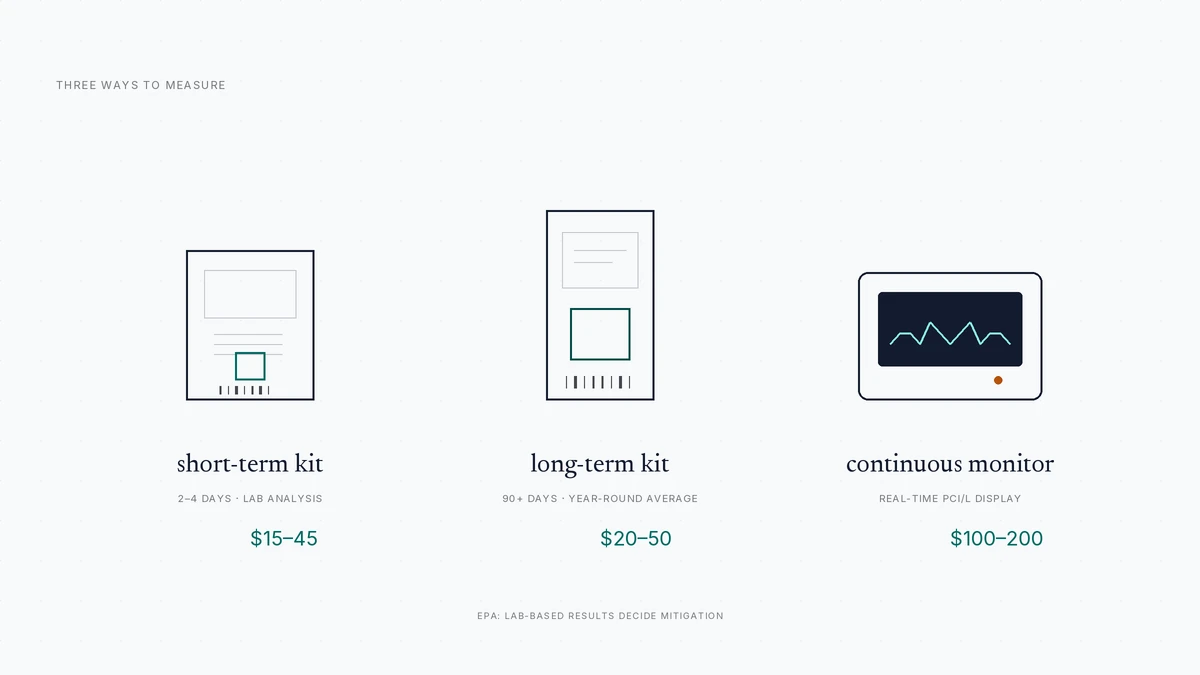
A short-term kit ($15–$45) averages 2–4 days and needs lab analysis. A long-term kit ($20–$50) averages 90 days or more. A continuous monitor ($100–$200) shows real-time pCi/L but is not a substitute for a lab result in a mitigation decision.
- Short-term kit
- $15–$45, 2–4 days
- Long-term kit
- $20–$50, 90+ days
- Continuous monitor
- $100–$200
- Certified measurement
- $150–$250
Some links on this page are affiliate links.If you buy through them we may earn a commission at no extra cost to you. We do not accept payment for rankings. Read the full disclosure.
| Short-term kit | Long-term kit | |
|---|---|---|
| Measurement period | 2–4 days | 90 days or more |
| Cost with lab analysis | $15–$45 | $20–$50 |
| What it captures | A snapshot under closed-house conditions | A season-adjusted average |
| Best use | Screening, real-estate deadlines, post-mitigation check | Deciding whether to mitigate, confirming a low reading |
Radon testing measures the concentration of radon gas in indoor air, reported in picocuries per liter (pCi/L). Every consumer device is doing the same basic job — counting radioactive decays in a sample of air over time — but the devices differ in how long they average and what that average can support. A four-day kit and a 90-day kit can give different numbers for the same house, and both can be correct. What you pay for each option varies less by state than by program — the state cost guide breaks that down.
What a radon test actually measures
Radon is a gas produced by the decay of radium in soil and rock. It seeps into a house through cracks, joints, sump pits and the slab-to-wall seam, and it accumulates indoors. A test measures how much of it is in the air at the sampling point, averaged over the test period.
That word “averaged” matters. Radon is produced continuously by radium decay in the soil, and its concentration in a house swings with weather, season, HVAC operation and how the house is pressurized. A device has to sit in that air long enough to accumulate a detectable signal: charcoal kits integrate over days, alpha-track detectors over months, and electronic monitors sample continuously and roll the readings into an average. A short test catches a window of that swing; a long test catches the average. Neither measures the soil, and neither predicts what a neighbouring house will read.
The unit itself is worth understanding. One picocurie per liter is one radioactive disintegration per minute in a liter of air, so a reading of 4 pCi/L means about four decays per minute in every liter. The devices count those decays directly or indirectly, which is why a lab can report a number with an uncertainty range attached. Two results that differ by a few tenths of a pCi/L are usually within that uncertainty; a result that doubles between seasons is telling you about the house, not the lab.
Short-term kits: a snapshot in 2–4 days
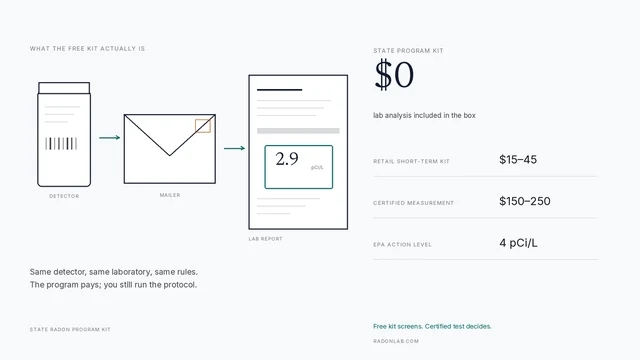
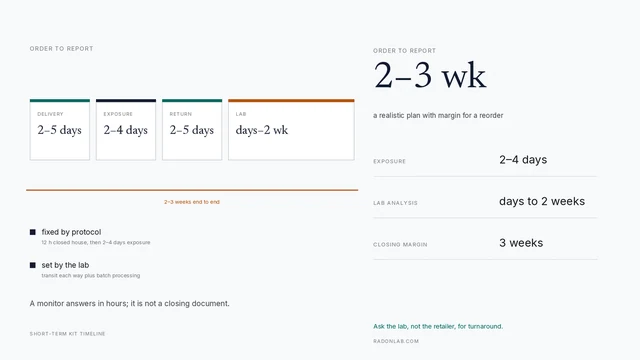
A short-term kit uses charcoal or a similar collector to sample air for two to four days, then goes to a lab for analysis. The kit itself costs $15–$45 including lab work, which makes it the cheapest way to get a real number. EPA protocols call for closed-house conditions starting 12 hours before the test and continuing through it: windows and exterior doors closed, exhaust fans off, normal heating and cooling allowed.
Short-term kits are the right tool when you need an answer fast — a home purchase, a post-mitigation check, or a first look at a house you just moved into. They are also the tool most likely to be run incorrectly, because “closed house” is easy to say and harder to do for four days in July.
Long-term kits: the better average
A long-term kit runs for 90 days or more, usually with an alpha-track detector. It costs $20–$50 with analysis and captures seasonal variation that a four-day test cannot. EPA recommends long-term testing when the question is whether to mitigate, because the decision is about a year of exposure, not a long weekend.
The trade-off is time. You will not have an answer this week, and if the reading comes back high you have spent a season finding out. For a homeowner planning a mitigation budget, that is usually the right trade. For a buyer with a 10-day inspection window, it is not.
Continuous monitors: real-time, with a caveat
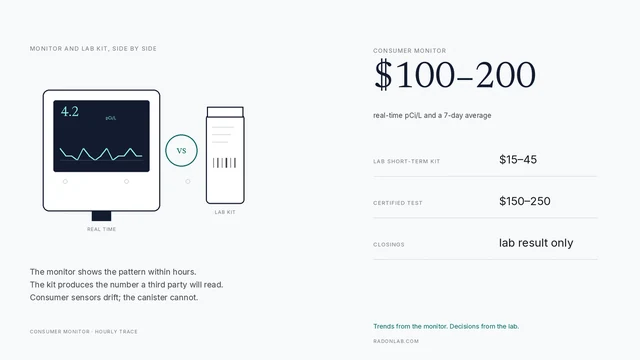
A consumer continuous radon monitor costs $100–$200 and displays a running pCi/L number, often with a graph of the past week or month. It is genuinely useful for watching daily patterns, checking that a fan is working, and understanding how the house behaves when the weather changes.
The caveat is regulatory. EPA does not recommend consumer monitors for real-estate transactions or as the sole basis for a mitigation decision. Those calls want a lab-based test or a certified professional measurement. A monitor is a diagnostic and verification tool, not a substitute for the document a lender or a buyer will accept.
Professional measurement: what the $150–$250 buys
A certified measurement runs $150–$250 and includes a trained tester, a calibrated device, a documented chain of custody, and a report that holds up in a transaction. In states that license radon professionals, the tester’s credential is verifiable. That is what you are paying for: not a better sensor, but a defensible process.
If you are buying or selling a house, or if a mitigation contractor needs a baseline, this is the version to use. It is also the number a mitigation quote should be based on. If you are a homeowner checking your own basement, a kit is enough to start.
Why two tests can disagree
Radon variability is real and well documented. A test in February and a test in June can differ by a factor of two or more in the same room, because the house is closed up in winter and open in summer. Placement matters too: a device next to a drafty window or a heating vent reads differently from one in the middle of the room.
Lab handling, device calibration and the exact number of hours the house stayed closed all add noise. EPA’s guidance is not that any single test is definitive; it is that a properly run test gives a useful estimate, and a long-term test gives a better one.
How to run a short-term test correctly
The steps above the article cover the sequence. The two that people skip are the closed-house precondition and the placement height. Start the closed-house period 12 hours before you open the kit, and put the device at breathing height in the lowest level you actually use. A basement that is only used for storage is not the right sampling point unless the protocol says otherwise.
Do not move the device mid-test, do not put it in a bathroom, and do not run a whole-house fan. If the kit comes with a questionnaire about the house, fill it out; labs use it to flag invalid samples.
When a monitor is the right tool
Three cases. First, after a mitigation system is installed: a monitor shows within hours whether the fan is drawing down the level, while a lab kit takes days. Second, in a house with a known intermittent problem: a monitor catches the spike that a four-day kit misses. Third, when you want to understand a seasonal pattern before committing to a long-term kit.
In all three cases the monitor is supporting a decision, not making it. The decision document is still a lab result or a certified measurement.
Reading the result
EPA’s action level is 4 pCi/L. At or above it, fix. If you have not looked up your county yet, the zone guide explains what the map can and cannot tell you. Between 2 and 4 pCi/L, consider fixing — EPA’s position is that there is no known safe level of radon exposure, so the threshold is a risk-management line, not a clean/dirty line. Below 2 pCi/L, keep the report and retest every couple of years or after a major renovation.
A mitigation system usually brings a house below 2 pCi/L. If a post-install test does not, the system needs diagnosis, not a second system. And if a first test comes back at 4.1, the right next step is a second test before a $1,200 purchase — not because the first was wrong, but because the number is close enough to the line that confirmation is worth $30.
How to do it
- Choose the device for the decisionA real-estate deadline wants a short-term kit or a certified measurement. A homeowner planning a budget wants a long-term kit or a full season of monitor data.
- Close the house before the testEPA protocols call for closed-house conditions for 12 hours before and throughout the test. Close windows and exterior doors and switch off fans that exhaust air or draw in outside air.
- Place it in the lowest lived-in levelBreathing height, at least 20 inches off the floor, away from exterior walls, drafts, heat, moisture and direct sunlight. Follow the kit's own placement diagram.
- Run the full periodDo not open the house to air it out mid-test. A short-term kit runs 2–4 days; a long-term kit runs at least 90 days. Note the start and end dates.
- Send it to the lab and read the reportThe lab result is the measurement. Keep the report: it is the document a buyer, a lender or a mitigator will ask for.
- Retest or mitigate on the resultAt or above 4 pCi/L, retest with a certified measurement or move to mitigation. Between 2 and 4 pCi/L, a long-term test is the better next step.
Frequently asked questions
How accurate are home radon test kits?
EPA says properly used test devices give practical, affordable and reliable results, but every measurement has variability. Placement, closed-house conditions, weather and lab handling all move the number. A kit is a screening tool; a certified measurement is the version used for real-estate and mitigation decisions.
How long does a short-term radon test take?
Two to four days is typical, with a minimum of 48 hours for most charcoal devices. EPA protocols call for closed-house conditions starting 12 hours before the test and continuing through it. Windows and exterior doors stay closed, and fans that bring in outside air stay off.
Is a long-term test better than a short-term test?
For deciding whether to mitigate, yes. Radon fluctuates day to day and season to season, and a 90-day or longer test averages that variation. A short-term test is the right first step when you need an answer quickly, such as during a home purchase.
Can I use a continuous radon monitor instead of a lab kit?
You can use one to watch daily patterns and to check that a mitigation system is working. EPA does not recommend consumer monitors for real-estate transactions or as the sole basis for a mitigation decision. Those calls want a lab-based or certified measurement.
Where should the test device be placed?
In the lowest level of the house that is regularly used, typically the basement or first floor. Place it at breathing height, at least 20 inches off the floor, away from exterior walls, drafts, heat sources and humidity. Do not put it in a closet, bathroom or crawl space unless the protocol says so.
What radon level is too high?
EPA's action level is 4 pCi/L. EPA says fix at or above that level and consider fixing between 2 and 4 pCi/L. There is no known safe level of radon exposure, which is why the recommendation does not stop at zero.
Sources
Some links are affiliate links.If you buy through them we may earn a commission at no extra cost to you. We do not accept payment for rankings. Read the full disclosure.