How long do radon test results take?
Two to four days for the test, then shipping and lab analysis. Why results usually take days to a couple of weeks, and how to plan a closing date with margin.
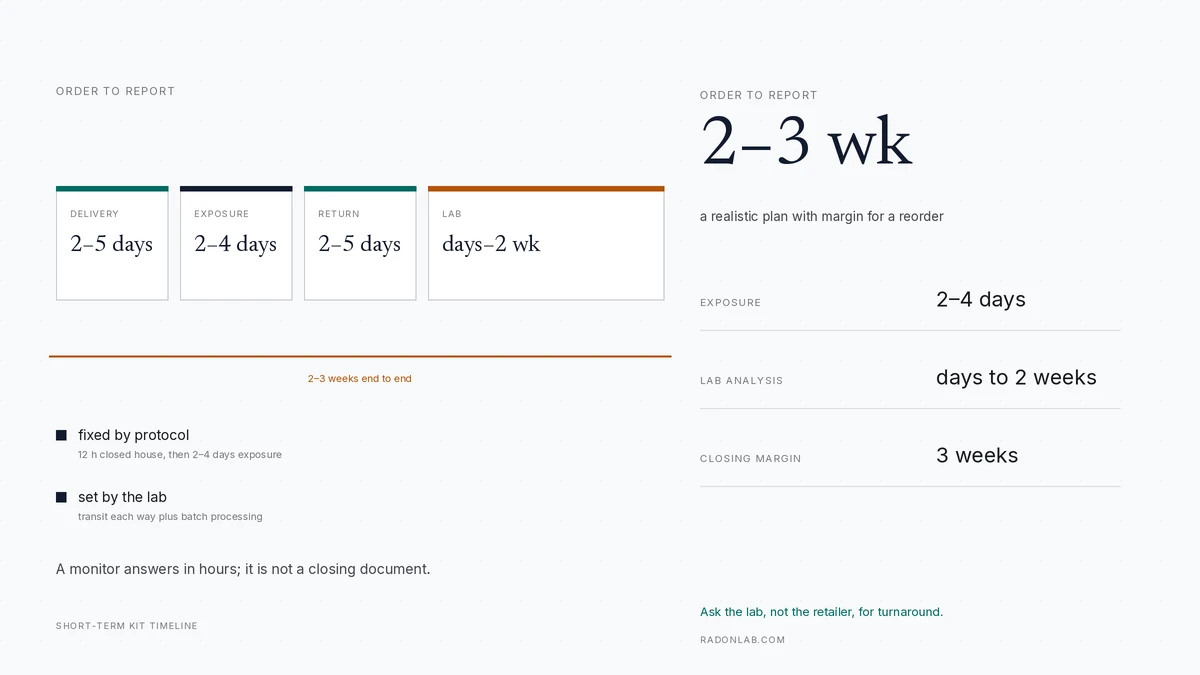
The test itself runs two to four days under closed-house conditions. Add shipping each way and lab analysis; most labs report within days to a couple of weeks, and each lab sets its own turnaround. For a closing, allow two to three weeks end to end.
- Test exposure
- 2–4 days
- Lab analysis
- days to a couple of weeks
- Monitor reading
- immediate, not a document
- Closing margin
- 2–3 weeks end to end
Some links on this page are affiliate links.If you buy through them we may earn a commission at no extra cost to you. We do not accept payment for rankings. Read the full disclosure.
| DIY short-term kit | Certified measurement | |
|---|---|---|
| Exposure | 2–4 days, you place it | 2–4 days, tester places and retrieves it |
| Shipping | Mailer each way, or a drop-off point | None for you; the tester carries the device |
| Analysis | Lab processing, usually days to a couple of weeks | Same lab process, often prioritized |
| When you get the number | After the report is emailed or posted | Usually at retrieval or within days |
| Document produced | A lab report | Chain of custody and a signed report |
Radon test results take two to four days of exposure plus shipping and laboratory analysis, which in practice means days to a couple of weeks from mailing the device to holding a report. The exposure window is fixed by protocol. The rest of the wait belongs to the postal service and the lab, and neither is under your control once the kit leaves the house.
The three clocks in every test
Every radon test runs on three separate clocks, and confusing them is how deadlines get missed.
The exposure clock. Two to four days for a short-term device, with a minimum of 48 hours for most charcoal canisters. This is the only part you control directly.
The transit clock. Shipping to the lab and, for a certified measurement, the tester’s trip. A mailer is usually two to five business days each way depending on distance and the day of the week.
The analysis clock. The laboratory’s processing time. This is the part sellers rarely state clearly and the part that decides whether you make a closing.
The test itself: two to four days
The exposure window starts after the closed-house precondition, which is 12 hours with windows and exterior doors shut and exhaust fans off. A device opened at 9 a.m. on Monday, with the house closed since 9 p.m. Sunday, runs until Thursday or Friday.
Cutting the window short is the most common way to waste a kit. A canister pulled after 36 hours may be rejected outright or may report a number the lab flags as an abbreviated exposure. Either way you have lost the week, not saved it.
Long-term kits run 90 days or more. They give a better annual average and they are the wrong instrument when a date is driving the decision.
Shipping both ways
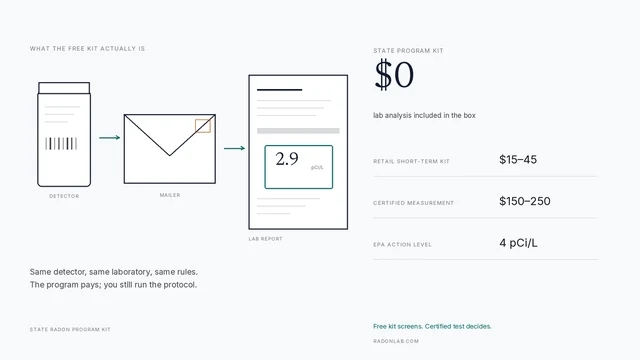
Most retail kits include a postage-paid mailer, which is convenient and slow. A first-class envelope can take the better part of a week to cross the country. If your kit uses a drop-off point — some state programs and university extension offices run them — you can cut several days off the return leg.
Two shipping details matter for validity as much as speed. Seal the device on the stated date and record the time. And do not leave a sealed canister in a hot car or a freezing mailbox for days; the collector has done its job, but extreme storage conditions give a lab a reason to question the sample.
Lab analysis: days to a couple of weeks
The analysis is short in machine time — a charcoal canister is counted in a detector for a measured interval — and long in queue time. A lab running hundreds of samples a week processes them in batches, and your report arrives when your batch comes up.
Published turnarounds vary by laboratory, and the honest figure to plan around is days to a couple of weeks. Ask the lab named on the kit before you buy, and treat the number as the lab’s commitment rather than the retailer’s marketing. Some labs email results and post a written report; some send only a PDF. Confirm which, because a lender may want the signed version.
Continuous monitors: instant, with a caveat
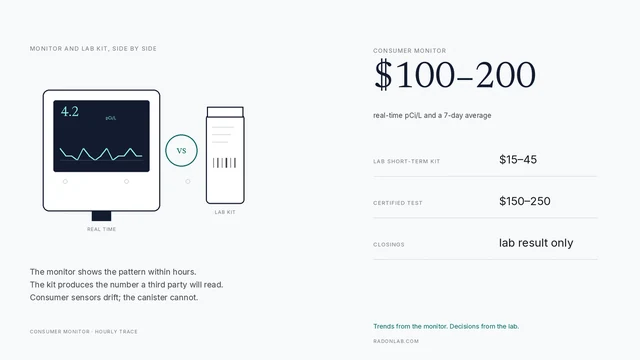
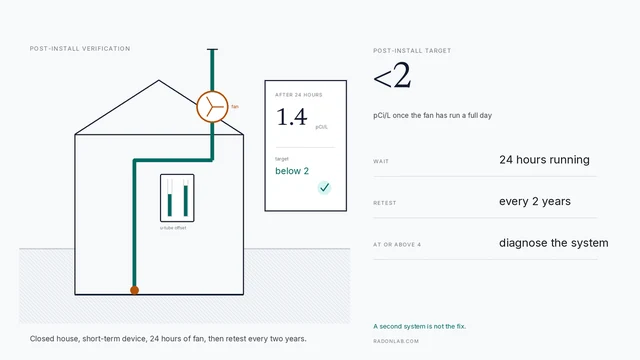
A consumer monitor at $100–$200 displays a number within hours and a stable average within a week. That is genuinely faster than any lab, and it is the right tool for checking whether a fan is working.
It is not a substitute for the report. EPA does not accept consumer monitors for real-estate transactions or as the sole basis for a mitigation decision. If a deadline depends on a document, a monitor screenshot will not satisfy it, no matter how plausible the number.
Planning a closing date with margin
Work backward and add slack.
| Stage | Time to allow |
|---|---|
| Order and delivery | 2–5 days |
| Closed-house precondition | 12 hours |
| Exposure | 2–4 days |
| Return shipping | 2–5 days |
| Lab analysis | days to a couple of weeks |
Two to three weeks end to end is a realistic plan. Ten days is tight and leaves no room for a rejected sample. Five days is not achievable with a mail-in kit.
If the deadline is shorter than that, the options narrow to a certified measurement, where a tester places and retrieves the device and the lab often prioritizes the sample, or an extension of the inspection period. Ask the lab about rush handling before you assume it exists.
Can you speed it up?
Four levers exist, and three of them are free.
Start the closed-house clock before the kit arrives. The 12-hour precondition is the easiest time to lose, because most people open the box the day it lands and only then start closing windows.
Use a drop-off point if one exists. Some state programs and county health offices accept sealed devices in person, which removes the return leg entirely.
Mail early in the week. A device sealed on Friday can sit in a collection box until Monday. Sealing on Tuesday or Wednesday keeps the return leg inside the working week.
Ask the lab about rush handling. Some labs offer priority processing for a fee. Ask before you buy rather than after, and get the price in writing.
What you cannot shorten is the exposure window. A 48-hour minimum is a protocol requirement, not a suggestion, and a device pulled early is the one shortcut that reliably costs more time than it saves.
What delays a result
A device mailed late. A start date left blank. A barcode that does not match the paperwork. A sample flagged for humidity, tampering or an exposure outside the protocol window. A holiday weekend in the middle of the transit clock. A lab backlog after a state giveaway in January, when tens of thousands of kits enter the mail at once.
The January effect is worth knowing about. Radon Action Month drives a surge in short-term kits, and a lab that turns samples in five days in October may take considerably longer in the first weeks of February.
Reading the report when it lands
The report gives a concentration in picocuries per liter, the exposure dates, the device type and usually an uncertainty range. Read the number against EPA’s bands: at or above 4 pCi/L, fix; 2 to 4, consider fixing; below 2, low.
Then check the dates before you act. A report whose exposure window does not match the closed-house period you actually ran is a report to question. The testing section covers how to run the window properly, and the state cost guide shows what each option costs where you live, including the difference between a kit and a certified test when a third party will read the result.
One practical habit makes all of this cheaper: keep a spare kit on the shelf. When a result lands at 4.1 and you need a confirmation inside the same week, the $15–$45 you spent in advance is the difference between a two-week delay and a same-week answer.
How to do it
- Work backward from the deadlineTake the date the report is needed and subtract the lab's stated turnaround, two shipping days each way, four exposure days and the 12-hour precondition. That is the day to order.
- Ask the lab, not the retailerBefore you buy, find the laboratory named on the kit and check its published processing time. If the kit does not name a lab, treat the turnaround as unknown.
- Start the closed-house clock firstClose windows and exterior doors 12 hours before you open the device. Starting the test the same hour you close the house shortens the exposure or invalidates it, depending on the device.
- Mail it the day you seal itSeal the device on the stated end date, fill in the start and end times, and get it into the mail the same day. A canister that sits on a counter for a week is a delayed result at best.
- Track the sampleNote the tracking number or drop-off receipt. If the lab has no record after a week, you want to know while a reorder is still possible rather than the day before closing.
- Keep a spare kit on the shelfA $15–$45 kit in a drawer is the cheapest insurance against a rejected sample. It also lets you run a confirmation test the same week a result lands near the action level.
Frequently asked questions
How long does a radon test take to get results?
Two to four days of exposure, plus shipping to the lab and the lab's own analysis time. Most labs report within days to a couple of weeks, and the exact figure is set by the lab, not by the kit. Ask the lab before you buy if a deadline depends on it.
Can I get radon results the same day?
Only from a continuous monitor, which displays a number within hours. That reading is useful for spotting a pattern or checking a fan, but EPA does not accept consumer monitors as the basis for a real-estate transaction or a mitigation decision. A lab result or certified measurement is the document.
Does the lab or the kit company control turnaround?
The lab does. Kits are sold by retailers, state programs and hardware stores, but the analysis happens at a laboratory, and each lab publishes or quotes its own processing time. A retailer's marketing copy is not a service-level commitment.
How early should I order a radon test before closing?
Allow two to three weeks from order to report. That covers delivery, the 12-hour closed-house precondition, a two-to-four-day exposure, shipping both ways and lab analysis, with room for a reorder if the first device is invalidated. Ten days is tight; five is not realistic.
What delays a radon test result?
A device mailed late, a missing start date or barcode, a sample flagged for humidity or tampering, a holiday weekend, or a lab backlog. A rejected sample means starting over, which is why the paperwork matters as much as the placement.
Is a long-term test faster?
No, it is much slower. A long-term kit runs 90 days or more before it is sent for analysis, so the answer arrives a season later. It gives a better annual average, and it is the wrong tool when a deadline is driving the decision.
Sources
Some links are affiliate links.If you buy through them we may earn a commission at no extra cost to you. We do not accept payment for rankings. Read the full disclosure.