How much does a radon test cost in each state
Radon test prices by state: DIY kits, certified measurements and monitors, plus which state programs subsidise kits and where licensing changes the bill.
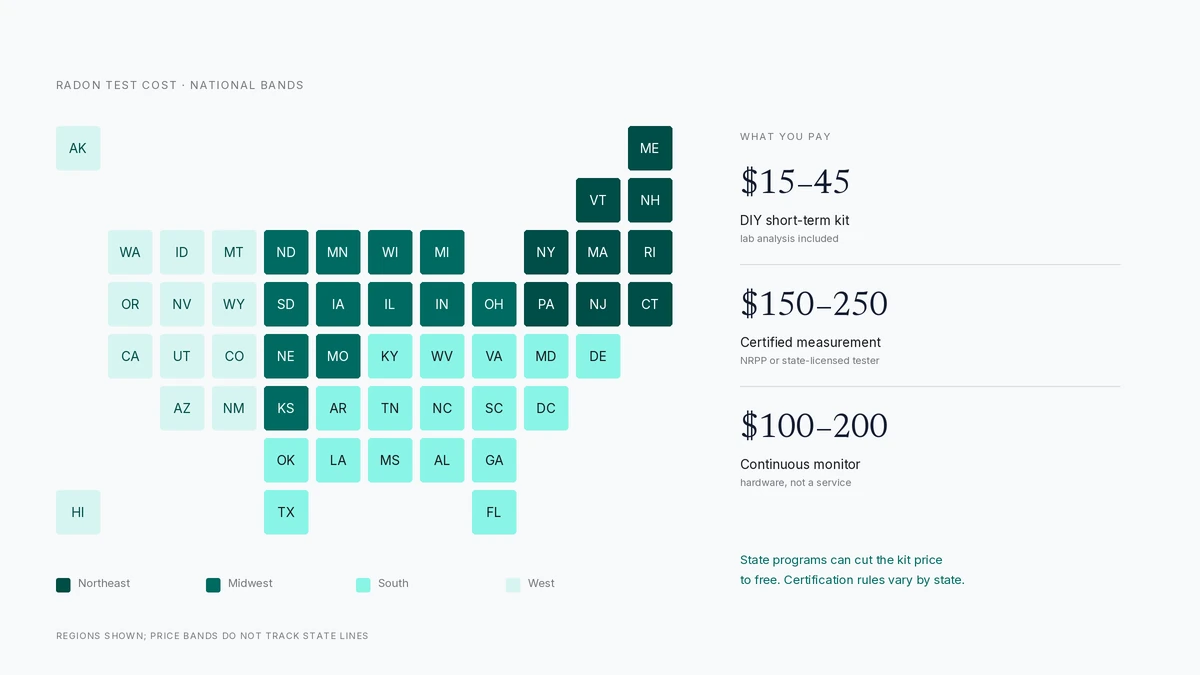
A DIY short-term kit runs $15–$45 in every state, a certified measurement runs $150–$250, and a consumer continuous monitor costs $100–$200. What changes by state is whether a subsidised kit program exists, whether testers must be licensed, and whether a sale triggers disclosure.
- DIY short-term kit
- $15–$45
- Certified measurement
- $150–$250
- Continuous monitor
- $100–$200
- State-subsidised kits
- as low as free
Some links on this page are affiliate links.If you buy through them we may earn a commission at no extra cost to you. We do not accept payment for rankings. Read the full disclosure.
| DIY short-term kit | Certified measurement | |
|---|---|---|
| Typical cost | $15–$45 | $150–$250 |
| Who runs it | The homeowner | NRPP-certified or state-licensed tester |
| Paper trail | Lab report | Chain of custody and signed report |
| Accepted for a sale | Usually not | Yes, where the state or lender requires it |
Radon test prices do not vary by state the way gasoline does. A short-term kit costs $15–$45 whether you buy it in Minnesota or Mississippi, because the kit is a stamped envelope and a charcoal canister shipped to a lab. What varies is everything around the kit: whether the state subsidises it, whether the person running the test needs a licence, and what the law requires when a house changes hands.
The national bands
Three price points cover almost every legitimate test.
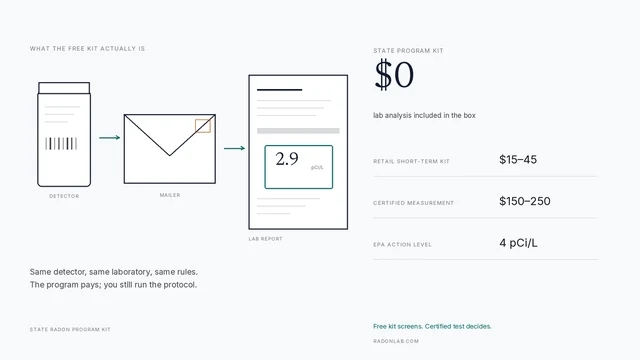
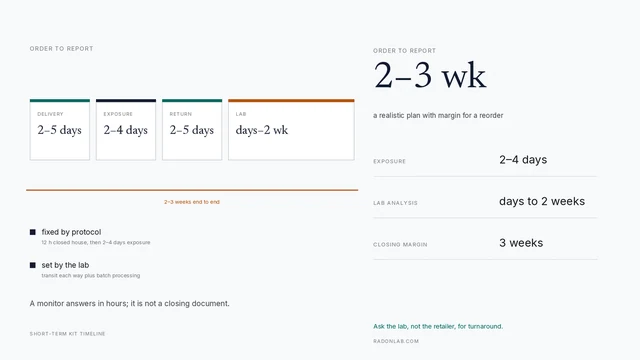
A DIY short-term kit with lab analysis runs $15–$45 — the testing guide explains what that number does and does not prove. You place it, leave it for two to four days under closed-house conditions, and mail it to a lab. The lab report is the result.
A certified measurement runs $150–$250. A trained tester brings a calibrated device, documents the chain of custody, and produces a report that a buyer or lender will accept.
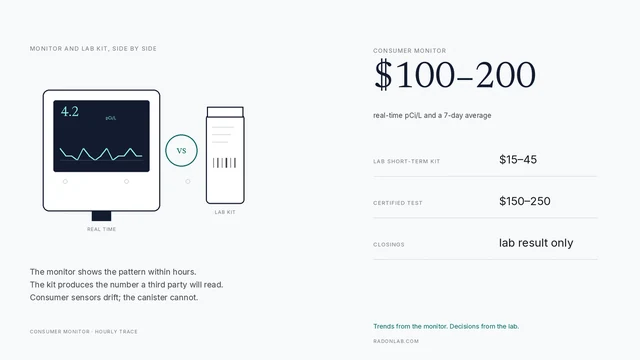
A consumer continuous monitor costs $100–$200 as hardware. It displays real-time pCi/L and is useful for verification and pattern-watching, but EPA does not treat it as a substitute for a lab result when a mitigation decision is being made.
Those three numbers are national. The state-level differences sit on top of them.
What actually varies by state
Four things move the real price you pay.
Subsidy programs. Some state radon programs buy kits in bulk and sell them below retail, or distribute them free with grant money. A $20 retail kit can become a $10 kit or a free one.
Licensing and certification. Where the state licenses radon professionals, the tester’s price includes compliance, insurance and continuing education. Where it does not, the market price is set by NRPP-certified firms and general inspectors.
Disclosure rules. A state that requires a radon disclosure at sale creates steady demand for certified tests, which supports more testing firms and shorter lead times. The zone guide explains why the county label does not change the price. A state without one has a thinner market.
Contractor density. A metro with a dozen certified mitigators and testers has more price competition than a rural county with one firm covering four counties. Travel time shows up in the invoice.
State programs and subsidised kits
Most state radon programs are funded through EPA grants and run a kit program as their main public-facing service. The pattern is similar across the country: a short-term kit sold at or below cost, a January promotion for Radon Action Month, and a website with county-level zone maps and a list of certified professionals.
Prices in the $10–$20 range are common, and free kits appear when a grant cycle allows. The catch is that subsidised kits are usually short-term devices, not certified measurements. They are the right first test for a homeowner and the wrong document for a real-estate closing.
Minnesota, Illinois, New Jersey, Pennsylvania and Iowa are among the states with long-running programs and disclosure rules. Ohio and Florida have licensing programs that shape the professional side of the market. Every state has an EPA-funded program contact, even where the kit supply is thin.
Certification rules and the professional price
A certified measurement is a process, not a device. The tester must place the device according to protocol, maintain closed-house conditions, document the chain of custody, and deliver a report that identifies the device and the lab.
Where the state licenses radon professionals, that process is audited. Ohio, Florida, New Jersey, Pennsylvania, Illinois and Iowa are the best-known licensing states; each maintains a searchable list of licensed testers and mitigators. In states without licensing, NRPP certification is the credential to ask for, and the NRPP directory is the place to verify it.
The price difference between a $150 test and a $250 test is usually not accuracy. It is travel, scheduling, the number of devices, and whether the report is being prepared for a transaction with a deadline.
Disclosure at sale: what the law actually requires
No state requires a radon test at the point of sale. That sentence surprises people, because radon comes up in almost every home inspection conversation. What several states require is disclosure: Illinois, Minnesota, New Jersey, Pennsylvania and Iowa have statutes that require sellers to tell buyers what they know about radon, often with a pamphlet and sometimes with a place to record known test results.
The practical effect is that a seller who has tested must disclose the result, and a buyer who wants a number has to order a test. A disclosure law is not a testing mandate; it is an information mandate. That distinction matters when a real-estate agent tells you a test is “required by the state.”
New construction rules
A handful of states and local jurisdictions require radon-resistant new construction in designated counties. Massachusetts is the best-known example: its building code requires passive radon-resistant features in specified counties, which is why new homes there often have a capped vent pipe already stubbed through the roof.
Elsewhere, the requirement is usually local or voluntary. If you are building, the cheapest time to install a passive system is before the slab is poured; the foundation-type guide explains the passive-to-active upgrade. The cost at that stage is $500–$1,500; retrofitting an active system into a finished house is $800–$2,500 or more.
Regional price patterns
Three broad patterns show up in the data.
The Northeast and upper Midwest have the highest testing activity, the most licensed professionals and the highest professional prices, generally at the top of the $150–$250 band. They also have the strongest subsidy programs, which keeps the DIY end cheap.
The South has lower contractor density outside major metros, so a certified test can involve travel and a longer wait, even though the headline price is often lower. Radon awareness is lower, which means fewer tests and fewer firms.
The West is mixed: mountain states with known radon problems have active programs and competitive testing, while coastal metros have thin radon markets because the geology is different.
None of this changes the national bands. It changes which end of the band you are likely to see.
How to get the lowest legitimate price
Start with the state kit. If a subsidised short-term kit is available, buy it. Run it correctly. If the result is below 2 pCi/L, you are done for now. If it is between 2 and 4 pCi/L, buy a long-term kit and let it run for 90 days. If it is at or above 4 pCi/L, order a certified measurement before you price a system — the cost guide shows what the install should look like.
That sequence spends the least money for the most information. The mistake is to skip from a $20 kit straight to a $1,200 mitigation quote, or to pay $250 for a certified test when a $20 kit would have told you the house is fine.
What the price does not include
A kit price does not include a second device for a second level, expedited lab processing, or a re-test after a failed sample. A certified measurement does not include mitigation, a second visit after a closed-house violation, or a report rushed for a closing. Ask about each before you book.
The one thing worth paying extra for is documentation. If the number is going to be used by someone other than you — a buyer, a lender, a contractor — the certified report is the version they will accept, and a cheap kit that produces an unacceptable result is not cheap.
How to do it
- Check the state program firstSearch your state health or environment department's radon page. If a subsidised kit is available, it is the cheapest legitimate first test.
- Decide whether you need a certified resultA sale, a lender requirement or a mitigation decision wants a certified measurement. A homeowner's first look does not.
- Verify the tester's credentialAsk for the NRPP number or the state license number, then check it against the issuing body's directory before booking.
- Time the test to the seasonHeating-season tests usually read higher because the house is closed. A winter short-term test is the conservative choice; a long-term test covers the whole year.
- Keep the reportStore the lab or certified report with the house documents. It is the baseline for a retest and the document a buyer will ask for.
Frequently asked questions
How much does a radon test cost?
A do-it-yourself short-term kit with lab analysis costs $15–$45. A certified professional measurement costs $150–$250 and includes a trained tester, a calibrated device and a report that stands up in a real-estate transaction. A consumer continuous monitor costs $100–$200 and is a diagnostic tool, not a certified result.
Do state health departments give away radon kits?
Some do, and many sell them at a discount. Several state programs price short-term kits in the $10–$20 range and run free-kit promotions, especially during January Radon Action Month. Availability changes with grant funding, so check the current state page rather than a list from an old article.
Why is a professional test so much more expensive than a kit?
You are paying for a calibrated device, a trained tester, chain of custody and a report that a buyer, lender or court will accept. A $20 kit measures the same gas, but the paperwork is not equivalent, and real-estate transactions require the certified version.
Does my state require a radon test when I sell my house?
No state requires a radon test at sale. Several states require disclosure or a pamphlet at the time of sale, and some require disclosure of known radon results. The requirement is about telling the buyer what is known, not about generating a new measurement.
What does radon tester licensing change?
Where a state licenses or certifies radon professionals, the tester's credential is verifiable and the price usually includes compliance costs. States with licensing include Ohio, Florida, New Jersey, Pennsylvania, Illinois and Iowa. In other states, NRPP certification is the credential to ask for.
Can I use one kit for a whole house?
A kit measures the air at one location. If the house has a basement and a first floor, or a finished basement plus a crawl space, the protocol may call for more than one device. A single kit in the lowest lived-in level is the normal starting point.
Sources
Some links are affiliate links.If you buy through them we may earn a commission at no extra cost to you. We do not accept payment for rankings. Read the full disclosure.