Are continuous radon monitors accurate?
Consumer radon monitors cost $100–$200 and update in real time. What their 7-day average is worth, where calibration drifts, and when to confirm with a lab kit.
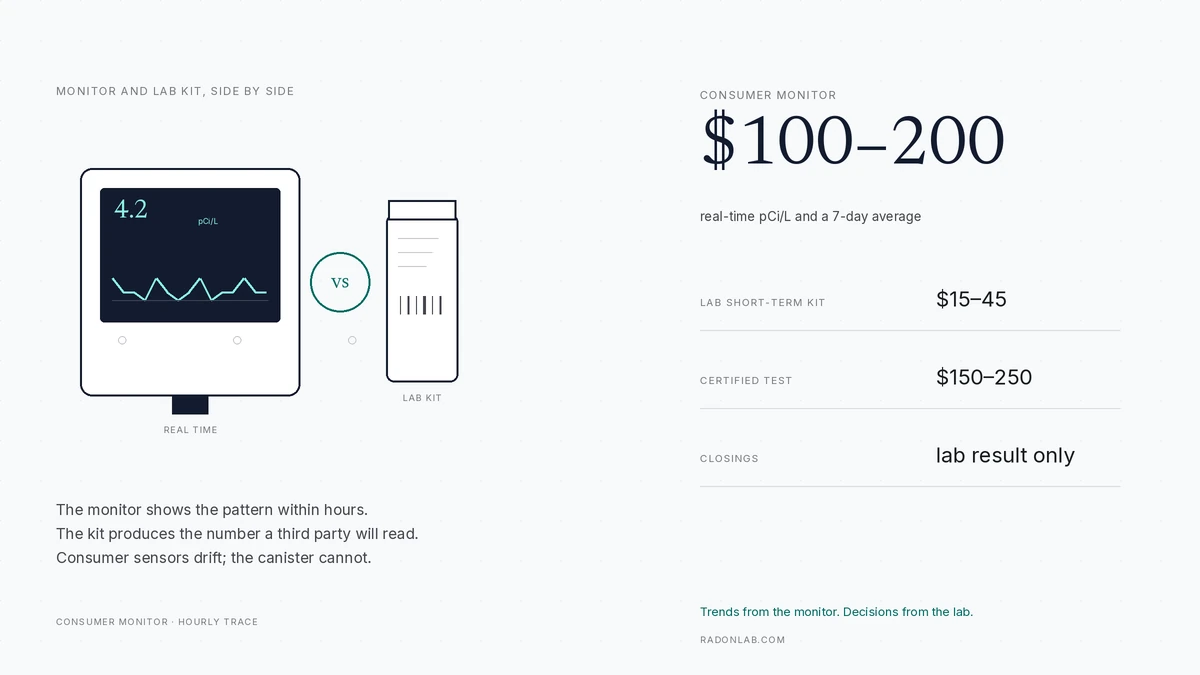
For spotting patterns, yes. A $100–$200 monitor tracks real-time pCi/L and builds a 7-day average usually in the same range as a lab kit. EPA does not accept it for real-estate transactions or as the sole basis for a mitigation decision. Confirm with a kit first.
- Consumer monitor
- $100–$200
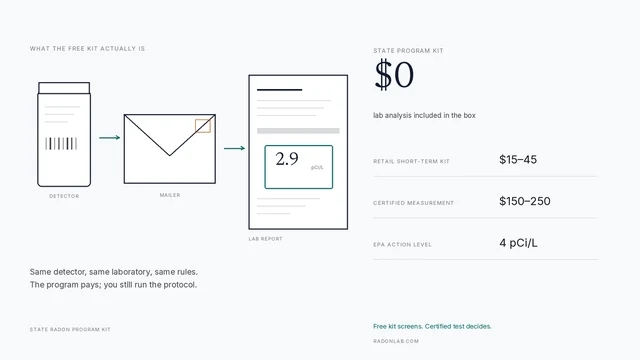
- Short-term lab kit
- $15–$45
- Certified measurement
- $150–$250
- EPA action level
- 4 pCi/L
Some links on this page are affiliate links.If you buy through them we may earn a commission at no extra cost to you. We do not accept payment for rankings. Read the full disclosure.
| Continuous monitor | Short-term lab kit | |
|---|---|---|
| Price | $100–$200, one-time hardware | $15–$45 per test, analysis included |
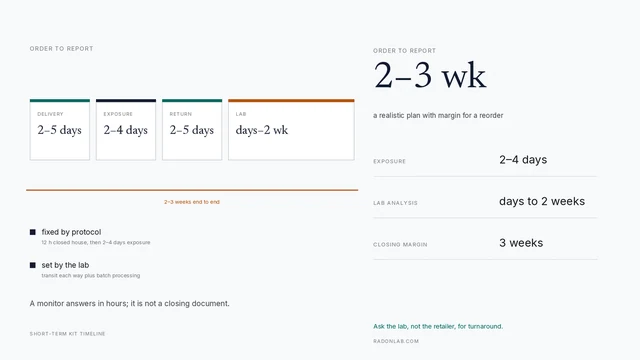
| Time to a number | Minutes to hours | Two to four days, plus lab turnaround |
| What it reports | Real-time pCi/L, hourly trace, 7-day average | One integrated average for the exposure window |
| Calibration | Drifts; rarely verifiable by the owner | Batch-checked by the lab, no certificate for the owner |
| Accepted for a closing | No | Usually not, but it is a lab result |
| Best use | Patterns, fan checks, seasonal watching | A number that decides whether to spend $1,200 |
A continuous radon monitor is an electronic detector that samples indoor air on a fixed cycle and displays a running concentration in picocuries per liter. Consumer units cost $100–$200, log hourly readings and build daily, weekly and monthly averages. They are accurate enough to show what a house is doing. They are not accurate enough to be the document that decides a $1,200 purchase.
What the $100–$200 box contains
Inside is an ionization chamber or a solid-state alpha detector, a small pump or a passive diffusion path, a temperature and humidity sensor, and a display with a few buttons. Most units store a month or more of hourly data and push it to a phone app. Some add a battery and a wall mount; a few add a Wi-Fi radio so you can watch the number from work.
The sensing element is real instrumentation, the same family of detector used in professional units that cost several times more. What the cheap unit lacks is the paperwork: a calibration certificate with a date, a chain of custody, and a documented placement protocol signed by a trained tester.
Real-time numbers and the 7-day average
The live number is the part people over-read. Radon in a room moves hour to hour as the furnace cycles, the wind changes and a door opens. A monitor that reads 1.2 at noon and 5.8 at 3 a.m. is not malfunctioning; it is showing the stack effect doing its work overnight.
The number worth acting on is the average. A 7-day average smooths out the daily cycle, and a 30-day average smooths out the weather. If you want a single figure from a monitor, take the longest average the unit offers, taken in the heating season, in the same room you would test with a kit.
Where the accuracy claim comes from
Manufacturers publish an accuracy figure, usually a percentage plus a floor in pCi/L, measured against a reference chamber. That specification describes a new unit in a controlled environment. It does not describe your unit after two years on a basement shelf, and it does not include the error introduced by where you put it.
Placement error is usually larger than sensor error. A monitor beside a drafty door can read half the room average. A monitor in a closed closet can read almost nothing. The placement rules apply to electronics exactly as they apply to charcoal.
What accuracy means at 4 pCi/L
The action level sits at 4 pCi/L, so the only accuracy that matters is accuracy near that number. A unit specified at plus or minus 10 percent is claiming about 0.4 pCi/L at the action level. On a stable week in a closed room, that is fine. On a week with a cold snap, a barometer drop and a furnace cycling every twenty minutes, the room average itself moves further than the specification allows.
That is why the useful question is not “how accurate is the sensor” but “how much of the answer is the sensor.” In a consumer monitor, most of the error lives in placement, season and calibration state. Two units of the same model in the same room can disagree by a picocurie and both be within specification.
Calibration drift is the real failure mode
Every radiation sensor drifts. The detector’s response changes slowly with age, humidity cycling and temperature exposure, and a consumer unit has no built-in reference to notice. Some manufacturers offer a return-to-factory recalibration; many do not advertise one.
That is the core reason EPA does not accept consumer monitors for decisions. A drifting sensor produces a confident number with no visible warning. A charcoal canister has no calibration to drift, because it is used once and analyzed against a batch curve the lab controls.
If your monitor is more than a few years old and has never been checked, treat it as a relative instrument. It can still tell you that today is worse than last week. It cannot tell you that your house is at 3.9 rather than 4.4.
There is also a storage problem. Sensors that sit in an unheated garage through a winter, or in a humid basement through a summer, age faster than the specification assumes. Keep the unit where the house is conditioned and out of direct sun, and note the date you put it into service.
What EPA will and will not accept
EPA’s position on consumer monitors is narrow and worth quoting in plain terms: they are not recommended for real-estate transactions, and they are not a substitute for a lab-based or certified measurement when the decision is whether to mitigate.
That is not a statement that the devices are junk. It is a statement about evidentiary standards. A buyer’s lender, a contractor’s warranty and a state licensing board all want a result that can be traced to a calibrated device, a documented exposure window and a named tester. A phone app screenshot satisfies none of those.
Three jobs a monitor does better than a kit
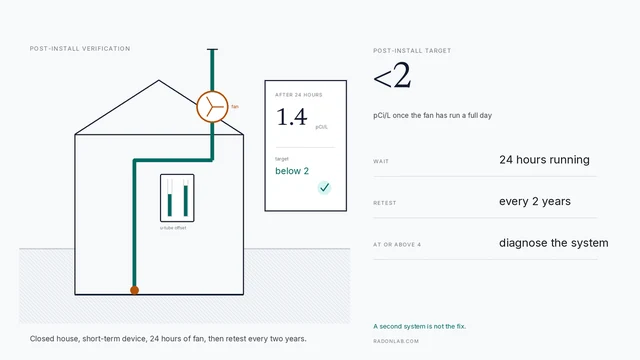
Verifying a fan. After a system is installed or a fan is replaced, a monitor shows the level falling within hours. A kit takes four days plus shipping to tell you the same thing.
Watching a seasonal pattern. A monitor logs the whole heating season. That is how you find out whether the February spike is a one-week event or a three-month condition.
Catching an intermittent problem. A house that reads 2 on a four-day kit but spikes to 9 during cold snaps will look fine to a canister and obvious to a monitor.
In all three cases the monitor is supporting a decision, not making it. The decision still wants a lab number, and the state cost guide shows what that costs where you live.
When to put the monitor down and buy a kit
Three triggers. The monitor shows an average at or above 4 pCi/L. You are buying or selling a house. A contractor has guaranteed a post-install level and you want independent proof.
In each case the kit is $15–$45 and produces a result that a third party will read. Buy two if you want a same-week comparison, and run them in the same room at the same height.
The verification sequence
Run the monitor for a week in the room you would test. Note the average. Then run a short-term kit in the same spot for its full two to four days, under closed-house conditions, and send it in.
If the two numbers agree within about a picocurie, you have a calibrated working relationship with your monitor: trust it for trends, and use a kit when the answer has to be official. If they diverge, the lab is right and the monitor needs service or replacement.
Then act on the result the way you would act on any other: at or above 4 pCi/L, confirm and mitigate; between 2 and 4, run a long-term test; below 2, keep the report and check again in two years. The device that produced the number is the least important part of that sequence.
How to do it
- Place it like a lab deviceLowest lived-in level, at least 20 inches off the floor, away from exterior walls, drafts, heat, moisture and sun. A monitor in a hallway beside the kitchen door measures the kitchen door.
- Run a full week before reading anythingIgnore the first day and the overnight spikes. Seven days gives you an average that weather noise cannot dominate, and 30 days is better still if you are comparing seasons.
- Compare it with a lab kit onceBuy a $15–$45 short-term kit and run it in the same room during the same week. If the two results sit within a picocurie, you know your monitor is tracking. If they diverge by more, trust the lab.
- Use it to verify the fanAfter a mitigation install or a fan swap, watch the monitor fall and hold. A reading that stays near the pre-mitigation level points at suction, not at the sensor.
- Confirm anything at or above 4 with a labA monitor reading of 4.6 is a reason to order a kit, not a reason to call a contractor. The kit produces the document the next step requires.
- Replace or recalibrate on a scheduleCheck whether the manufacturer offers recalibration and what it costs. Once a unit is several years old and unverified, demote it to a trend indicator and keep a kit on the shelf.
Frequently asked questions
Are home radon monitors as accurate as lab tests?
Close enough to spot a pattern, not close enough to replace the document. A consumer monitor and a charcoal kit measure the same gas, and a 7-day average usually lands in the same range. EPA does not accept consumer monitors for real-estate or mitigation decisions, and a lab result is what a contractor, buyer or lender will act on.
Why does EPA not accept consumer radon monitors?
Because the device is not the whole measurement. A laboratory result carries a chain of custody, a documented exposure window and a device batch that the lab has checked. A $150 monitor in a kitchen has none of that, and its sensor can drift between calibrations without any visible warning.
Do radon monitors need calibration?
Yes, and that is the weak point. Consumer sensors drift over time, and most units give you no way to verify the reading against a known source. Professional monitors are calibrated on a schedule and carry a certificate. Treat a monitor older than a few years as a trend indicator, not a measuring instrument.
How long should I run a radon monitor before trusting it?
Seven days is the useful minimum for a first impression, and a month is better. Radon swings with weather and season, so a single overnight dip or spike means little. Read the weekly average, then compare it with the range the house showed across a full month.
Can a monitor tell me if my mitigation fan is working?
That is its best job. After a system is installed or a fan is replaced, a monitor shows within hours whether the level drops. Watch the reading fall and hold; if it climbs back toward the pre-mitigation number, check the U-tube before you call anyone.
Should I buy a monitor or a lab kit first?
Buy the kit first if you need a number you can act on, because it costs $15–$45 and produces a document. Buy the monitor if you already have a system, want to watch a seasonal pattern, or need to know whether a fan is doing anything. Many owners end up with both.
Sources
Some links are affiliate links.If you buy through them we may earn a commission at no extra cost to you. We do not accept payment for rankings. Read the full disclosure.