Radon mitigation system cost what you actually pay
EPA puts a fan-based radon system at $800–$2,500 installed, averaging near $1,200. What drives the bill, what quotes leave out, and the yearly fan cost.
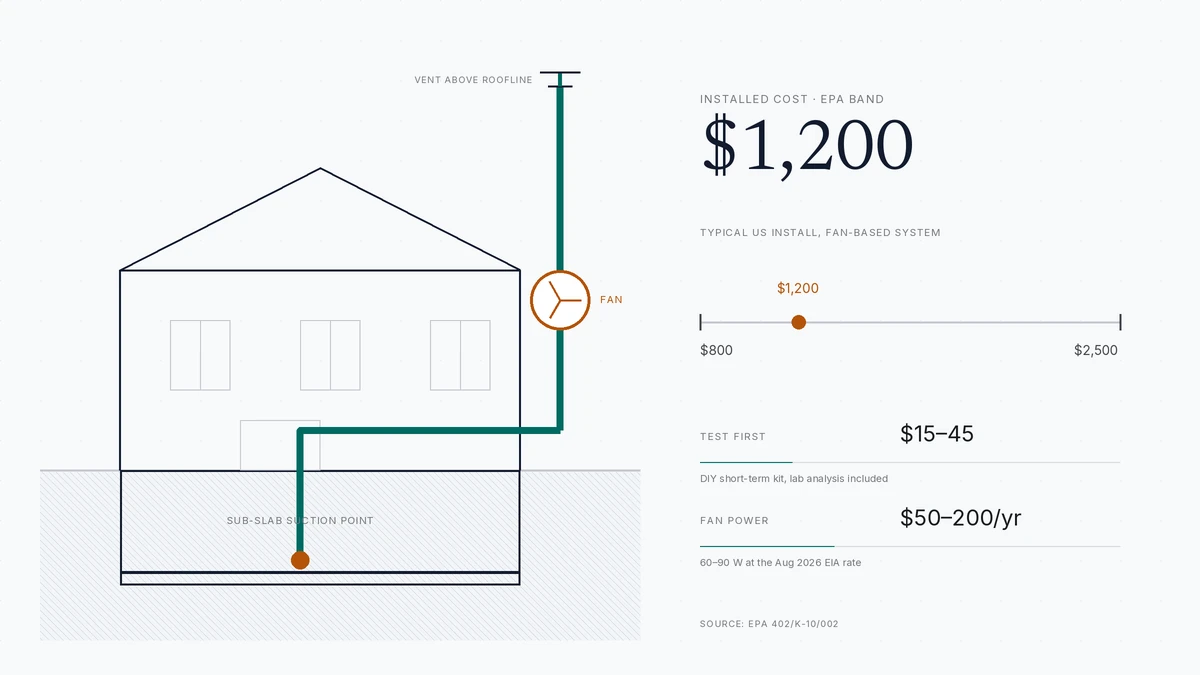
EPA's published band for a fan-based sub-slab system in an existing home is $800–$2,500 installed, with a national average near $1,200. Crawl spaces, multiple suction points and long pipe runs push the price up; the fan adds roughly $50–$200 a year to run.
- EPA installed band
- $800–$2,500
- Typical US install
- about $1,200
- Test before you bid
- $15–$45 DIY kit
- Fan running cost
- $50–$200 per year
Some links on this page are affiliate links.If you buy through them we may earn a commission at no extra cost to you. We do not accept payment for rankings. Read the full disclosure.
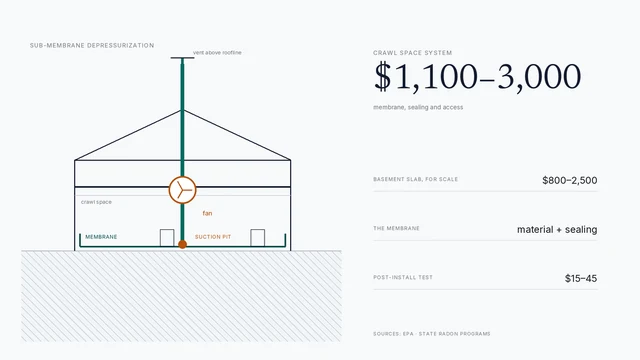
| Sub-slab (basement or slab) | Sub-membrane (crawl space) | |
|---|---|---|
| EPA-linked installed band | $800–$2,500 | $1,100–$3,000 |
| What the work involves | Core through the slab, one suction point, pipe to the roof | Seal the dirt floor under a membrane, then draw from beneath it |
| Typical extra | Second suction point if the slab is broken up | Membrane repair, sealing penetrations, crawl-space access |
| Running cost | About $127 a year for an 80 W fan | Same fan class, same running cost |
Radon mitigation is the work of lowering the concentration of radon gas inside a house, almost always by pulling soil gas from beneath the foundation and venting it above the roofline. The hardware is simple — a PVC pipe, a suction point through the slab, and a small inline fan — but the price is set by how hard your foundation makes the job. That is why the same system can cost $850 in one house and $2,400 in the house next door.
What a radon mitigation system costs
EPA’s Consumer’s Guide to Radon Reduction (402/K-10/002, January 2010) puts a fan-based system in an existing home at $800–$2,500 installed, with a national average near $1,200. It remains the last official EPA statement on residential cost, so it is the number to hold against any quote you receive. A bid well below the band usually means a missing permit, an undersized fan, or no post-install test. A bid well above it should come with an explanation you can point to: more suction points, a crawl space, a long exterior run, or a difficult roof penetration.
The price covers the system, not the diagnosis. Testing comes first. A short-term kit with lab analysis runs $15–$45 — here is what each test actually measures — and a certified measurement runs $150–$250. Spending $30 before you spend $1,200 is the cheapest part of the project.
Why the EPA band is so wide
Five things move the number, and most quotes are really a mix of all five.
Foundation type. A basement with a clean, unbroken slab is the easiest case: one core through the concrete, one suction point, one pipe. A crawl space needs a membrane sealed to the walls and piers before any suction can work — the foundation-type guide covers that case in detail. A house with both — a basement plus a crawl-space wing — often needs two separate suction points and two runs.
Number of suction points. One is normal. Two or three appear when the slab is divided by footings, when a previous addition sits on its own pour, or when the soil is tight and pressure does not travel. Each additional point adds pipe, a core, and labor.
Pipe route. An interior run hides the pipe but crosses closets, ceilings and a roof penetration. An exterior run is faster but adds weatherproofing, paint, and sometimes a chase. Neither is automatically cheaper; the house decides.
Labor market and permits. Mitigation is skilled trade work. Rates vary by region, and some jurisdictions require a permit and inspection while others do not. The permit line is usually small, but it changes the schedule.
Electrical. Many fans run on a dedicated circuit. If the panel has no spare breaker or the run is long, an electrician’s invoice lands on top of the mitigation quote.
Cost by system type
The table below is the band to expect for each system in an existing home. The first two rows cover most houses.
| System | Best foundation | Installed band |
|---|---|---|
| Sub-slab depressurization (SSD) | Basement, slab-on-grade | $800–$2,500 |
| Sub-membrane depressurization | Crawl space | $1,100–$3,000 |
| Drain-tile or sump-pit tie-in | Slab with perimeter drainage | $800–$2,500 |
| Block-wall depressurization | Hollow-block foundation | $1,000–$3,000 |
| Passive system, new construction | Any, built in | $500–$1,500 |
| Adding a fan to a passive system | Any, already piped | $300–$900 |
| Heat-recovery ventilator | Tight houses, limited cases | $1,200–$3,500 |
| Water aeration (radon in well water) | Private well | $3,500–$6,500 |
Sub-slab depressurization is the default because it works on the most common foundation and needs the least material. Sub-membrane is the crawl-space answer. Block-wall systems appear in older homes with hollow concrete block, where the wall cavities themselves become the suction field.
What the install price usually includes
A complete bid should list the fan and its model number, the PVC pipe and fittings, the suction point and its sealing, a U-tube manometer or system indicator, the required system label, and the roof or wall penetration with flashing. In states with licensing, the installer’s certification number belongs on the contract too.
Ask whether the price includes the permit and the post-install test. Those two lines are the most common omissions, and both matter. The permit protects you at resale; the post-install test proves the system does what it was sold to do.
What it often does not include
- A new electrical circuit, where local code requires one.
- Drywall repair or paint after an interior pipe run.
- A new airtight sump lid, if the existing one cannot be sealed.
- A second suction point discovered mid-install.
- A post-mitigation test, unless it is written into the quote.
- Landscaping or exterior restoration after an outdoor run.
None of these is unusual. The point is to know before you sign which side of the line each one falls on.
Running cost: about $127 a year for the fan
The fan is the only part of the system that uses electricity, and it uses very little. EPA describes typical mitigation fans as drawing under 90 watts; most residential models sit between 60 and 90 W. At the August 2026 US average residential price of 18.16 cents per kWh, an 80-watt fan running continuously uses about 701 kWh a year and costs roughly $127. EPA’s own budget line is $50–$200 a year, which covers the same arithmetic at different fan sizes and electricity rates.
If your rate is higher — California and the Northeast run well above the national average — redo the multiplication with your own cents per kWh, or use the calculator, which does it for you. The formula is watts × 8.76 = annual kWh, then kWh × your rate.
Fan replacement and the ten-year bill
EPA describes a typical fan service life of 5 to 15 years. Replacement fans cost roughly $150–$450, and a failed fan is not a cosmetic problem: without suction, the system stops working even though the pipe is still there. Keep the model number and install date.
A rough ten-year total for a $1,200 install at $127 a year, with one fan replacement in the middle, lands near $2,800. That is an estimate, not a quote, but it is the honest way to compare mitigation with the cost of doing nothing. For context, EPA estimates about 1 in 15 US homes sits at or above the 4 pCi/L action level.
Testing before and after
The sequence is test, mitigate, test again. The first test tells you whether you need a system. The second tells you whether the system works. EPA recommends a short-term test after the system has run for at least 24 hours, and a retest every two years afterward, plus any time a major renovation or HVAC change alters how the house breathes.
A post-install reading below 2 pCi/L is the usual target. If the number stays above 4, the contractor should return and diagnose the system rather than bill you for a second one.
How to read a quote
Five checks separate a professional bid from a number on a business card.
- Certification. NRPP certification, or a state license where the state issues one. Ask for the number.
- Fan model. A named model lets you check the warranty and the wattage. “Standard fan” tells you nothing.
- Suction points. The count should match the foundation, not the price the contractor wants to hit.
- Permit and post-test. Both should appear as line items or be explicitly included.
- Written guarantee. It should state the target level and the remedy if the post-install test misses it.
What actually moves the number
In order of impact: crawl space versus basement, the number of suction points, interior versus exterior routing, local labor rates, and whether electrical work is needed. The methodology page explains which band comes from which source. Everything else — the fan brand, the manometer style, the label — is rounding.
If you have a basement slab, a working sump pit with an airtight lid, and a straightforward roof penetration, expect the low end of the EPA band. If you have a crawl space, a finished basement, or an addition on its own slab, expect the middle or the top. Either way, the number should be explainable line by line, and the explanation should be in the contract before the first core goes through the floor.
How to do it
- Test the house firstOrder a short-term kit ($15–$45 with lab analysis) or a certified measurement ($150–$250). Do not price a system before you have a number; a reading below 4 pCi/L does not call for one.
- Get three itemised bidsAsk each contractor for the suction-point count, the fan model, the pipe route, whether the permit and the post-install test are included, and the written performance guarantee.
- Check certificationConfirm the installer holds NRPP certification or a state license where one exists. Ask for the certificate number and check it against the issuing body's directory.
- Put the guarantee in writingA credible bid states the radon level the system is expected to reach, usually below 2 pCi/L, and what happens if a post-install test does not get there.
- Verify with a post-install testRun a short-term test after the system has operated for at least 24 hours, then retest every two years or after a major renovation or HVAC change.
Frequently asked questions
How much does a radon mitigation system cost installed?
EPA's Consumer's Guide to Radon Reduction publishes $800–$2,500 for a fan-based sub-slab system in an existing home, with a national average near $1,200. Crawl-space systems and homes that need more than one suction point typically land at the top of that band or above it.
Why is the price range so wide?
The band covers foundation type, the number of suction points, whether the pipe runs inside or outside the house, local labor rates and permit rules. A single suction point through a basement slab is the low end; a crawl space with a sealed membrane plus a second suction point is the high end.
What is the EPA action level for radon?
4 picocuries per liter of air. EPA says fix at 4 pCi/L or above, and consider fixing between 2 and 4 pCi/L because prolonged exposure at any level carries some risk. A working system usually brings a home below 2 pCi/L.
How much does the fan cost to run each year?
A mitigation fan draws under 90 watts, usually 60–90 W. At the August 2026 US average of 18.16 cents per kWh, an 80-watt fan running continuously uses about 701 kWh and costs roughly $127 a year. EPA budgets $50–$200 a year for operating cost.
Does the install price include the post-mitigation test?
Often not. Ask. A short-term test after the system has run for at least 24 hours is the only proof the system is working. Some contractors include it, some charge for it, and some simply leave it to the homeowner. Put it in the contract.
How long does a radon fan last?
EPA describes typical fan service life as 5 to 15 years. Replacement fans cost roughly $150–$450 depending on model and speed, plus labor if you do not install it yourself. Keep the model number from the original install.
Sources
Some links are affiliate links.If you buy through them we may earn a commission at no extra cost to you. We do not accept payment for rankings. Read the full disclosure.