Are free radon test kits good enough?
State programs give away short-term radon kits, often in January. The detector is the same lab-grade device you would buy; the protocol decides the result.
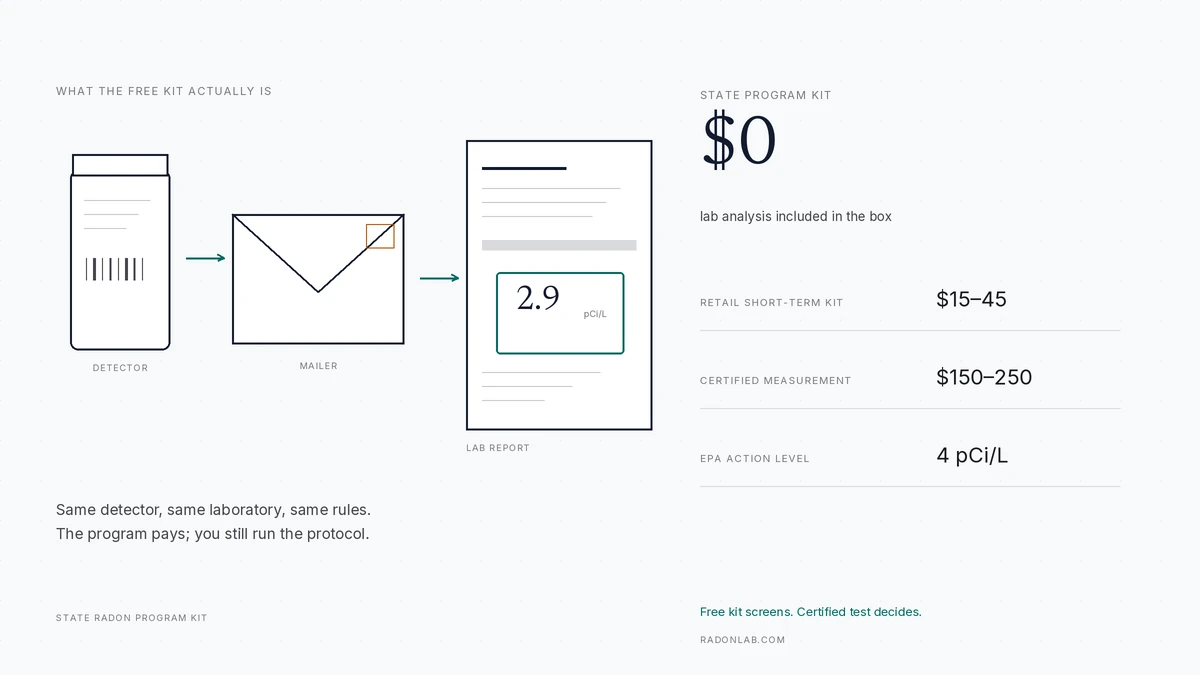
Yes, for screening. A free kit from a state program is usually the same single-use detector sold for $15–$45, analyzed the same way, under the same closed-house and placement rules. It is not accepted at a closing, where a $150–$250 certified measurement counts.
- Free state kit
- $0, lab analysis included
- Retail short-term kit
- $15–$45
- Certified measurement
- $150–$250
- EPA action level
- 4 pCi/L
Some links on this page are affiliate links.If you buy through them we may earn a commission at no extra cost to you. We do not accept payment for rankings. Read the full disclosure.
| Free state kit | Certified measurement | |
|---|---|---|
| Cost | $0 while the program has stock | $150–$250 |
| Device | Single-use charcoal canister, analyzed by a lab | Calibrated monitor or single-use device with a calibration record |
| Closed-house conditions | Self-enforced, undocumented | Verified and recorded by the tester |
| Placement | You follow a printed diagram | Tester places and retrieves to protocol |
| Paperwork | A lab report, usually by email | Chain of custody and a signed report |
| Accepted at a closing | Usually not | Yes, where a buyer or lender requires it |
A free radon test kit is a short-term radon detector supplied by a state radon program at no cost, usually a charcoal canister with laboratory analysis already covered. It measures the same gas with the same method as a $15–$45 kit from a hardware store, because it is often the same device from the same manufacturer. Free does not mean a lesser instrument. It means the state paid the lab fee.
What is actually in the box
Open the envelope and you find a sealed charcoal canister or an alpha-track slip, a barcode label tying the device to your address, a return mailer or a drop-off list, and an instruction sheet written by the state program rather than the manufacturer. Many programs add a one-page questionnaire: foundation type, whether the basement is finished, how many levels are lived in, whether anyone smokes in the house.
The device comes from the small group of manufacturers that supply the retail market. States buy in volume, negotiate a laboratory contract, and distribute kits because testing coverage is the constraint on every radon program. A state that wants more houses tested will pay for the canister and the analysis rather than wait for a real-estate closing to force the question.
That is the whole answer to the headline. The hardware is lab-grade either way.
Why the price is zero
State radon programs run on federal indoor radon grants plus state appropriations, and they spend part of that budget on devices. The economics are simple: a kit costs a few dollars wholesale plus a lab fee, and a state that hands out thousands of them gets a map of where the problem actually is. Programs also use the returns to target outreach — a county that generates a run of high results gets a mitigation campaign next year.
The catch is supply. Kits are finite, most programs limit one per household per year, and stock runs out during the January push. A program that has exhausted its allocation will point you at a discounted kit rather than a free one.
January is when the kits move
EPA designates January as National Radon Action Month, and state programs schedule their giveaways around it. The timing is not arbitrary. January is when houses are shut tight against the cold, which is also when a short-term test best represents the closed-house conditions the protocol requires.
Winter is also the season when a house reads highest, which makes a January result conservative. A house that measures 3 pCi/L in January is unlikely to measure 8 in July. If you test in the summer and get a low number, you have learned less than you think — the testing section covers the seasonal detail, and the state cost breakdown shows how program pricing varies by region.
The detector is not the weak point
A charcoal canister is used once and then analyzed in a lab, so it cannot carry a calibration certificate the way a professional’s continuous monitor can. That is not a defect. The lab runs known-activity spikes and blank samples through every batch, and EPA states that properly used test devices produce practical, affordable and reliable results.
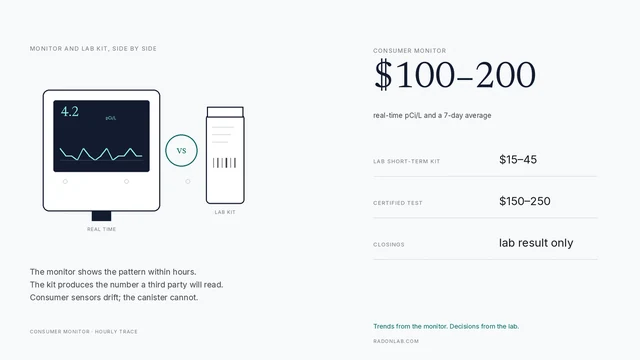
What a single-use device cannot do is prove anything about the conditions it sat in. A calibrated monitor records an hourly trace; a canister records nothing except the integrated number. If the house was opened on day two, the canister has no way to tell you.
What makes a result valid
Three things decide whether the number means anything, and none of them changes with the price of the kit.
Closed house. Windows and exterior doors shut for 12 hours before the test and for the whole exposure period. Exhaust fans, whole-house fans and dryers that vent outdoors stay off. Normal heating and cooling is fine.
Placement. Lowest level the house is regularly used at, at least 20 inches off the floor, away from exterior walls, drafts, heat sources, moisture and direct sunlight. Not a bathroom, not a closet, not a crawl space unless the protocol says so.
Handling. Seal the device on the stated date, write the times down, and mail it the same day. A canister left in a hot car for a week is a wasted test.
What the lab does with your canister
A charcoal canister arrives sealed, logged and weighed. The lab opens it in a controlled sequence, transfers the charcoal into a counting container and counts it in a gamma detector for a set interval. Radon’s decay products emit gamma radiation at known energies, so the detector can separate the sample’s signal from background.
The count is compared against canisters exposed to known concentrations for known periods, which is how a raw count becomes picocuries per liter for your exposure window. A blank canister travels with every batch to show what the instrument reads with no sample in it, and spiked quality-control canisters check that the calibration still holds.
That process is why the paperwork matters as much as the placement. The barcode ties the canister to an address and a pair of dates; the questionnaire tells the lab what kind of house it was. A sample with no start date, or a count that implies an exposure far outside the protocol, gets flagged before anyone reports a number.
Where free kits actually fail
The failures are procedural, and they are the same failures that hit paid kits. Someone opens a window to clear cooking smoke. Someone runs the bathroom fan overnight. The device ends up on a shelf above a radiator, or in a basement bedroom that is used twice a year. The kit gets mailed eleven days after the exposure window closed.
The other failure is administrative. A canister whose barcode does not match its paperwork, or whose start date is missing, can be rejected outright. Read the instruction sheet before you open the sealed device, because once it is open the clock is running.
Where the free kit stops being enough
Four situations need a certified measurement at $150–$250. A sale or purchase, where a buyer or lender will want a signed report. A mitigation decision, where $30 of confirmation sits in front of an $800–$2,500 purchase. A warranty claim against an installer who guaranteed a level. Any result a landlord, employer or insurer will rely on.
The comparison of store-bought and professional tests lays out what the extra money buys: a calibration record, chain of custody, verified conditions and a report someone else will accept. It is not a better sensor. It is a defensible process.
The cheapest correct sequence
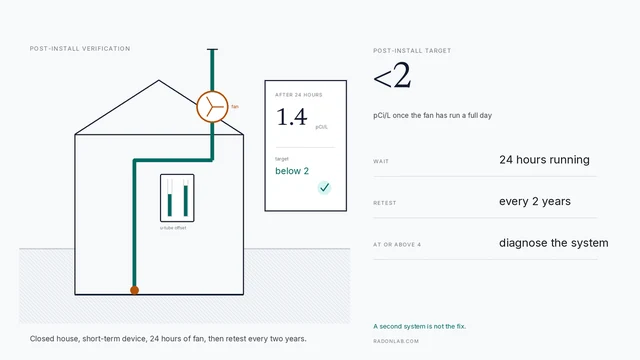
Free kit first, if your program has stock. At or above 4 pCi/L, confirm with a second short-term test or a certified measurement before you call a contractor. Between 2 and 4, move to a long-term kit at $20–$50 and let 90 days average out the season. Below 2, file the report and retest every two years, or after a major renovation or HVAC change.
That sequence spends the least money for the most information, and it uses the free kit for exactly what it is good at: telling you whether the expensive conversation is on the table at all.
How to do it
- Ask the state program firstSearch your state health department's radon page before you buy anything. Programs list current kit offers, county pickup points and any January giveaway, and most cap households at one kit a year.
- Close the house before you open the boxEPA protocols call for closed-house conditions for 12 hours before the test and throughout it. Shut windows and exterior doors and switch off fans that exhaust air or pull in outside air.
- Place it in the lowest lived-in levelAt least 20 inches off the floor, away from exterior walls, drafts, heat sources, moisture and direct sun. Not in a bathroom, closet or crawl space unless the program's instructions say otherwise.
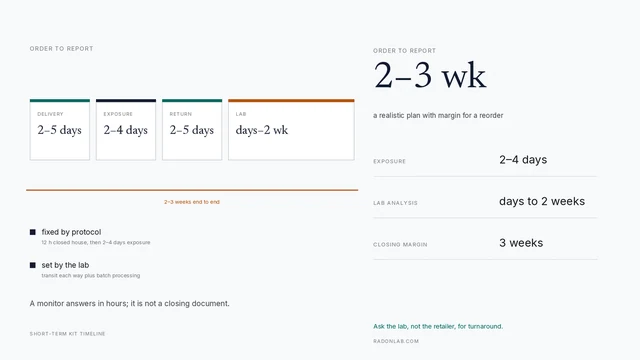
- Run the full window and mail it promptlyA short-term device runs two to four days. Seal it on the stated date, fill in the start and end times, and get it into the mail the same day rather than leaving it on a counter for a week.
- Read the number against 4 and 2At or above 4 pCi/L, act. Between 2 and 4, consider fixing and confirm with a long-term test. Below 2, keep the report and retest every couple of years.
- Escalate if the number is near the lineA reading of 4.1 is close enough to the action level that a second test is worth the money. A reading of 12 does not need a second opinion before you call a mitigator.
Frequently asked questions
Are free radon test kits as accurate as ones you buy?
The detector is usually identical. State programs buy charcoal canisters and alpha-track detectors in bulk from the same manufacturers that supply retail kits, and the analysis runs through a laboratory. EPA states that properly used test devices give practical, affordable and reliable results. What differs is who enforces the test conditions.
Why do states give radon kits away for free?
Testing coverage is the bottleneck in every radon program. A state that wants more houses tested buys devices in volume and covers the lab fee, because a $20 kit is cheap next to the cost of finding a high level at resale. Many programs limit households to one kit a year and run out of stock.
When can I get a free radon kit?
January is the usual window. EPA designates January as National Radon Action Month, and state programs time their giveaways, media pushes and short-term kit offers to it. Some programs distribute kits year-round through county health offices, libraries or extension services, and some discount rather than waive the fee.
Is a free kit good enough to decide on a mitigation system?
It is good enough to start. A result at or above 4 pCi/L should be confirmed with a second test or a certified measurement before you spend $800–$2,500 on a system. A single canister is a screening tool, and the decision it triggers is expensive enough to justify a $30 confirmation.
Can I use a free kit result when selling my house?
Usually not. No state requires a radon test at the point of sale, but a buyer or lender who asks for one will want a certified measurement with a calibration record, documented conditions and a signed report. A self-administered kit result is generally not accepted in a transaction.
What invalidates a free radon test?
Opening windows during the exposure window, running an exhaust fan or whole-house fan, placing the device in a bathroom, closet or crawl space, moving it mid-test, or mailing it late. The lab can also reject a sample whose barcode or paperwork does not match, which is the one failure mode that has nothing to do with your house.
Sources
Some links are affiliate links.If you buy through them we may earn a commission at no extra cost to you. We do not accept payment for rankings. Read the full disclosure.