Radon Zone 3: why low-risk counties still need a test
Zone 3 counties are predicted below 2 pCi/L. Why low risk is not no risk, how local geology beats the county average, and the two-year retest habit.
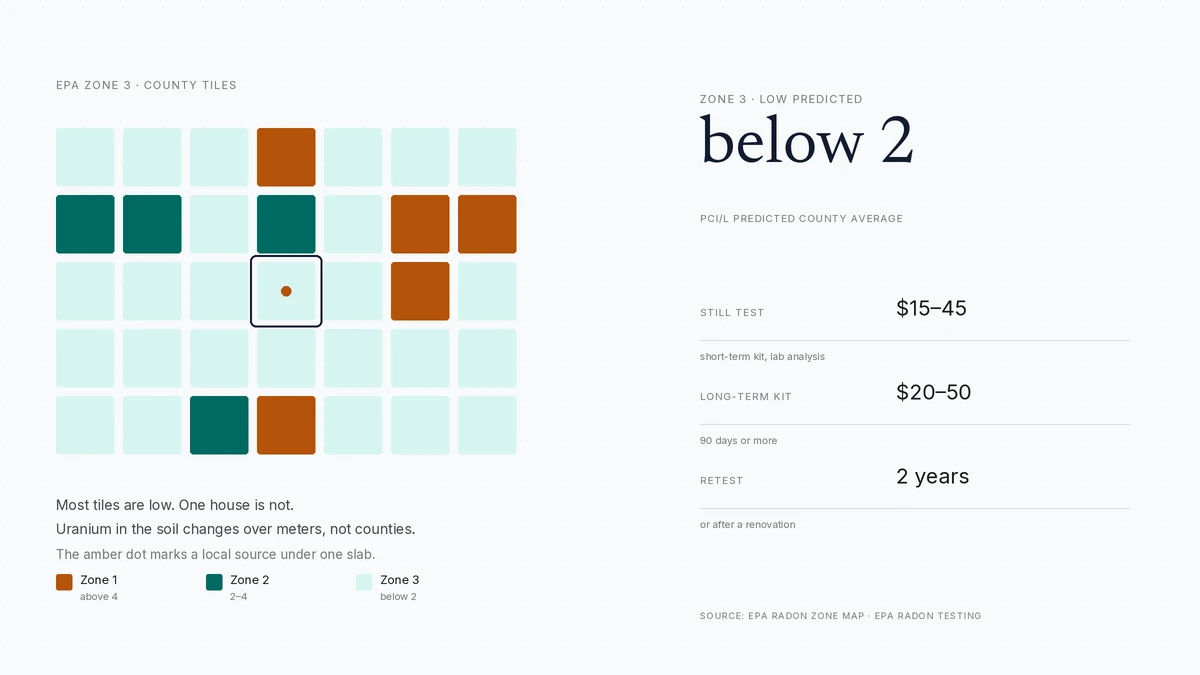
A Zone 3 county is predicted below 2 pCi/L, the lowest of EPA's three radon zones. Low risk is not no risk: local soil, a bare slab and an open sump can push one house above 4 pCi/L in a county that averages 1. Test anyway, and retest every two years or after a major renovation.
- Zone 3 definition
- predicted county average below 2 pCi/L
- EPA guidance
- test every home regardless of zone
- Short-term kit
- $15–$45
- Retest interval
- every 2 years
Some links on this page are affiliate links.If you buy through them we may earn a commission at no extra cost to you. We do not accept payment for rankings. Read the full disclosure.
| Zone 3 county prediction | A tested Zone 3 house | |
|---|---|---|
| Scale | The whole county | One foundation, one room |
| Typical value | Below 2 pCi/L predicted average | Anything from under 1 to well above 4 |
| What drives it | Regional geology and the measurements behind the model | Local soil, slab condition, sump, air sealing, season |
| What it justifies | A lower testing priority | A decision about mitigation or retesting |
| How to update it | A new EPA or state map | A new test every two years |
A radon Zone 3 county is a county where EPA predicts the average indoor radon level will sit below 2 pCi/L. It is the lowest of the three zones, and the one most often read as permission to skip testing. That reading is wrong on EPA’s own terms: the agency recommends testing every home in every zone, because a county average is a model of an area and a radon reading is a measurement of a building.
What Zone 3 actually predicts
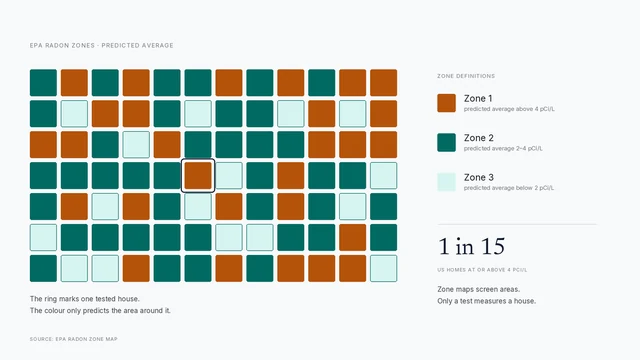
EPA’s zone map gives each county one predicted average, assembled from indoor radon measurements, geological information and aerial radioactivity surveys. Zone 1 is above 4 pCi/L, Zone 2 is 2–4, and Zone 3 is below 2; the zones section lists all three. The boundaries are built around the 4 pCi/L action level, so Zone 3 sits comfortably under the line where the agency says to fix a house.
Two words carry the weight: predicted and average. Neither is a measurement, and neither describes a single address. The zone map overview explains how the model is assembled; the short version is that a county can be mostly low and still contain houses that are not.
Low risk is not no risk
Nationally, EPA estimates about 1 in 15 homes sits at or above 4 pCi/L. That figure is a national average across all three zones, and it exists because high houses turn up in low-risk counties too. A Zone 3 label lowers the probability that any given house is one of them. It does not take the probability to zero.
The failure mode is predictable. A homeowner in a Zone 3 county reads the map, decides testing is unnecessary, finishes the basement, and never measures. Years later a home inspection or a sale turns up a number above 4 and the system gets installed under time pressure at the worst possible moment. The test costs $15–$45. The sequence costs more.
Local geology beats a county average
Radon is produced by the decay of uranium in soil and rock. Uranium is not distributed evenly: it concentrates in certain granites, shales, phosphatic deposits and glacial materials, and it can sit in a pocket under one subdivision and be absent under the next. A county average blends all of that into one number.
Three local factors decide what reaches the living space.
The soil under the footprint determines the source strength. Fill material, a drained gravel layer or a change in bedrock can move the reading by a large factor over a short distance.
The foundation determines the pathway. A bare slab with cracks, an open sump and unsealed penetrations gives soil gas several routes in. A sealed slab with a tight sump lid gives it almost none.
The house determines the dilution. A leaky, drafty house exchanges air with outdoors and dilutes soil gas. A tight, recently weatherized house holds it. That is why a reading can climb after efficiency work without anything changing underground.
Why low-risk counties hide high houses
Testing rates follow the map. Where the predicted average is low, fewer people buy kits, fewer real estate transactions include a radon test, and fewer high houses are ever recorded. The absence of evidence gets read as evidence of absence, and the next homeowner inherits the assumption.
That is also why state programs keep publishing local data. A state health department with its own measurements can refine the county picture, and a town-level map is often more useful than the national one for a single address. The state map comparison covers how those two sources differ, and the state cost guide covers subsidised kits.
How to test in a Zone 3 county
The mechanics do not change with the zone. A short-term kit costs $15–$45 with lab analysis and runs two to four days. The house stays closed for 12 hours before and during the test. The detector goes at the lowest lived-in level, four feet off the floor, away from exterior walls, drafts and the sump. The testing section covers placement errors in detail, and the kit comparison explains what each device measures.
A certified measurement at $150–$250 is worth it in a real estate transaction or when the first result is disputed. A long-term kit at $20–$50 integrates 90 days or more and is the better instrument when you want a year-round average rather than a snapshot. A consumer continuous monitor at $100–$200 is useful for watching trends but does not replace a lab-based test for a decision.
Do not test during a renovation, with windows open, or in a room that is closed off from the rest of the house. Those conditions measure the wrong air.
What to do with each result
Below 2 pCi/L: file the report, note the date, and retest in two years. No hardware, no sealing project, no contractor visit.
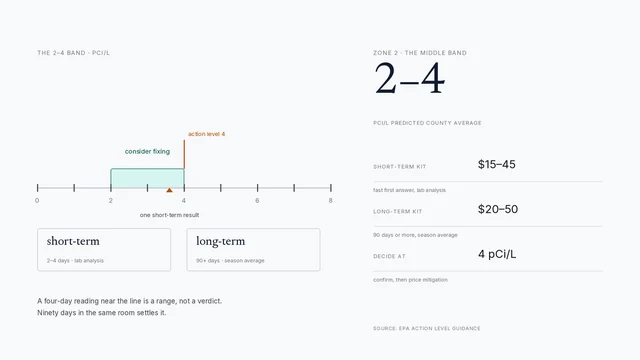
Between 2 and 4 pCi/L: EPA says consider fixing. In a Zone 3 county that usually means a long-term test first, because a single short-term reading in the ambiguous band is weak evidence. If the long-term number stays in the upper half of the band and the basement is lived in, price a system.
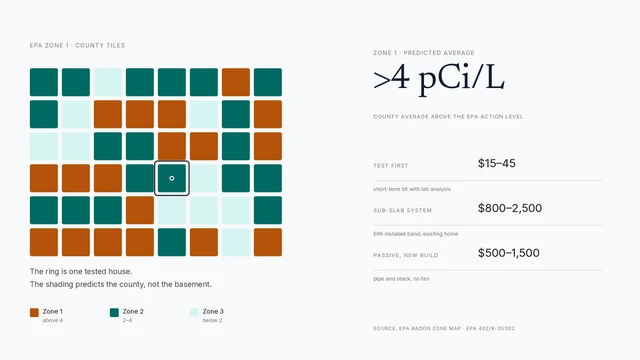
At or above 4 pCi/L: confirm with a second short-term test or a certified measurement, then mitigate. EPA’s band for a fan-based sub-slab system is $800–$2,500 installed, averaging near $1,200, and the cost guide explains the spread. A system should bring the house below 2 pCi/L.
Retest every two years
EPA’s retest guidance is every two years, and again after a major renovation or HVAC change. The interval does not shorten in a high zone or lengthen in a low one. Two years is roughly the period over which a house’s behavior can shift enough to matter: a new furnace, a finished basement, new windows, a sump pump replacement or a foundation repair can all change the pressure field under the slab.
Put the date somewhere you will see it. A note on the furnace, a calendar entry, or a line on the system label if one exists. The report itself is worth keeping with the house paperwork; the next owner will want it.
When a Zone 3 reading surprises you
A high reading in a low-risk county is not automatically an error, and it is not automatically a system either. Check three things before you spend.
First, the test conditions. Was the house closed for 12 hours? Was the detector at the lowest lived-in level and away from the sump? Was it a stormy week with the windows shut and the furnace running?
Second, the pathway. An open sump, a cracked slab, an unsealed crawl space or a basement floor drain can be closed for far less than a full system, and closing them sometimes drops the number enough to change the decision.
Third, the repeat. A second test in a different season separates a real pattern from a bad week. If both tests are high, the county average was simply not about your house — which is the whole point of testing.
The zone is a starting prior. The test is the evidence. In a county predicted below 2 pCi/L, the honest position is that most houses will test low and yours still has to be checked, because the cost of being wrong is a system installed in a hurry and a basement nobody wants to use.
How to do it
- Test even when the map says lowPlace a short-term kit at the lowest lived-in level with the house closed for 12 hours before and during the test. The county average cannot see your slab, your sump or your soil.
- Read the result against 2 and 4Below 2 pCi/L, keep the report and set a two-year reminder. Between 2 and 4, run a long-term kit. At or above 4, confirm with a second test before pricing a system.
- Check the local detailLook at your state radon program's map, which often resolves to town or county level, and ask whether the area has a known local source. Treat that as context, not as a substitute for the test.
- Fix the pathways if the number is highSeal the sump with an airtight lid, close slab cracks and seal penetrations before or alongside mitigation. EPA's band for a fan-based sub-slab system is $800–$2,500 installed.
- Diarize the retestRetest every two years, and again after a major renovation or HVAC change. Write the date, result and any work done in the folder with the original report.
Frequently asked questions
What does radon Zone 3 mean?
It means EPA predicts the average indoor radon level across your county is below 2 pCi/L, the lowest of its three zone categories. That is below the 4 pCi/L action level and below the 2–4 band where the agency says to consider fixing. It is a county prediction, not a measurement of your house.
Do I still need to test my house in Zone 3?
Yes. EPA recommends testing every home in every zone. Zone 3 lowers the odds of finding a problem; it does not remove it. Local soil, foundation type and the house's air exchange matter more at one address than a county average does, and a Zone 3 house can read above 4 pCi/L.
Can a Zone 3 house really have high radon?
It can. Radon comes from uranium in the soil and rock directly under the house, and that geology changes over short distances. A house sitting on a local radon source, with a bare slab and an open sump, can read well above 4 pCi/L in a county whose predicted average is under 2.
How often should I retest in a low-risk county?
Every two years, and after any major renovation or HVAC change. EPA's retest guidance does not relax for Zone 3. A house that read 1.4 pCi/L two years ago can read differently after weatherization, a basement finish or a new furnace changes how the house breathes.
Why do local radon levels differ from the county map?
Because the map is a model at county scale. It uses indoor measurements, geology and aerial radioactivity surveys averaged over a large area. Uranium content in soil, the depth of the foundation, the number of slab openings and the house's air exchange all vary at the scale of a street, and all of them move the indoor number.
What is the cheapest way to test in Zone 3?
A short-term kit at $15–$45 including lab analysis is the cheapest credible option, and several state radon programs sell subsidised kits for less. A long-term kit at $20–$50 is better value when you want a year-round average. Consumer continuous monitors at $100–$200 are useful for tracking but are not a substitute for a lab-based result.
Sources
Some links are affiliate links.If you buy through them we may earn a commission at no extra cost to you. We do not accept payment for rankings. Read the full disclosure.