Radon Zone 1: what to do in a high-risk county
Zone 1 counties are predicted above 4 pCi/L. Test priority, how often mitigation is really needed, the $800–$2,500 sub-slab band and passive new builds.
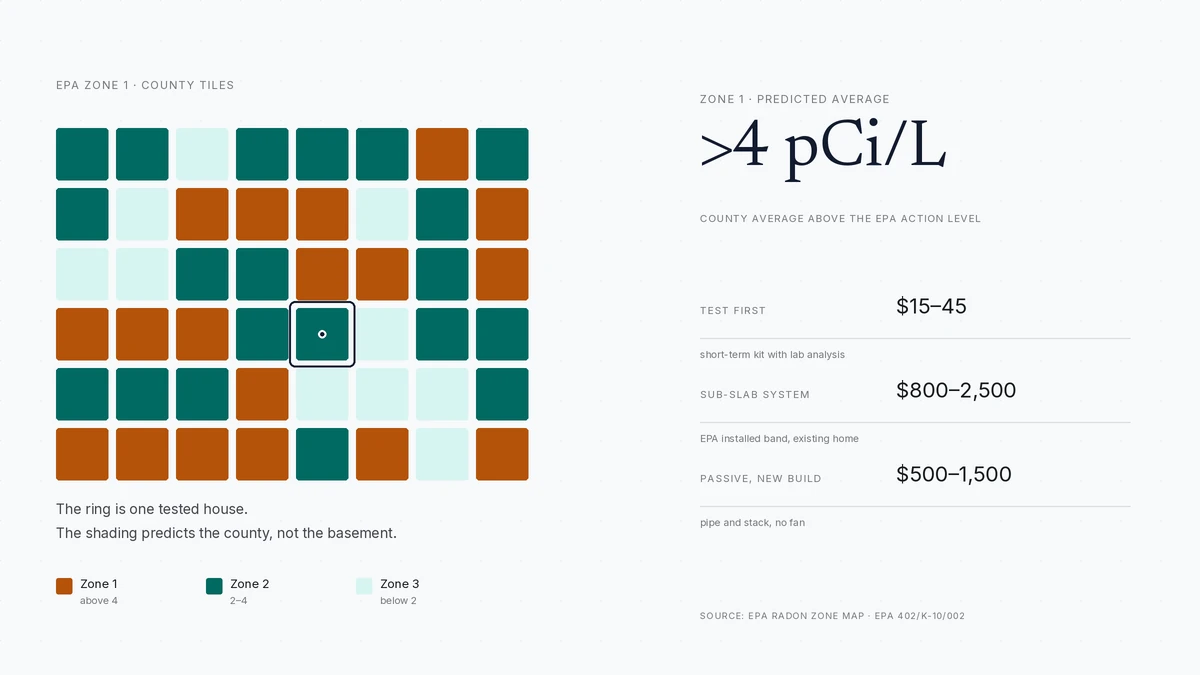
A Zone 1 county has a predicted average indoor radon above 4 pCi/L, so testing comes first and mitigation is more likely. EPA's installed band for a fan-based sub-slab system is $800–$2,500. A Zone 1 house can still test below the action level, and only a test settles it.
- Zone 1 definition
- predicted county average above 4 pCi/L
- First action
- test the lowest lived-in level
- Sub-slab system
- $800–$2,500 installed
- Passive system, new build
- $500–$1,500
Some links on this page are affiliate links.If you buy through them we may earn a commission at no extra cost to you. We do not accept payment for rankings. Read the full disclosure.
| Zone 1 county | Your house, tested | |
|---|---|---|
| What it describes | A predicted average across the whole county | One measurement in one room on one foundation |
| Where the number comes from | EPA model using indoor data, geology and aerial surveys | A lab-analyzed kit or a certified measurement |
| What it can tell you | How urgently testing is worth doing | Whether the house is at or above 4 pCi/L |
| What changes the answer | A new EPA map, years apart | Season, foundation, air sealing and any mitigation system |
| Cost to obtain | Nothing | $15–$45 for a short-term kit |
A radon Zone 1 county is a county where EPA predicts the average indoor radon level will land above 4 pCi/L, the agency’s action level for a home. The label comes from a model rather than a measurement: EPA combined indoor readings, geology and aerial radioactivity data into one predicted average per county. It raises the odds that testing finds a problem. It says nothing about the slab under your particular house.
What the Zone 1 label actually represents
The map’s unit is the county, and its number is a predicted average. EPA’s three inputs were indoor radon measurements where states had collected them, geological information about radon-bearing rock and soil, and aerial radioactivity surveys that detect uranium-series material near the surface. Where the indoor data was thin, the prediction leans harder on geology and the surveys.
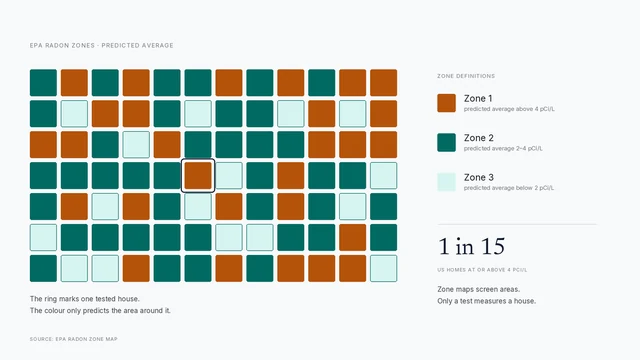
That matters when you read the label. A county is hundreds of square miles of different soils, different building styles and different foundation depths. The predicted average smooths all of it into one figure. It is a screening result, built to point testing programs and construction rules at the places where they do the most good — not a result for a single address. The zones section puts all three bands side by side.
Why Zone 1 sets the testing priority
Nationally, EPA estimates about 1 in 15 homes sits at or above 4 pCi/L. Zone 1 counties are where that share is expected to be highest.
Three situations make it urgent. Buying a house: test before the inspection contingency expires, because mitigation is a negotiated cost. Finishing a basement: test before the drywall goes up, since the slab and sump become harder to work on afterward. Living on the lowest level: a bedroom in a basement is where the exposure happens, and a first-floor reading does not describe it.
How to test a Zone 1 house
A short-term kit runs $15–$45 with lab analysis and takes two to four days, with the house closed for 12 hours before and during the test. Place the detector at the lowest lived-in level, four feet off the floor, away from drafts, exterior walls and the sump. The testing section covers placement in detail, and the kit comparison explains what each device actually measures.
A certified measurement runs $150–$250 and buys a trained tester, documented chain of custody and a result a buyer or a lender will accept. A long-term kit runs $20–$50 and integrates 90 days or more, which is the honest way to measure a house’s year-round average.
In a Zone 1 county, a short-term kit first is the rational order: $30 answers the question that decides everything else.
How often a Zone 1 house actually needs mitigation
The honest answer is that the zone cannot tell you. Here is the mechanism. The county figure is a mean of the measurements behind the model, so a county predicted at 5 or 6 pCi/L cannot reach that number without a substantial share of homes above the action level. A county predicted at 4.1 pCi/L can be mostly below it. Both are Zone 1.
Foundation type splits the result further. A basement with a bare slab and an open sump gives soil gas an easy path into the house. A sealed slab with a passive stack and a reasonably tight house may read far lower. Two houses on the same street can differ by a factor of five for reasons that have nothing to do with the county line.
What the zone changes is the prior. A test at 6 pCi/L is no surprise and a mitigation quote is the expected next step. A test at 1.2 pCi/L means this house is not the one the average describes.
What mitigation costs when the test says fix
EPA’s Consumer’s Guide to Radon Reduction publishes $800–$2,500 installed for a fan-based sub-slab system in an existing home, with a national average near $1,200. That is the band to hold against a quote, and the full cost breakdown explains what moves a job from one end of it to the other.
Crawl spaces run higher because the dirt floor has to be covered and sealed before suction can work: $1,100–$3,000 for sub-membrane depressurization. Hollow-block foundations land at $1,000–$3,000. The zone does not change any of those numbers. What it can change is how many certified contractors work near you.
Running cost is small. A mitigation fan draws 60–90 W; an 80 W fan running continuously uses about 701 kWh a year, roughly $127 at the August 2026 US average of 18.16 cents per kWh. EPA budgets $50–$200 a year.
Passive systems in new construction
If you are building in a Zone 1 county, the cheap moment to deal with radon is before the slab is poured. A passive radon-resistant system — a gas-permeable layer under the slab, a sealed collection point, and a PVC pipe running up through the roof — costs $500–$1,500 as part of the build. There is no fan, so there is nothing to run and nothing to replace.
Passive systems work on stack effect: warm indoor air rises up the pipe and out above the roofline, pulling soil gas with it. That is weaker than a fan and depends on the house being reasonably tight. If a post-occupancy test still reads high, adding a fan to the existing pipe runs $300–$900, well under the cost of a retrofit from scratch. Massachusetts requires passive radon-resistant construction in designated counties, and Zone 1 is usually the reason a builder offers it elsewhere.
The foundation guide covers how the detail changes for a basement, a slab and a crawl space, and the systems section explains the hardware.
Why a Zone 1 house can still test low
Radon is produced by uranium decaying in soil and rock, and it moves by pressure, not by county. Four things decide what reaches your living space.
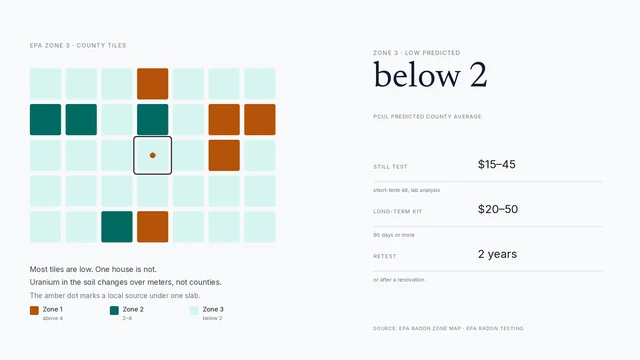
The first is the soil directly under the footprint. Radon concentrations change over meters, and a pocket of low-uranium fill or a drained gravel layer can starve the source.
The second is the foundation and its openings. A sealed slab, a tight sump lid and no unsealed penetrations give gas nowhere to go. A cracked slab, an open sump and a hollow block wall give it several paths.
The third is air exchange. A drafty house dilutes soil gas with outdoor air; a new tight house holds it. That is why weatherization can raise a reading without anything changing in the ground.
The fourth is season. The stack effect is strongest in cold weather, when the indoor-outdoor temperature difference pulls soil gas up through the house. A summer test in a Zone 1 county can read lower than the same house in January.
The map cannot see any of that. EPA’s guidance is unchanged across all three zones: every home should be tested.
A sequence that works
- Test the lowest lived-in level with a short-term kit. Record the dates and confirm the house stayed closed.
- At or above 4 pCi/L, confirm with a second test or a certified measurement before you sign anything.
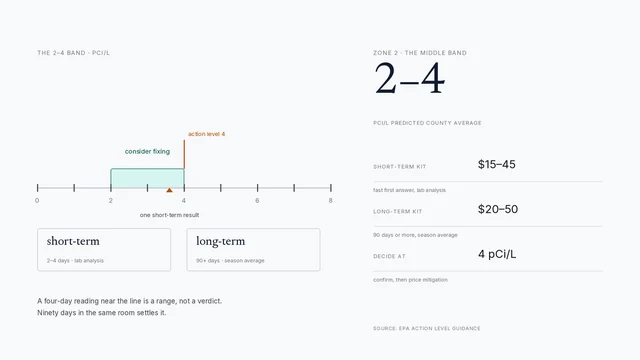
- Between 2 and 4 pCi/L, run a long-term kit for 90 days or more, ideally through winter.
- If you mitigate, get three itemized bids and put the target level and the post-install test in the contract.
- Retest after at least 24 hours of operation, then every two years or after a major renovation or HVAC change.
The zone is a reason to start, not a verdict. Read your county’s designation on the zone map overview, spend $30 on a kit, and let the number from your own basement set the budget. Everything after that is arithmetic you can check.
How to do it
- Test the lowest lived-in levelPlace a short-term detector in the basement or first floor, four feet off the floor, away from exterior walls, drafts and the sump. Keep the house closed for 12 hours before and during the two-to-four-day test.
- Confirm before you sign a mitigation contractAt or above 4 pCi/L, run a second short-term test or a certified measurement at $150–$250. Two tests or a documented professional result remove the argument about whether the first number was a fluke.
- Price the work from the foundation, not the zoneA basement slab sits at the low end of the $800–$2,500 band. A crawl space needs a sealed membrane and lands at $1,100–$3,000. Get three itemized bids that name the fan model and the suction-point count.
- Check certification and the written targetAsk for NRPP certification or a state license where one exists, plus a contract that states the expected post-install level, usually below 2 pCi/L, and the remedy if the test misses it.
- Retest and diarize the next oneRun a short-term test after the system has operated for at least 24 hours, then retest every two years or after a major renovation or HVAC change. Write the date and result on the system label.
Frequently asked questions
What does it mean to live in a radon Zone 1 county?
It means EPA predicts the average indoor radon level across your county is above 4 pCi/L, the agency's action level. The prediction is built from indoor measurements, geology and aerial radioactivity surveys. It raises the odds that testing finds a problem in a given house, but it does not measure your house.
Do I need to test if my house is in Zone 1?
Yes. EPA recommends testing every home regardless of zone, and a Zone 1 address is the strongest reason to do it now rather than later. A short-term kit costs $15–$45 with lab analysis and takes two to four days under closed-house conditions. Test the lowest lived-in level, not the first floor.
How likely is a Zone 1 house to need mitigation?
More likely than a house in another zone, but the county label cannot give you a number for one address. A county predicted at 5 or 6 pCi/L cannot reach that average without a substantial share of homes above 4. One predicted at 4.1 can be mostly below. Foundation type and local soil split the result further.
What does a radon system cost in a Zone 1 county?
The zone does not set the price. EPA's band for a fan-based sub-slab system in an existing home is $800–$2,500 installed, averaging near $1,200. Crawl-space sub-membrane systems run $1,100–$3,000 and block-wall systems $1,000–$3,000. The fan adds roughly $127 a year at the August 2026 US average electricity price.
Why did my Zone 1 house test below 2 pCi/L?
Because radon moves through soil and pressure, not through county lines. A sealed slab, a tight sump lid, a drained gravel layer, a leaky house that dilutes soil gas, or simply low-uranium soil under the footprint can all produce a low reading in a high-risk county. Keep the report, retest every two years and retest after major renovations.
Should I pay for a passive system when building in Zone 1?
It is the cheapest moment to act. A passive radon-resistant system costs $500–$1,500 as part of new construction: a soil-gas collection layer under the slab and a pipe to the roof, with no fan. If a post-occupancy test still reads high, adding a fan to that pipe costs $300–$900 instead of a full retrofit.
Sources
Some links are affiliate links.If you buy through them we may earn a commission at no extra cost to you. We do not accept payment for rankings. Read the full disclosure.