Radon Zone 2 explained: the 2–4 pCi/L middle band
Zone 2 counties are predicted at 2–4 pCi/L, where the advice gets soft. Long-term testing, when to fix, and reading a short-term result near the line.
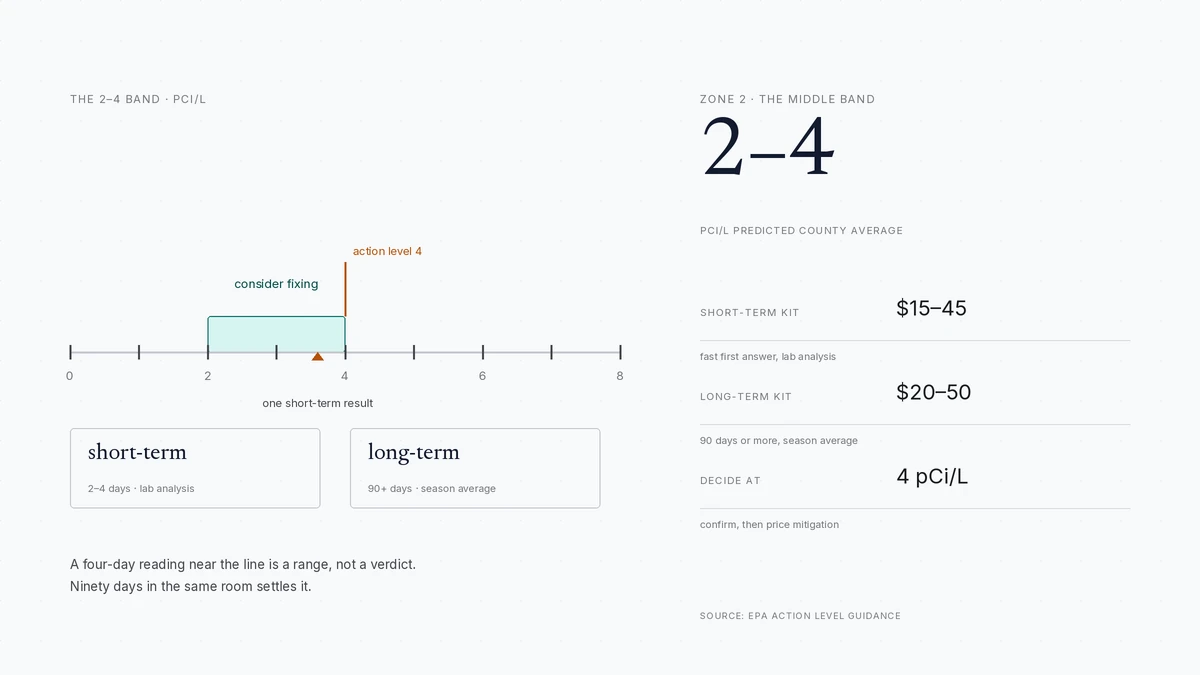
A Zone 2 county has a predicted average of 2–4 pCi/L, the ambiguous middle where a house can land either side of the action level. Test the lowest lived-in level, follow a borderline reading with a 90-day kit, and treat 4 pCi/L as the point where mitigation becomes the default.
- Zone 2 definition
- predicted county average 2–4 pCi/L
- Action level
- 4 pCi/L
- EPA position on 2–4
- consider fixing
- Long-term kit
- $20–$50, 90+ days
Some links on this page are affiliate links.If you buy through them we may earn a commission at no extra cost to you. We do not accept payment for rankings. Read the full disclosure.
| Short-term kit | Long-term kit | |
|---|---|---|
| Exposure window | 2–4 days under closed-house conditions | 90 days or more, across seasons |
| Cost | $15–$45 with lab analysis | $20–$50 with lab analysis |
| Best use | A fast first answer and post-mitigation checks | Deciding what to do with a 2–4 pCi/L result |
| What it misses | Seasonal swing, storms, windows left open | Nothing much, but the answer arrives next season |
| Read it when | The house has been closed for 12 hours | The kit has sat in place for the full 90 days |
A radon Zone 2 county is a county where EPA predicts the average indoor radon level will fall between 2 and 4 pCi/L. That is the middle of the three zones and the least useful one to act on directly: it sits above the level where EPA says to consider fixing and below the 4 pCi/L action level, so the label describes a house that might need nothing and might need a system. The number from your own test is what breaks the tie.
What Zone 2 actually predicts
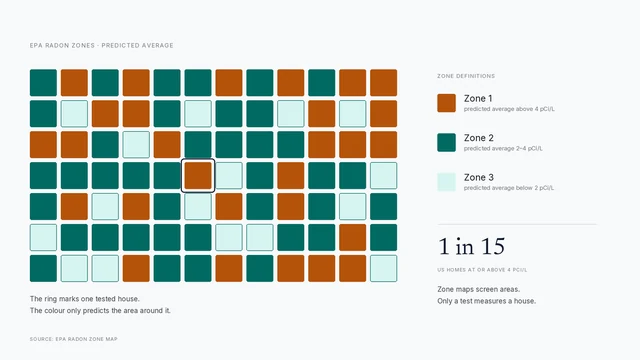
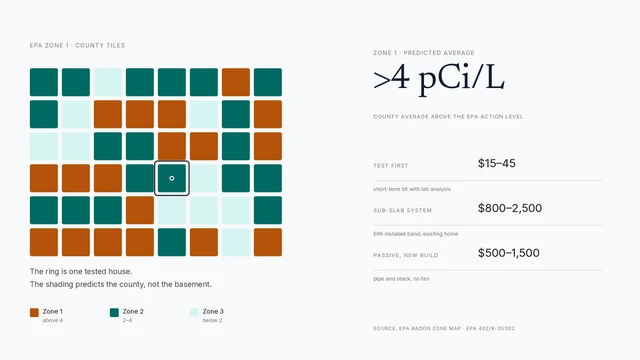
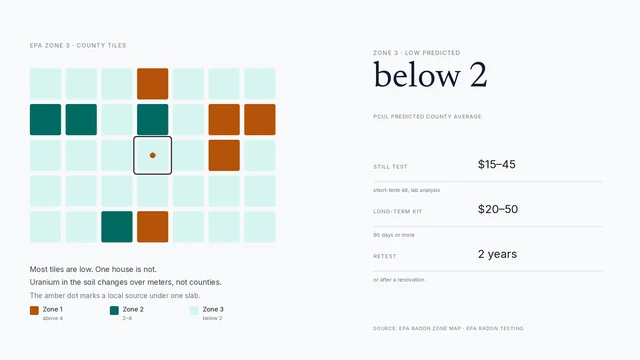
The zone map assigns every county one predicted average, built from indoor measurements, geology and aerial radioactivity surveys. Zone 1 is above 4 pCi/L, Zone 2 is 2–4, Zone 3 is below 2; the zones section sets out all three. The thresholds follow the action level, which is why Zone 2 starts at the point where EPA first suggests considering a fix.
The prediction is a county mean. A county that sits at 3 pCi/L in the model contains houses at 1 and houses at 9, and the mean says nothing about which is which. Reading the label as a forecast for one address is the mistake the zone map overview spends most of its length correcting.
Why the middle band is the hardest to act on
At 6 pCi/L the decision is easy: confirm, then mitigate. At 1 pCi/L it is also easy: keep the report and retest later. Between 2 and 4 the answer depends on details the county average cannot see — whether the basement is finished, whether anyone sleeps there, whether the reading came from January or July, and whether the first test was even placed correctly.
EPA’s language reflects that. The agency says to consider fixing in the 2–4 band, and to fix at 4 or above. “Consider” is doing real work: it is a risk judgment about a specific house, not a threshold that trips automatically. The action level explainer covers how the guidance is written.
Test the house before you reason about the zone
Start with a short-term kit at $15–$45 including lab analysis: two to four days, house closed for 12 hours before and during, detector at the lowest lived-in level and four feet off the floor. The testing section covers placement, and the kit comparison explains what each device measures and what it does not.
That first result sorts the house into one of three buckets. Below 2 pCi/L, you have a report and a two-year calendar entry. At or above 4, you have a reason to confirm and price a system. Between 2 and 4, you have a reason to test again with a longer instrument.
The order matters. A homeowner who starts with a mitigation quote in a Zone 2 county is usually buying a system before knowing whether the house needs one, and a $1,200 install is an expensive way to answer a question a $35 kit already answered.
Reading a single result near the line
A short-term reading of 3.6 or 3.9 pCi/L is not a verdict. Three things move a four-day number.
Season is the largest. The stack effect is strongest when indoor and outdoor temperatures diverge, so a January test in a cold climate tends to read higher than a July test in the same room. A house that reads 3.8 in summer may read above 4 in winter and below 3 in spring.
Placement is the second. A detector next to a draft, in a closet, or on the second floor measures something other than the basement air. Basement readings are the ones that matter when the basement is lived in.
Device uncertainty is the third. Every measurement carries an analytical and sampling error, and EPA’s own guidance on measurement reliability treats a result near a threshold as a range rather than a point. A single 3.9 is compatible with a true annual average on either side of 4.
The practical response to all three is the same: run a long-term kit before deciding.
The long-term test that settles it
A long-term kit costs $20–$50 with analysis and stays in place for 90 days or more. It integrates the seasonal swings into one number, which is exactly what you need when the question is whether the house’s year-round average crosses 4 pCi/L. Place it in the same room as the first test, keep the house in normal use, and leave it alone.
A 90-day kit started in late autumn is the strongest version of this test, because it includes the coldest months when radon indoors peaks. If the long-term result comes back at 5 pCi/L, the case for mitigation is settled. If it comes back at 2.2, you have a defensible reason to wait, retest in two years, and spend nothing.
When “consider fixing” becomes fixing
Four conditions push a Zone 2 house from watching to acting.
The confirmed number sits in the upper half of the band, roughly 3 pCi/L and up, on a long-term or repeated short-term test. The basement or lowest level is used daily, so exposure is not theoretical. The house has an obvious pathway — a bare slab, an open sump, a crawl space without a membrane — that a system would close. Someone in the house is at higher risk from long-term radon exposure, which is a conversation for a physician rather than a contractor.
When those line up, price the work from the foundation. EPA’s band for a fan-based sub-slab system is $800–$2,500 installed, averaging near $1,200, and the cost guide explains what moves a job within it. A crawl space runs $1,100–$3,000 because the dirt floor needs a sealed membrane first. The systems section covers the hardware.
Running cost is minor next to the install: a fan draws 60–90 W, and an 80 W unit uses about 701 kWh a year, roughly $127 at the August 2026 US average of 18.16 cents per kWh.
Zone 2 in a sale or a new build
No US state requires a radon test at sale. Illinois, Minnesota, New Jersey, Pennsylvania and Iowa require disclosure or a pamphlet, which means a Zone 2 address may come with paperwork and no measurement. In a purchase, treat a missing test as a reason to order one during the inspection period rather than a reason to assume the house is fine.
For new construction, Zone 2 is the awkward case for passive radon-resistant construction. The system costs $500–$1,500 built in, and the case for it is weaker than in Zone 1. If the builder offers it and the budget allows, it is cheap insurance and can be activated later with a fan for $300–$900. If not, test after occupancy and mitigate if the number calls for it.
A decision sequence for a Zone 2 house
- Short-term test at the lowest lived-in level. Record the dates and confirm closed-house conditions.
- Below 2 pCi/L: file the result, retest in two years.
- At or above 4 pCi/L: confirm with a second test or a certified measurement at $150–$250.
- Between 2 and 4 pCi/L: run a long-term kit for 90 days through winter.
- Act on the long-term number, then verify any system with a post-install test and retest every two years.
The zone tells you the question is live. It cannot tell you the answer, and in the middle band the honest tool is time — 90 days of it, in the room where you actually breathe the air.
How to do it
- Test the lowest lived-in levelUse a short-term kit in the basement or first floor, four feet up, away from the sump, exterior walls and drafts. Keep the house closed for 12 hours before and during the test.
- Hold the result against the bandBelow 2 pCi/L, keep the report and retest in two years. Between 2 and 4, move to a long-term kit. At or above 4, confirm with a second test or a certified measurement.
- Run the long-term kit through winterA 90-day kit placed in late autumn captures the stack effect at its strongest. That is the season most likely to show whether the house genuinely sits above the action level.
- Decide with the confirmed numberA confirmed result in the upper half of the band in a lived-in basement usually justifies a system. A confirmed result near 2 pCi/L justifies another two years of watching.
- Verify anything you installAfter mitigation, test once the system has run at least 24 hours, then retest every two years or after a major renovation or HVAC change.
Frequently asked questions
What does radon Zone 2 mean?
It means EPA predicts the average indoor radon level across your county sits between 2 and 4 pCi/L. That is above the level at which EPA says to consider fixing and below the 4 pCi/L action level. The prediction describes the county, not your house, and a Zone 2 house can test at 1 or at 8.
My short-term test read 3.8 pCi/L. What should I do next?
Do not sign a mitigation contract on one four-day snapshot. Run a long-term kit for at least 90 days through a heating season, or a second short-term test in winter. A result that close to 4 pCi/L is inside the range where season, placement and device uncertainty can move the number either way.
Is a long-term test better than a short-term test?
For a borderline result, yes. A long-term kit costs $20–$50 and integrates 90 days or more, which averages out weather and seasonal stack effect. Short-term kits at $15–$45 are the right tool for a fast answer and for post-mitigation checks; long-term kits are the right tool for deciding whether a 3 pCi/L house needs work.
Does Zone 2 mean I need a mitigation system?
No. EPA says consider fixing between 2 and 4 pCi/L and fix at 4 or above. In practice that means a confirmed result in the upper half of the band, especially in a basement that is used every day, usually justifies a system. A result near 2 pCi/L usually justifies a retest and no hardware.
Can a Zone 2 house test above 4 pCi/L?
Yes, and it happens often enough that the zone should never be read as a ceiling. Zone 2 is a county average, and local soil, a bare slab, an open sump or a tight house can push one address well above it. Conversely, a Zone 2 house with a sealed foundation can sit below 2.
What does mitigation cost if I decide to fix a Zone 2 house?
The same as anywhere else, because the zone does not set the price. EPA's band for a fan-based sub-slab system is $800–$2,500 installed, averaging near $1,200. A crawl space runs $1,100–$3,000. The fan adds about $127 a year at the August 2026 US average electricity price.
Sources
Some links are affiliate links.If you buy through them we may earn a commission at no extra cost to you. We do not accept payment for rankings. Read the full disclosure.