What your radon test result means
4 pCi/L is the action level, 2–4 is the consider-fixing band, below 2 is low. What a 4.1 really says, why repeat tests disagree, and what a system should reach.
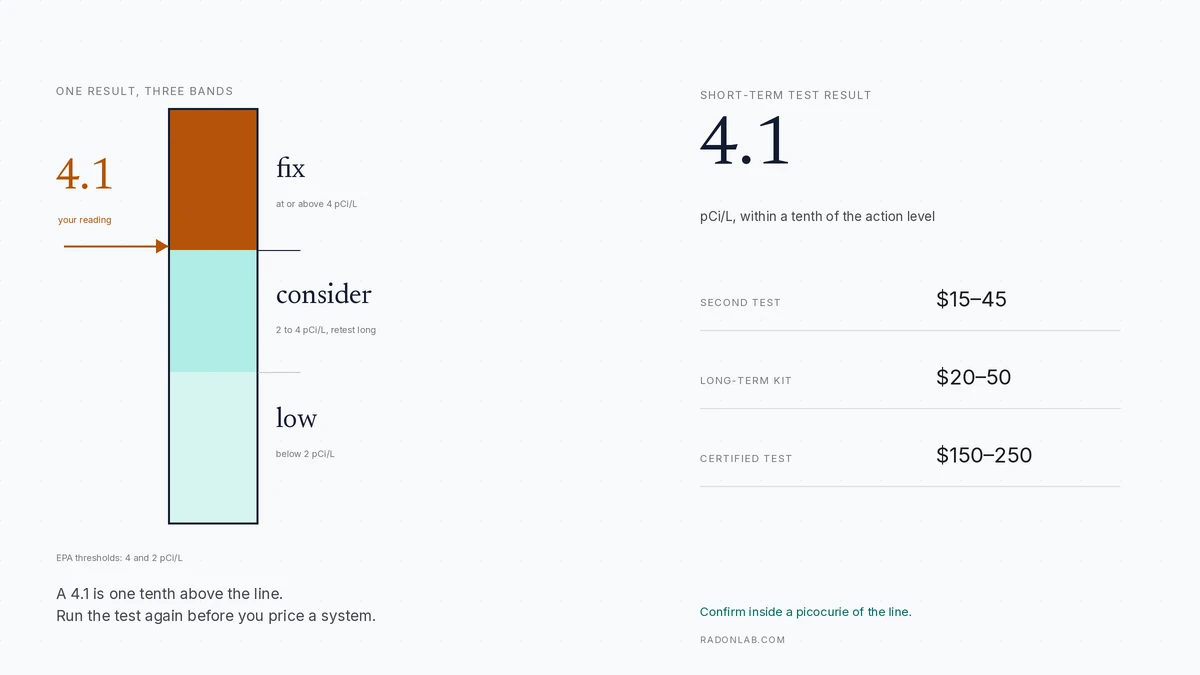
EPA's action level is 4 pCi/L: at or above it, fix. Between 2 and 4, consider fixing and confirm with a long-term test. Below 2, keep the report and retest every few years. A first result of 4.1 is close enough to the line that a second test is the right next step.
- Fix at or above
- 4 pCi/L
- Consider fixing
- 2–4 pCi/L
- Low reading
- below 2 pCi/L
- Post-system target
- below 2 pCi/L
Some links on this page are affiliate links.If you buy through them we may earn a commission at no extra cost to you. We do not accept payment for rankings. Read the full disclosure.
| At or above 4 pCi/L | Below 4 pCi/L | |
|---|---|---|
| EPA guidance | Fix the house | 2–4: consider fixing. Below 2: low |
| What to do next | Confirm, then get mitigation bids | Long-term test if 2–4; retest in two years if below 2 |
| Typical spend | $800–$2,500 installed, near $1,200 | $20–$50 for a long-term kit, if you test at all |
| Time to act | Weeks, not years | No deadline; watch for renovation or HVAC changes |
| What changes the answer | A second test that comes back under 4 | A season of data, or a change to the house |
A radon test result is a concentration of radon gas in indoor air, reported in picocuries per liter, averaged over the days the device was exposed. The number is compared against two EPA thresholds: 4 pCi/L, where the agency says to fix the house, and 2 pCi/L, below which the reading is considered low. Everything between is a judgment call about risk and money.
What a picocurie per liter measures
One picocurie is one radioactive disintegration per minute. A reading of 4 pCi/L means roughly four decays per minute in every liter of air in the room, produced by radon that seeped out of the soil and accumulated because the house is tighter than the ground beneath it.
The device does not measure risk. It measures concentration at one point over one window of time. The risk estimate behind the 4 pCi/L line comes from epidemiological studies of miners and homeowners, extrapolated to a lifetime of exposure. That is why the threshold is a policy number rather than a physical one.
EPA’s own framing is that the action level is a risk-management line, not a boundary between safe and unsafe. Outdoor air averages far below 1 pCi/L, indoor air in the average US home sits near 1.3 pCi/L, and about 1 in 15 homes reaches the action level. A house at 4.5 is not in a different category of building from a house at 3.5. It is a house whose soil, slab and pressure balance happen to deliver more gas into the living space.
The three bands, and what each asks of you
| Result | EPA guidance | Usual next step |
|---|---|---|
| 4 pCi/L or above | Fix the house | Confirm, then get mitigation bids |
| 2.0–3.9 pCi/L | Consider fixing | Long-term test, then decide |
| Below 2 pCi/L | Low | Retest in two years |
The bands are blunt on purpose. A house at 4.2 and a house at 4.0 get the same recommendation, even though the difference is smaller than the uncertainty on either measurement. Holding the line at a round number keeps the guidance usable; it does not make 4.0 a cliff.
Reading 4.1: the case for a second test
A result of 4.1 pCi/L clears the action level by a tenth of a picocurie. Short-term devices carry enough variability that a repeat test in the same room, under the same conditions, can land at 3.6 or at 5.2 without anything in the house changing.
The practical consequence is that 4.1 is the single most common number where homeowners overpay or underreact. A $30 second test, run with the same placement and the same closed-house discipline, resolves it. If both results sit at or above 4, the case for a system is solid. If the second lands at 3.4, you have bought yourself a long-term test instead of a $1,200 install.
A result of 12 does not need that treatment. Far above the line, a single properly run test is enough to act on.
Reading 2 to 4: the long-term band
Between 2 and 4 pCi/L, EPA says consider fixing. The word “consider” is doing real work. This is the band where a 90-day test earns its $20–$50, because the short-term number is a snapshot of one weather pattern and the decision is about a year of exposure.
A long-term kit averages the heating season and the open-window season together. If it returns above 4, the case for mitigation is clear. If it returns at 2.6, you have a number to watch and a reason to retest after the next big renovation.
There is a second option in this band: fix it anyway. Mitigation runs $800–$2,500, and a homeowner who intends to stay for twenty years may decide that a confirmed 3.4 is worth a system regardless of what a 90-day average would say. That is a legitimate reading of “consider.” What is not legitimate is treating 3.4 as a clean result and forgetting it.
Reading below 2: low, not zero
Below 2 pCi/L, EPA does not recommend mitigation. That is not the same as a clean bill of health. The agency’s stated goal is to get indoor radon as low as reasonably achievable, and outdoor air averages well under 1 pCi/L, so a house reading 1.8 is not at zero.
The useful action at this level is a calendar entry. Retest every two years, and again after a major renovation, a furnace or HRV change, or any work that alters how the house breathes. A basement finished into a bedroom is exactly the change that turns a 1.6 into a 3.
Why two tests disagree
Radon concentration is a function of soil gas supply and the pressure difference between the soil and the house. Both move. A cold snap increases the stack effect and pulls harder on the slab. A windy week does the same. Rain saturates the soil and can suppress or spike the reading depending on the site. Summer opens the windows, which dilutes everything.
Placement adds its own variance: a device near an exterior wall reads lower than one in the middle of the room, a device above a floor vent reads higher, and a device on a shelf in a closet reads almost nothing. The placement rules exist to remove that noise.
A lab’s counting uncertainty is the smallest of the three sources. Two results that differ by a few tenths are usually the same measurement reported twice; two results that differ by a factor of two are telling you about the season.
Barometric pressure does the same thing on a shorter cycle. A falling barometer ahead of a storm lowers the pressure over the soil relative to the house, which pulls more gas in. That is why a three-day test during a storm front can read higher than the same house a week later. Wind accelerates the effect by lowering pressure on the downwind side of the building.
What a mitigation system should reach
A working sub-slab depressurization system typically brings a house below 2 pCi/L, and that is the target a credible installer will write into the contract. EPA frames the goal as as-low-as-reasonably-achievable rather than a fixed pass mark, because the achievable floor depends on the soil, the slab and the number of suction points.
Verify it with a short-term test after the system has run for at least 24 hours, under the same closed-house conditions as the original test. The post-install sequence matters more than the invoice: a system that is not tested is an assumption.
What to do with the number tonight
Put the report somewhere you will find it. If the reading is at or above 4, book a confirmation test this week and start reading about systems in parallel, so the two tracks finish together. If it is between 2 and 4, order a long-term kit and let it run through the heating season. If it is below 2, set a reminder for two years out.
The one thing not to do is treat a single short-term number as a verdict, in either direction. The testing section covers how each device produces its result, and the difference between a screening number and a decision number is the whole reason the site separates them.
How to do it
- Find the number on the reportThe laboratory reports picocuries per liter, usually with an uncertainty range and the exposure dates. Read the number and the dates together; a result with no dates cannot be checked.
- Place it in a bandAt or above 4 pCi/L is the action band. Between 2 and 4 is the consider-fixing band. Below 2 is low. The bands are EPA's, not a lab's, and the lab will not tell you which one you are in.
- Check the test conditions before you actA reading only counts if the house was closed for 12 hours before and throughout, the device sat in the lowest lived-in level at least 20 inches up, and the exposure window was the full two to four days.
- Repeat anything within a picocurie of the lineA 4.1 or a 3.9 sits inside the noise of a short-term test. Run a second test before you spend money, and use the same placement so the comparison is fair.
- Choose the next test by the decisionBuying or selling wants a certified measurement. Deciding whether to mitigate wants a long-term kit or a second short-term test. Checking a working system wants a short-term test after 24 hours of operation.
- File the reportKeep the lab report or signed measurement with the house paperwork. It is the baseline for the next retest and the first document a buyer, lender or contractor will ask for.
Frequently asked questions
What radon level is dangerous?
EPA sets the action level at 4 pCi/L and says to fix at or above it. EPA also says to consider fixing between 2 and 4 pCi/L, because there is no known safe level of radon exposure and risk falls with the concentration. Below 2 pCi/L is low, not zero.
My result is 4.1 pCi/L. Do I need a mitigation system?
Not on one test. A 4.1 sits a tenth of a picocurie above the action level, well inside the variability of a short-term device. Run a second short-term test, or a certified measurement, before you commit $800–$2,500. If the second result also lands at or above 4, mitigate.
Why did my radon test come back different the second time?
Radon concentration swings with weather, season, soil moisture, HVAC operation and how tight the house is. A February test and a July test in the same room can differ by a factor of two. Placement and closed-house compliance add more variation. Two different numbers from one house are normal.
Is a radon level of 2 pCi/L safe?
EPA calls below 2 pCi/L low and does not recommend mitigation there, but it does not call it safe either. The agency's position is that any exposure carries some risk and that levels should be as low as reasonably achievable. Retest every couple of years or after a renovation.
What should radon be after a mitigation system is installed?
Below 2 pCi/L is the usual target, and a working sub-slab system routinely reaches it. EPA frames the goal as as-low-as-reasonably-achievable. If a post-install test stays at or above 4 pCi/L, the system needs diagnosis rather than replacement.
Does a high radon result mean my house is defective?
No. Radon comes from the soil and rock under and around the foundation, and it varies house to house on the same street. A high reading describes the pressure relationship between your soil and your house, not the condition of the building. It is fixable with a pipe, a fan and a sealed suction point.
Sources
Some links are affiliate links.If you buy through them we may earn a commission at no extra cost to you. We do not accept payment for rankings. Read the full disclosure.