Does Home Insurance Cover Radon Mitigation?
Standard homeowners insurance usually does not pay for radon mitigation. Learn what policies typically cover, typical costs, and when testing makes sense.
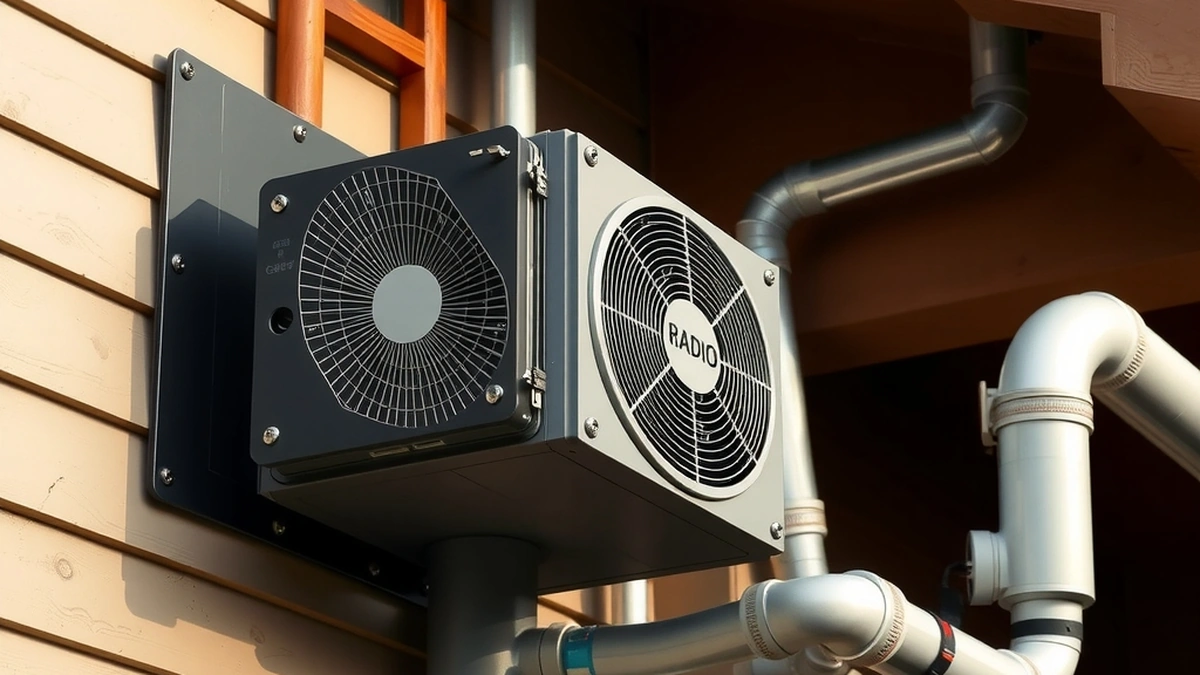
No. Standard homeowners insurance policies generally do not cover radon testing or mitigation because radon is considered an environmental condition, not sudden accidental damage.
- Typical insurance coverage for radon mitigation
- Not covered by standard policies
- EPA action level
- 4 pCi/L
- Consider fixing range
- 2–4 pCi/L
- Average active soil depressurization cost
- $1,200
- Common installed cost range
- $800–$2,500
Some links on this page are affiliate links.If you buy through them we may earn a commission at no extra cost to you. We do not accept payment for rankings. Read the full disclosure.
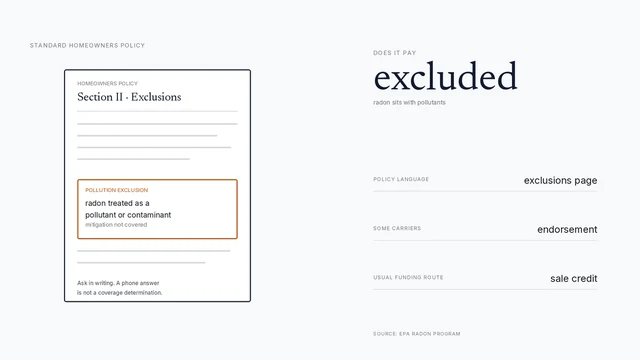
Standard homeowners insurance generally does not cover radon testing or radon mitigation. Insurance policies are designed to cover sudden, accidental damage from events like fire, wind, or burst pipes. Radon is classified as an environmental condition that builds up over time, so it falls outside most covered perils. Homeowners should expect to pay for testing and mitigation out of pocket.
Radon is a naturally occurring radioactive gas that enters homes from soil and rock beneath the foundation. The EPA action level is 4 pCi/L. The agency recommends fixing your home if results are at or above that level, and considering fixes for results between 2 and 4 pCi/L. The World Health Organization reference level is 2.7 pCi/L. Average indoor radon is about 1.3 pCi/L, compared with 0.4 pCi/L outdoors. Roughly one in 15 U.S. homes is estimated to have elevated radon, and millions of homes may need mitigation.
EPA radon zones help describe risk, but testing is the only way to know your home’s level. Zone 1 areas have predicted averages above 4 pCi/L and represent the highest potential risk. Zone 2 areas have predicted averages of 2 to 4 pCi/L. Zone 3 areas have predicted averages below 2 pCi/L. Even in Zone 3, individual homes can test above the action level, which is why testing matters regardless of location.
Why Insurance Typically Excludes Radon
Homeowners policies cover sudden and accidental losses. Radon infiltration is gradual and continuous, not a single event. Because there is no sudden damage to the structure or contents, insurers classify mitigation as home maintenance rather than a covered claim. This is similar to how insurers treat lead paint, asbestos, mold prevention, and general indoor air quality upgrades.
There are rare exceptions. If a covered peril such as a sudden foundation collapse caused by a named storm created new pathways for radon entry, a claim might be reviewed on a case-by-case basis. However, simply discovering radon during a routine test or real estate transaction does not trigger coverage. Homeowners should read their policy exclusions and speak with their agent, but they should not assume mitigation costs will be reimbursed.
Typical Radon Mitigation Costs
Since insurance usually will not pay, homeowners should budget for mitigation directly. Costs vary by foundation type, system design, and local labor rates.
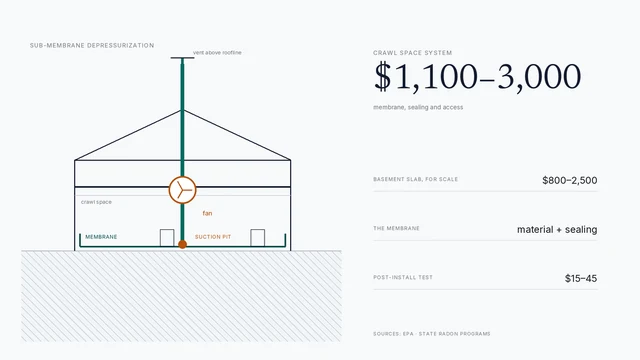
Active soil depressurization (ASD) is the most common method. It uses a fan and piping to draw radon from beneath the slab and vent it outside. Installed ASD systems typically cost $800 to $2,500, with an average around $1,200. Sub-membrane systems for crawl spaces usually range from $1,100 to $3,000. Drain tile systems cost about $800 to $2,500. Block wall suction systems range from $1,000 to $3,000. Heat recovery ventilator approaches can cost $1,200 to $3,500 but are less common for radon alone.
Passive systems, which rely on natural pressure differences without a fan, cost about $500 to $1,500 to install. Activating a passive system by adding a fan later typically adds $300 to $900. Water treatment systems are separate from air mitigation. Aeration systems for radon in water cost roughly $3,500 to $6,500 installed, while granular activated carbon systems range from $1,000 to $3,000.
Permit costs, where required, range from $0 to $150. Some jurisdictions do not require permits for radon mitigation, while others charge a small fee. Homeowners can check local building department requirements before hiring a contractor.
Ongoing Costs After Installation
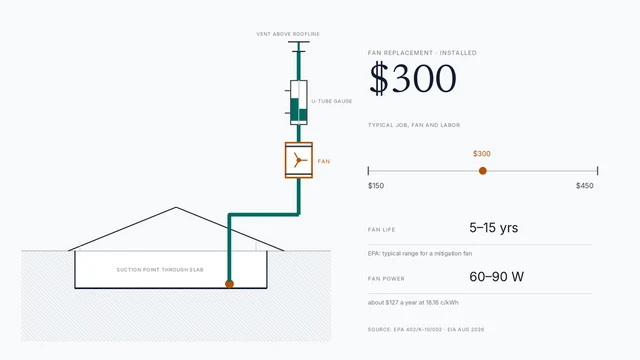
A radon mitigation system is not a one-time expense. The fan typically lasts 5 to 15 years and costs $150 to $450 to replace. A typical 80-watt fan uses about 701 kWh per year. At the EIA residential average of 18.16 cents per kWh, that works out to roughly $127 per year in electricity. Actual costs will vary based on local utility rates and fan size.
The EPA recommends retesting every two years after mitigation to confirm the system continues to lower radon below the action level. Post-mitigation results are typically below 2 pCi/L when the system is properly installed and maintained. Short-term test kits cost about $15 to $45, while long-term kits cost about $20 to $50. Professional testing typically costs $150 to $250.
Testing Comes First
Before spending money on mitigation, homeowners should test. Short-term tests take a few days and are useful for quick screening. Long-term tests run for 90 days or more and better reflect average exposure across seasons. If a short-term result is at or above 4 pCi/L, a follow-up test can confirm whether mitigation is needed. Results between 2 and 4 pCi/L warrant consideration of mitigation, especially if occupants spend significant time in lower levels.
RadonLab provides guidance on testing for radon to help homeowners choose the right test and place it correctly. Testing should be done in the lowest lived-in level of the home, with closed-house conditions during short-term tests.
Choosing a Mitigation Contractor
If test results indicate mitigation is needed, hire a mitigator certified by NRPP or state-licensed. A qualified contractor will perform a diagnostic assessment, design a system suited to the foundation, install it according to industry standards, and verify performance with post-installation testing.
RadonLab covers how to eliminate radon and how to reduce radon in your home with practical steps homeowners can take before and after hiring a professional. Sealing cracks and sump covers can support a mitigation system but rarely replaces active ventilation on its own.
Basement homes present specific considerations. Radon mitigation in basement setups often use sub-slab suction through the floor slab, which is effective for homes with poured concrete foundations. Costs and system design depend on slab integrity, soil type, and whether the basement is finished.
Foundation type strongly affects price. Radon mitigation cost by foundation type breaks down slab-on-grade, basement, crawl space, and pier-and-beam scenarios. A radon system installation cost breakdown explains equipment, labor, piping, fan, and electrical components so homeowners can review contractor estimates line by line.
Fans eventually wear out. Radon fan replacement cost covers typical replacement pricing and signs that a fan is failing, such as increased noise or a manometer reading outside the normal range.
Some municipalities require permits. Radon mitigation permit cost outlines when permits are needed and what they typically cost, helping homeowners avoid fines or issues during a future home sale.
Bottom Line
Homeowners insurance does not usually cover radon mitigation because radon is treated as an environmental maintenance issue rather than sudden accidental damage. Testing is the first step. If results are at or above the EPA action level of 4 pCi/L, or in the 2 to 4 pCi/L range where fixes are worth considering, mitigation typically costs between $800 and $2,500 for air systems, with an average around $1,200 for active soil depressurization. Ongoing costs include fan replacement every 5 to 15 years, electricity of roughly $127 per year for a typical fan, and retesting every two years. Hiring an NRPP-certified or state-licensed mitigator and verifying results after installation ensures the system performs as intended.
Frequently asked questions
Does homeowners insurance pay for radon mitigation?
No. Standard homeowners policies treat radon as a maintenance or environmental issue, not sudden accidental damage, so mitigation is typically excluded.
Will insurance cover radon testing?
Generally no. Radon testing is considered preventative home maintenance, similar to checking for mold or lead, and is not a covered peril.
Are there exceptions where insurance might help?
Rarely. If radon entry is tied to a covered event like sudden structural collapse from a named peril, a claim might be considered, but this is uncommon.
What does radon mitigation usually cost?
Active soil depressurization systems average about $1,200 installed, with common ranges from $800 to $2,500 depending on foundation and system type.
Should I test before assuming I need mitigation?
Yes. The EPA recommends fixing at 4 pCi/L and considering fixes between 2 and 4 pCi/L; testing confirms whether action is needed.
Who should install a radon mitigation system?
Use a mitigator certified by NRPP or state-licensed, and retest every two years after installation to confirm the system is working.
Sources
Some links are affiliate links.If you buy through them we may earn a commission at no extra cost to you. We do not accept payment for rankings. Read the full disclosure.