Does insurance cover radon mitigation?
Most standard homeowners policies exclude radon, and no carrier has to cover it. Where coverage sometimes exists, and who usually pays.
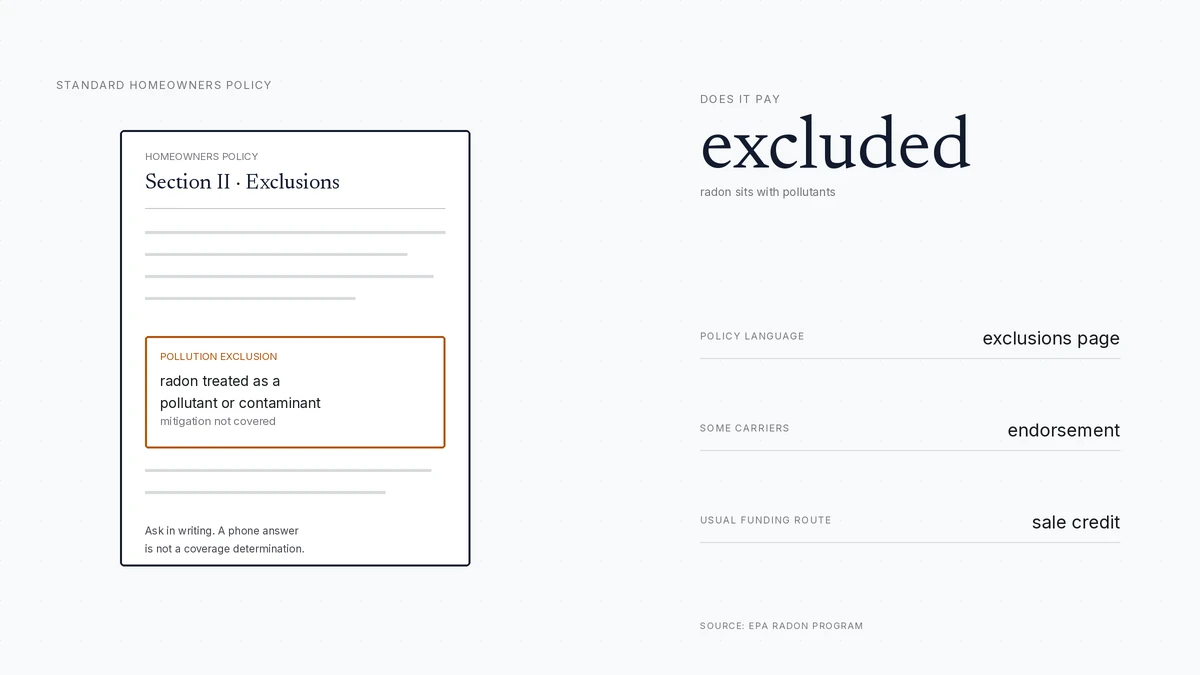
Usually not. A standard homeowners policy treats radon as a pollutant and excludes it, so a claim for mitigation generally fails. Some carriers sell an endorsement with limited coverage. When a system does get funded, a real-estate negotiation is the usual route.
- Standard policy
- radon excluded
- Endorsement
- sold by some carriers
- Common funding route
- sale negotiation
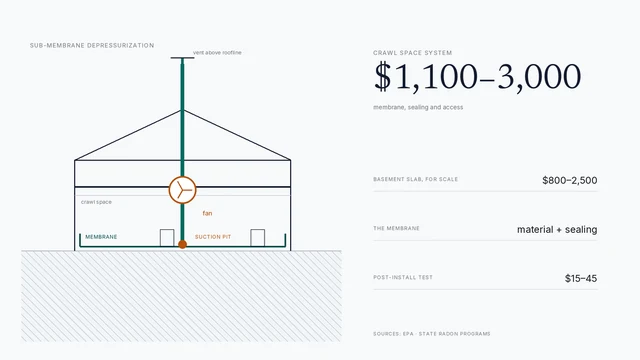
- Typical system cost
- $800–$2,500
Some links on this page are affiliate links.If you buy through them we may earn a commission at no extra cost to you. We do not accept payment for rankings. Read the full disclosure.
| Insurance claim | Sale negotiation | |
|---|---|---|
| Who decides | Carrier, against the policy form | Buyer and seller, in the contract |
| Standard outcome | Denied as a pollution exclusion | Credit or repair agreed before closing |
| What is needed | Coverage that names the peril | A test result both sides accept |
| Timing | Weeks to months, with an adjuster | Days, inside the inspection period |
| Effect on price | None; the policy pays or it does not | Usually a dollar credit at closing |
Radon mitigation insurance coverage is the question of whether a homeowners policy will pay to install a system that lowers indoor radon. For most households the answer is no: radon is treated as a pollutant, pollution is excluded, and nothing in the policy obliges the carrier to buy you a system. The money usually comes from the homeowner, or from a negotiation at the sale.
The short answer
A standard homeowners policy covers named perils — fire, wind, hail, sudden water damage, theft, liability. Radon is none of those. It is a gas that seeps in continuously from the soil, and carriers classify it with pollutants and contaminants rather than with accidents.
That classification is why the answer is consistent across the market even though policy forms differ. The exclusion is written into the base form, not added as an unusual restriction. A homeowner reading their own policy will usually find the word radon absent and the pollution exclusion present, which is enough to deny a claim.
Why radon sits outside a standard policy
Insurance prices sudden, accidental, measurable events. A furnace puffback is an event. A hailstorm is an event. Radon is a chronic condition of the site, present at some concentration in every house, and it is the homeowner’s job to test for it.
The underwriting logic follows. A carrier cannot inspect every basement for a gas that varies house to house within the same block. If policies covered mitigation on demand, the cost would be set by the number of homes that happen to test high, which is roughly 1 in 15 nationally. That is a maintenance and disclosure problem, not an insurable peril, and the policy forms reflect it.
There is also a causation problem. A radon-related illness claim would have to establish exposure, duration and medical causation, which is a liability question rather than a property one. Property policies do not pay for the mitigation that would have prevented an exposure.
Where coverage sometimes appears
Some carriers sell an endorsement that adds limited radon coverage. The endorsement is not standard, it is not uniform, and its limits vary. What to ask about it:
- What does it cover: testing, mitigation, or repair of an existing system?
- Is there a dollar cap, and does it apply per claim or per policy term?
- Does it cover a reading discovered before the policy started, or only a future discovery?
- Does it require a certified tester or a specific test protocol?
- Does it cover a failed fan or a damaged pipe?
Get the answers in writing before you rely on any of it. An endorsement described on the phone is not coverage.
Some policies also cover the consequences of mitigation work indirectly, through water damage or a failed component, but that is not radon coverage. It is coverage for the accident that happened during the job.
A denial, when it comes, is usually a short letter that cites the pollution exclusion and quotes the definition of pollutant. That letter is the start of an appeal rather than the end of the question, and the appeal rests on the policy language: either the definition does not reach a naturally occurring soil gas, or an endorsement adds the coverage. The first argument is a long shot against a base-form exclusion; the second is the one worth checking, because an endorsement is written to change the answer.
The three lines to read in your own policy
Skip the marketing summary and open the exclusions section. Three passages decide the question.
The pollution exclusion. This is usually the operative clause. It excludes loss caused by the discharge, dispersal or release of pollutants, and defines pollutants broadly enough to include a naturally occurring soil gas.
The definition of pollutant. If radon is not named, the definition still may capture it as an irritant or contaminant. Read the definition, not just the exclusion heading.
Any endorsement schedule. This is where an added coverage would appear. If the schedule lists no radon endorsement, there is none, regardless of what an agent recalls about a similar policy.
Then ask the carrier in writing. A letter or email that states the question and the answer is the document you will need if a claim is ever disputed.
Ask the state insurance department
Every state regulates homeowners insurance through a department of insurance or a comparable agency. Most publish consumer guides to homeowners policies, and some publish complaint data by carrier. They will not interpret your specific contract, but they will tell you what is sold in the state and where to file a complaint if a claim is handled badly.
This is also the place to check whether a state has any requirement about radon disclosure in insurance. The answer in most states is that there is none, and a regulator’s page is a more reliable source than a forum post.
The real-estate route is how most systems get paid for
No state requires a radon test at sale, but a test frequently happens anyway, because a buyer asks for one during the inspection period. When the result comes back at or above 4 pCi/L, the number becomes a negotiating item.
The usual outcomes are a seller credit equal to a bid, a seller-paid installation before closing, or a price adjustment. All three move money without an insurance company. From the buyer’s side, a credit is often better than a rushed install, because it lets you choose the contractor and specify the post-install test.
If you are the seller, a completed install with a passing post-install test is a stronger position than a credit, because it removes the question from the buyer’s mind. The cost breakdown gives you the band to negotiate against, and the cost section covers what each system type should run.
Document the test and the install
Whatever funds the work, the paperwork does the arguing. Keep the lab report from the original test, with the date, the location in the house and confirmation that closed-house conditions were held. Keep the contractor’s proposal, the invoice, the permit if one was pulled, the fan make and model, the warranty, and the post-install test result.
That packet serves three purposes: it supports an insurance question, it supports a resale disclosure, and it supports a warranty claim when a fan fails at year eight. A homeowner who can produce a lab report and a post-install result is in a different conversation from one who says the level was high once.
The testing section explains how to run a test that will stand up to scrutiny, including the 12-hour closed-house window and what makes a result defensible.
If you have no coverage
Assume you are paying, then reduce the number where you can. Test first, because a reading below 4 pCi/L does not call for a system, and a $15–$45 kit is the cheapest decision in the project. Get three itemized bids and compare scope rather than totals. Ask whether the post-install test is included, because a system without one is an unverified expense.
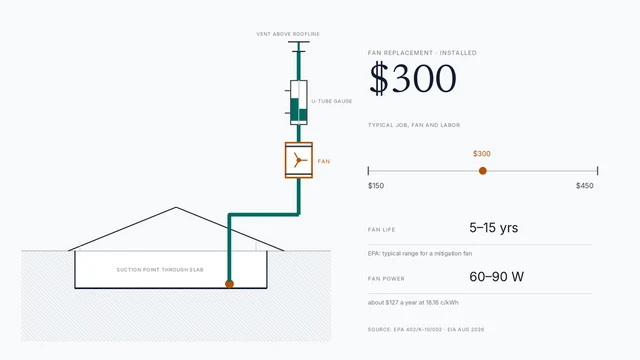
If the reading is between 2 and 4 pCi/L, EPA says consider fixing. That is a judgment call about exposure over time, not an emergency, and it is a reasonable point to plan the work rather than finance it in a hurry. Either way, the system itself is a known quantity: the EPA band is $800–$2,500 for a fan-based install, with an average near $1,200, and the fan adds roughly $127 a year at the August 2026 US average electricity price.
How to do it
- Read the exclusions page firstLook for pollution, pollutant, contaminant and radon. The exclusion wording decides the claim before any conversation with an agent begins.
- Ask the carrier in writingSend an email that asks whether the policy or any endorsement covers testing, mitigation or system repair. Keep the reply with your policy documents.
- Check for an endorsementSome carriers sell a rider that adds limited coverage. Ask what it costs, what it caps, and whether it applies to an existing elevated reading or only to future discoveries.
- Call the state insurance departmentState regulators publish consumer guides and can confirm what is sold in your state. They will not interpret your policy, but they will tell you where to complain if a claim is mishandled.
- Document the test before you callA lab report with a date, a location and closed-house conditions is the evidence any claim or negotiation rests on. Without it there is no number to discuss.
Frequently asked questions
Does homeowners insurance cover radon mitigation?
A standard homeowners policy usually does not. Radon is handled as a pollutant or contaminant, and policies commonly exclude pollution from the covered perils. Some carriers offer an endorsement that adds limited coverage, so the answer depends on the wording you hold, not on the industry as a whole.
Is radon damage ever covered as a sudden event?
Radon is a long-term condition, not a sudden event, which is why it falls outside the standard peril structure. A policy pays for things like fire, wind, hail and sudden water discharge. Gradual exposure to a soil gas does not match any of those categories, so a claim is unlikely to succeed without specific coverage.
How do I find out if my policy covers radon?
Read the exclusions section for the words pollution, pollutant, contaminant and radon. Then call the carrier and ask the question in writing, so the answer is on record. A phone answer is not a coverage determination; an email or a letter from the carrier is.
Who usually pays for a radon system?
The homeowner, in most cases. At a sale, the cost is frequently negotiated between buyer and seller as a credit or a repair, which is the single most common route by which a system gets installed. No state requires a radon test at sale, and no state requires an insurer to pay for the fix.
Does a radon system lower my insurance premium?
There is no general rule, and any specific claim would depend on the carrier and the policy. Ask your agent whether the carrier recognizes a mitigation system, and get the answer in writing. Treat a discount as a possibility to confirm, not a reason to buy the system.
What paperwork should I keep for an insurance question?
The lab report from the test that triggered the work, the contractor's proposal and invoice, the fan model and serial number, the permit if one was pulled, the post-install test result and the warranty. That packet answers most underwriting and claims questions without a second visit.
Sources
Some links are affiliate links.If you buy through them we may earn a commission at no extra cost to you. We do not accept payment for rankings. Read the full disclosure.