Radon System Installation Cost Breakdown by System Type
A line-by-line guide to radon system installation cost, including SSD, sub-membrane, passive, HRV, and water treatment options.
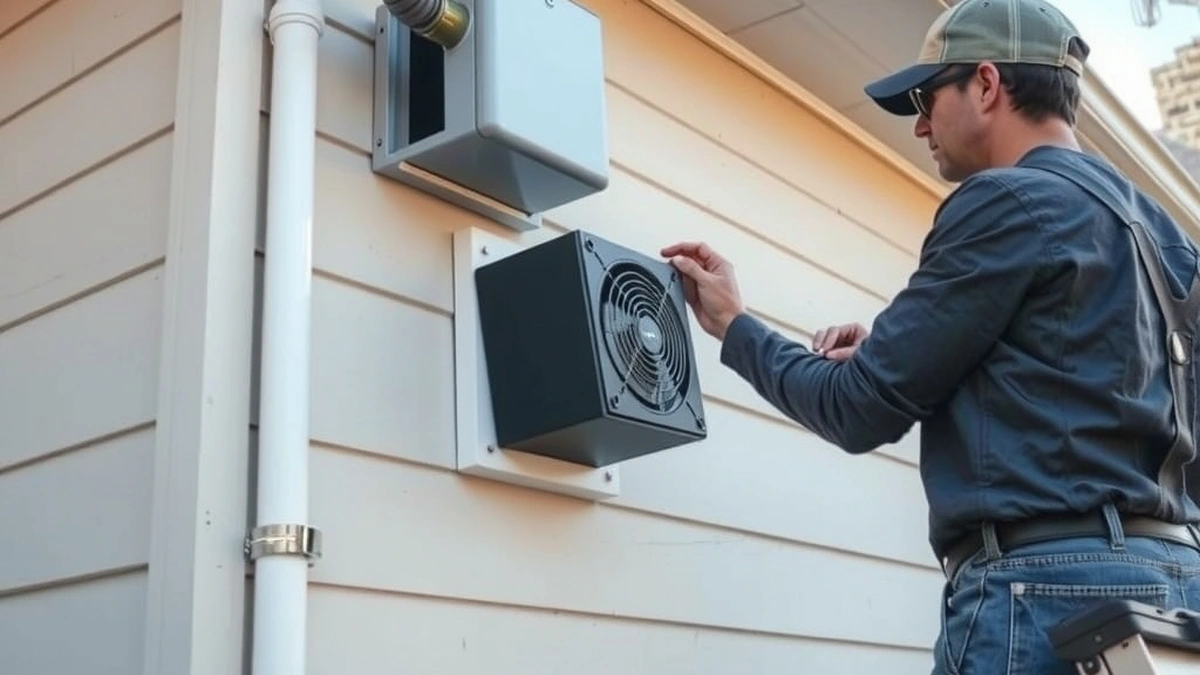
Most radon system installations cost between $800 and $2,500, with the average active sub-slab system around $1,200 before permits or optional upgrades.
- Typical installed range
- $800 - $2,500
- National average
- $1,200
- Fan replacement
- $150 - $450 every 5-15 years
- Annual fan electricity
- $50 - $200 per year
Some links on this page are affiliate links.If you buy through them we may earn a commission at no extra cost to you. We do not accept payment for rankings. Read the full disclosure.
Radon system installation cost typically runs between $800 and $2,500, with the national average around $1,200 for an active sub-slab depressurization system. Your final price depends on foundation type, system configuration, local labor rates, and whether your municipality requires a permit. The figures below are estimates based on typical installed prices; always request an itemized quote from an NRPP-certified or state-licensed mitigator.
What You Pay For: System Types at a Glance
Radon mitigation is not one-size-fits-all. The installation method depends on how your home is built and where radon enters. The table below shows typical installed cost ranges for common residential systems.
| System Type | Typical Installed Cost | Best For |
|---|---|---|
| Active sub-slab depressurization (SSD) | $800 - $2,500 | Homes with slab-on-grade or basement foundations |
| Sub-membrane depressurization | $1,100 - $3,000 | Crawl spaces with exposed soil |
| Drain tile depressurization | $800 - $2,500 | Homes with existing perimeter drain tile |
| Block wall depressurization | $1,000 - $3,000 | Homes with hollow-block foundation walls |
| Passive radon system | $500 - $1,500 | New construction with radon-resistant features |
| Passive system activation | $300 - $900 | Adding a fan to an existing passive stack |
| Heat recovery ventilator (HRV) | $1,200 - $3,500 | Whole-house ventilation where sub-slab is impractical |
| Water aeration treatment | $3,500 - $6,500 | High radon in well water |
| Water granular activated carbon (GAC) | $1,000 - $3,000 | Moderate radon in well water |
Most homeowners need an active soil depressurization system rather than water treatment. If your water comes from a public supply, radon in water is usually not a primary concern; private well owners should test water separately if indoor air results remain high after soil mitigation.
Active Sub-Slab Depressurization Line Items
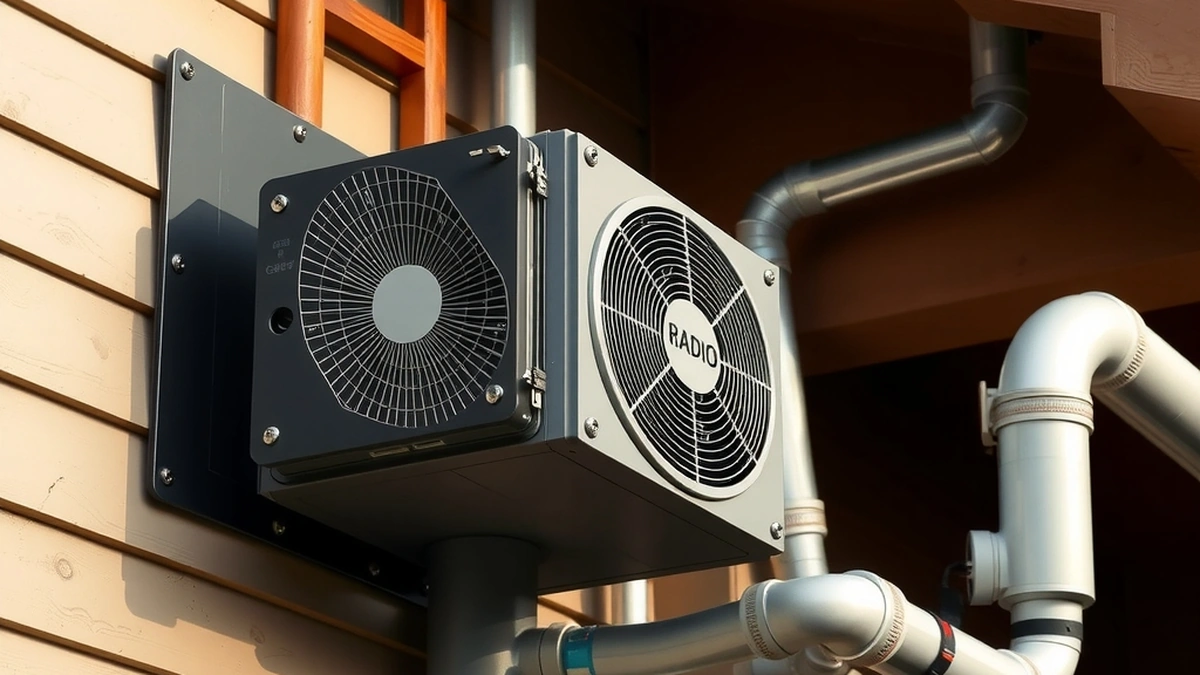
SSD is the most common radon mitigation method. A contractor drills suction points through the slab, connects them to PVC piping, and vents radon-laden air above the roofline with an inline fan. Here is how the cost typically breaks down.
Diagnostic testing and design: $0 - $300 Some contractors include a communication test or pressure-field extension test in the base price; others charge separately. This step determines how many suction points are needed and where the fan should be located.
Materials: $200 - $600 PVC pipe, fittings, sealant, junction boxes, and mounting hardware make up the material bundle. A standard single-suction-point system uses less material than a multi-point system spanning a large basement.
Labor: $400 - $1,200 Installation labor varies by region, accessibility, and whether the crew must work around finished spaces. Drilling through a slab, running pipe through a rim joist, and sealing cracks all add time.
Fan: $150 - $300 A radon-rated inline fan is sized to the system. Most residential fans draw between 60 and 90 watts. A typical 80-watt fan running continuously uses about 701 kWh per year. At the U.S. Energy Information Administration residential average of 18.16 cents per kWh, that equals roughly $127 per year in electricity.
Permit: $0 - $150 Permit requirements vary by city and county. Some jurisdictions waive permits for radon mitigation; others charge a flat fee. Check with your local building department before work begins.
Typical total: $800 - $2,500 The national average is approximately $1,200. A simple ranch home with an unfinished basement often lands near the low end, while a large home with multiple slabs or finished living space over the slab trends higher.
Sub-Membrane and Drain Tile Systems
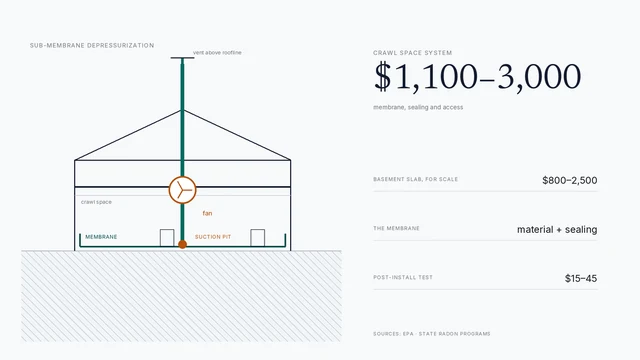
If your home has a crawl space with a dirt floor, sub-membrane depressurization is often the right approach. The contractor lays a heavy polyethylene membrane over the soil, seals it to the foundation walls, and draws air from beneath it through a vent pipe and fan.
Membrane and sealing: $300 - $800 The liner itself plus tape, caulk, and termination strips account for much of the material cost. Larger crawl spaces require more material and more labor to seal penetrations around piers and supports.
Piping and fan: $300 - $700 Similar to SSD, but the suction point is under the membrane rather than beneath a concrete slab.
Labor: $500 - $1,500 Crawl-space work is physically demanding and often takes longer than slab work, especially in low-clearance areas.
Typical total: $1,100 - $3,000
Drain tile depressurization uses an existing perimeter drain system as the suction point. Because the collection infrastructure is already in place, material costs are lower. Typical installed cost is $800 to $2,500, but this option is only available if the home has functional drain tile accessible to the mitigator.
Block wall depressurization applies to hollow masonry foundation walls. The contractor seals the top course of blocks and extracts air from the wall cores. Installed cost ranges from $1,000 to $3,000 because sealing every block opening is labor-intensive.
Passive Systems and Fan Activation
Passive radon systems rely on natural pressure differences and convection rather than a powered fan. They are common in new construction built with radon-resistant features.
Passive installation: $500 - $1,500 Includes a vent pipe routed from below the slab or crawl space through the conditioned space and out above the roof. No fan is installed at the time of construction.
Activation: $300 - $900 If post-occupancy testing shows radon above the EPA action level of 4 pCi/L, a fan is added to the passive stack. The cost covers the fan, electrical hookup, and a monitoring device such as a manometer.
If you are buying a new home, ask whether the passive system was installed to code and whether a post-installation radon test was performed. Activation is usually cheaper than retrofitting an active system from scratch because the piping is already in place.
Ventilation and Water Treatment Alternatives
Heat recovery ventilators can lower indoor radon by exchanging indoor air with outdoor air, but they are generally considered a secondary option when soil depressurization is not feasible or when radon levels are only moderately elevated.
HRV installed: $1,200 - $3,500 The unit itself plus ductwork and controls. An HRV also affects heating and cooling loads, so operating costs can extend beyond the fan electricity.
Water aeration: $3,500 - $6,500 Used when radon enters through well water and releases into the air during showers, dishwashing, and laundry. Aeration agitates water to release radon gas, which is then vented outdoors.
Water GAC: $1,000 - $3,000 Granular activated carbon tanks adsorb radon from water. Carbon beds require periodic replacement, adding long-term maintenance cost.
Water treatment should only be considered after a water test confirms radon in the water supply. Air testing alone cannot tell you whether water is the source.
Ongoing Costs After Installation
A radon mitigation system is not a one-time expense. Budget for the following recurring items.
Fan replacement: $150 - $450 Fans typically last 5 to 15 years. Replacement includes the unit and labor. Some contractors offer warranties on fans; check the terms before signing.
Electricity: $50 - $200 per year Using the example math above, an 80-watt fan consumes 701 kWh annually. At 18.16 cents per kWh, annual cost is about $127. Your actual cost depends on fan wattage and your local electricity rate.
Retesting: Every 2 years The EPA recommends retesting every two years to confirm the system is still working. A DIY short-term kit costs $15 to $45, while a professional test costs $150 to $250. If you have not tested recently, start with /testing-for-radon/ to establish a baseline before mitigation.
Permits, Warranties, and Contractor Selection
Permit costs range from $0 to $150 depending on your municipality. Some areas require no permit for radon mitigation, while others treat it like any mechanical alteration. For more on local requirements, see /radon-mitigation-permit-cost/.
Warranty terms vary by contractor and manufacturer. Fan warranties often run 1 to 5 years, while system workmanship warranties may cover installation defects for a longer period. Review what is covered before work begins; see /radon-mitigation-warranty/ for typical coverage details.
Always hire an NRPP-certified or state-licensed mitigator. Request an itemized quote that separates materials, labor, fan, permit, and any diagnostic fees. If your home has a basement, /radon-mitigation-in-basement/ covers foundation-specific considerations. For cost differences across slab, crawl space, and basement homes, see /radon-mitigation-cost-by-foundation-type/. When a fan eventually fails, /radon-fan-replacement-cost/ details replacement pricing.
After installation, retest within 30 days to confirm the system reduced radon below the action level of 4 pCi/L. The EPA considers levels between 2 and 4 pCi/L a range where homeowners should consider fixing, and the World Health Organization reference level is 2.7 pCi/L. A properly installed active system typically brings indoor radon below 2 pCi/L.
Radon system installation cost is predictable when you know which components apply to your home. Most projects fall between $800 and $2,500, with ongoing fan and electricity costs under $250 per year for the typical household. Test first, mitigate second, and retest on schedule to keep long-term exposure low.
Next, compare testing for radon, how to eliminate radon, how to reduce radon in your home before you commit.
Frequently asked questions
What is the average radon system installation cost?
The average installed cost for an active radon mitigation system is about $1,200, with most projects falling between $800 and $2,500 depending on foundation type and system complexity.
Do radon mitigation prices include permits?
Permit costs vary by jurisdiction and typically range from $0 to $150; some areas require no permit at all, so confirm local requirements before signing a contract.
How often does a radon fan need replacement?
Radon fans generally last between 5 and 15 years, and replacement typically costs $150 to $450 including labor.
What does a radon fan cost to run annually?
Running a typical 80-watt fan continuously costs about $127 per year at the national average residential electricity rate of 18.16 cents per kWh.
Is a passive radon system cheaper to install?
Passive systems usually cost $500 to $1,500 to install, but activating one later with a fan adds $300 to $900 and may be necessary if post-installation testing shows elevated levels.
Can water treatment add to radon mitigation cost?
Yes, water radon treatment can add significant cost, with aeration systems ranging from $3,500 to $6,500 and granular activated carbon systems from $1,000 to $3,000 installed.
Sources
Some links are affiliate links.If you buy through them we may earn a commission at no extra cost to you. We do not accept payment for rankings. Read the full disclosure.