Radon mitigation permit cost: $0 to $150
Permits run $0–$150 and electrical work may need a second one. What the inspector checks, and why unpermitted work hurts at resale.
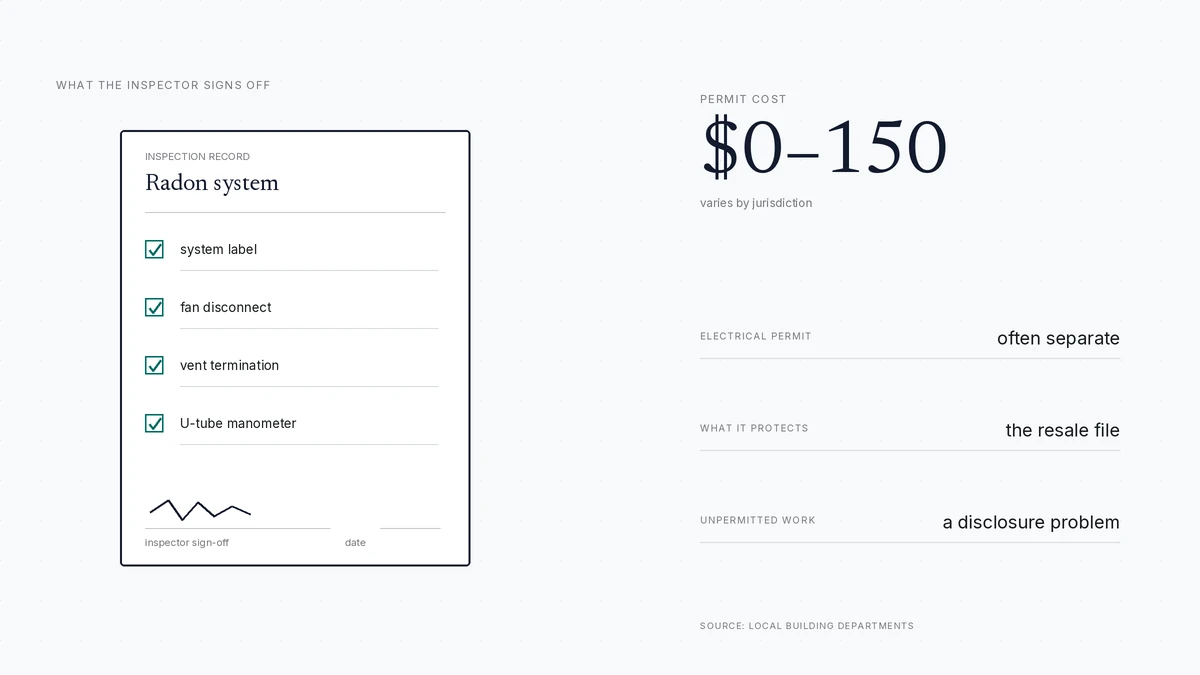
A permit costs $0–$150 depending on the jurisdiction, and many jurisdictions issue none. Electrical work may need a separate permit. The fee is minor; what you buy is an inspector's sign-off on the label, the disconnect, the vent termination and the manometer.
- Radon permit fee
- $0–$150
- Electrical permit
- often separate
- Inspection items
- label, disconnect, vent, gauge
- System cost, for scale
- $800–$2,500
Some links on this page are affiliate links.If you buy through them we may earn a commission at no extra cost to you. We do not accept payment for rankings. Read the full disclosure.
| Permitted install | No permit | |
|---|---|---|
| What you pay | Contract price plus $0–$150 | Contract price, sometimes lower |
| What gets checked | Label, disconnect, vent termination, gauge | Nothing by an official |
| At resale | Inspection record in the file | A question with no answer |
| If the vent is wrong | Caught before the job closes | Found by a buyer's inspector |
| Insurance question | Documented work | Work with no record |
A radon mitigation permit is the local building department’s authorization to install a system, issued after a plan review and closed out by an inspection. The fee runs $0–$150 where a permit exists at all. The money is trivial against an $800–$2,500 install; the inspection is the part that carries value.
What a permit costs
Fees are set locally, so there is no national schedule. In practice a radon or mechanical permit lands somewhere between nothing and about $150. Some departments charge a flat fee, some charge a percentage of the declared job value, and some fold radon work into a general building permit that covers the whole project.
Electrical work is the wildcard. If the fan needs a dedicated circuit, a service disconnect or a new run from the panel, that work may require its own electrical permit and its own inspection, with its own fee. Ask both questions at once: radon permit, and electrical permit.
Against the system cost, the permit is noise. Against the cost of discovering a bad vent termination at resale, it is the cheapest line on the invoice.
Whether your jurisdiction requires one
Permit authority sits with local building departments, not with states, so requirements vary from one town to the next inside the same state. Some require a permit and an inspection for radon work. Some issue nothing specific and treat the job as ordinary mechanical work. Some require it only when the electrical circuit is new.
The only reliable answer comes from the department that would issue it. One phone call settles it: does this address need a permit for a radon mitigation system, does the electrical work need a separate one, and who is allowed to pull them.
Do that call before you sign a bid, not after. A contractor who says “we don’t bother with permits here” may be right about the jurisdiction and wrong about your house, and you will not know which until you ask.
The electrical permit is often separate
Radon mitigation is a plumbing-and-electrical job wearing a ventilation hat. The pipe and the fan are the visible part; the circuit is what makes the fan run continuously for years.
A dedicated circuit needs a breaker, a run, and often a service disconnect within sight of the fan. That work belongs to a licensed electrician in most jurisdictions, and it is inspected under an electrical permit rather than the radon one. Two permits, two inspections, two fees, both small.
The practical consequence is scheduling. If the electrician is a separate trade, the mitigation crew may finish the pipe and leave the fan unpowered until the electrical inspection passes. Put both in the contract with dates, and confirm who calls for which inspection.
What the inspector checks
The inspection is a code and standard check, not a radon test. Four items do most of the work.
The system label. A label on the pipe with the installer’s name, contact information and install date. An unlabeled system is anonymous work, and the inspector knows it.
The fan disconnect. A means to de-energize the fan at the unit, so service work does not require hunting for a breaker. This is the item most often missing on unpermitted installs.
The vent termination. Height above the roof and distance from windows, doors and other openings, so the exhaust does not re-enter the house. This is the item most often installed wrong, and the one with a real consequence.
The manometer. A U-tube or system indicator mounted where it can be read, showing that the fan is producing suction. It is the homeowner’s only daily diagnostic.
Some inspectors also look at pipe support, labeling along the run, and condensation management. The systems guide covers what a complete installation includes, and the methodology page explains which standard the details come from.
Why a permit protects resale
At resale, the permit is evidence. It shows that a building official looked at the vent termination, the disconnect and the label, and signed the job off. It converts “there is a radon system” into “there is a radon system that was inspected.”
That matters because the buyer’s inspector will find the system and will ask for the paperwork. A permit record, a post-install test and a fan model make a complete packet. Without the permit, the packet has a hole in it, and the buyer is entitled to wonder what else is missing.
There is also a safety argument that has nothing to do with resale. A vent that terminates too close to a window returns the radon to the house. A fan with no disconnect is a service hazard. An inspection is how those two get caught before anyone relies on the system.
Unpermitted work is a disclosure problem
No state requires a radon test at sale, but five states — Illinois, Minnesota, New Jersey, Pennsylvania and Iowa — require disclosure or a pamphlet. In those states, a known system is a known fact that has to be passed along.
An unpermitted system is not automatically a failed system. Many are built to standard by competent installers who skipped the paperwork. The problem is evidentiary: you cannot prove the vent termination was checked, and neither can the buyer. In a negotiation, an unprovable system is priced like an unknown one.
The remedy is usually cheap. A building department can sometimes inspect existing work and issue a permit retroactively, though some will not. Ask before you list, not during the inspection period.
How to confirm the permit was pulled
Ask for the permit number, and then look it up. Many departments publish an online permit search; others will confirm by phone. The record should show the address, the scope and the inspection result.
Check three things: the permit exists, the scope matches the work, and the inspection was closed rather than left open. An open permit is a loose end that can surface at closing, when the seller no longer has time to resolve it.
If the contractor pulled the permit, the number should appear on the invoice or the contract. If it does not, ask for it in writing. A contractor who cannot produce a permit number either did not pull one or does not want you to see what it covers.
If the work was never permitted
Start with the building department and describe the installation: when it was done, what was installed, and whether the fan has a disconnect and where the vent terminates. Ask whether they will inspect existing work and issue a permit after the fact.
If they will, the cost is usually the same small fee plus an inspection visit. If they will not, get a qualified contractor to review the installation against the standard and put the findings in writing. That letter is not a permit, but it is a document, and a document is what the buyer’s inspector will ask for.
Either way, run a fresh test. A short-term kit costs $15–$45, and a result below 2 pCi/L tells you the system is doing its job regardless of its paperwork history. The cost section covers what remediation should run if the inspection turns up a vent or electrical problem.
How to do it
- Call the building departmentAsk whether radon mitigation needs a permit, whether electrical work needs a separate one, and who is allowed to pull it. Do this before you accept a bid.
- Put the permit in the contractThe scope should state who pulls the permit, who pays the fee and who calls for the inspection. Verbal assurances are not a permit.
- Ask for the permit numberA permit number is a record you can look up. Get it before work starts, not after, because some jurisdictions allow work to begin only after issuance.
- Attend the inspection if you canThe inspector checks the label, the disconnect, the vent termination and the manometer. Being there is how you learn what was signed off and what was noted.
- File the sign-offKeep the inspection record with the test report, the fan model and the warranty. That packet is what answers the question at resale.
Frequently asked questions
How much does a radon mitigation permit cost?
Usually $0–$150. Some jurisdictions charge a flat fee in that range, some charge a small percentage of the job value, and many have no radon permit at all because the work falls under a general building or mechanical permit. Electrical work can carry its own fee.
Does every state require a permit for radon mitigation?
No. Permit authority sits with local building departments, and requirements vary from one jurisdiction to the next inside the same state. Some require a permit and an inspection; others issue nothing specific to radon. Ask the local building department before work starts.
What does a radon inspector look for?
The system label with the installer's name and contact, the fan's electrical disconnect, the vent termination height and its distance from windows and doors, the U-tube manometer, and whether the pipe is supported and labeled. The inspection is a check that the installation matches the standard, not a radon test.
Is a permit required for a fan replacement?
Usually not, because the pipe, the suction point and the electrical circuit already exist and the work is a like-for-like swap. If the replacement changes the circuit, adds a disconnect or moves the vent termination, ask the building department whether that triggers an inspection.
What happens if I sell a house with an unpermitted radon system?
It becomes a disclosure problem. A buyer's inspector will see the pipe and the fan, and a system with no permit and no inspection record invites questions about the vent termination and the electrical work. Illinois, Minnesota, New Jersey, Pennsylvania and Iowa require radon disclosure or a pamphlet at sale, and no state requires a test.
Can I pull the permit myself as the homeowner?
Sometimes. Many jurisdictions allow a homeowner permit for work on their own residence, and some require a licensed contractor for radon or electrical work. Ask the building department which category applies, and confirm who is responsible for calling for the inspection.
Sources
Some links are affiliate links.If you buy through them we may earn a commission at no extra cost to you. We do not accept payment for rankings. Read the full disclosure.