Radon mitigation vs crawl space encapsulation
Encapsulation seals a crawl space against moisture and soil gas. It is not a radon system. Sub-membrane depressurization is, and the two can share one membrane.
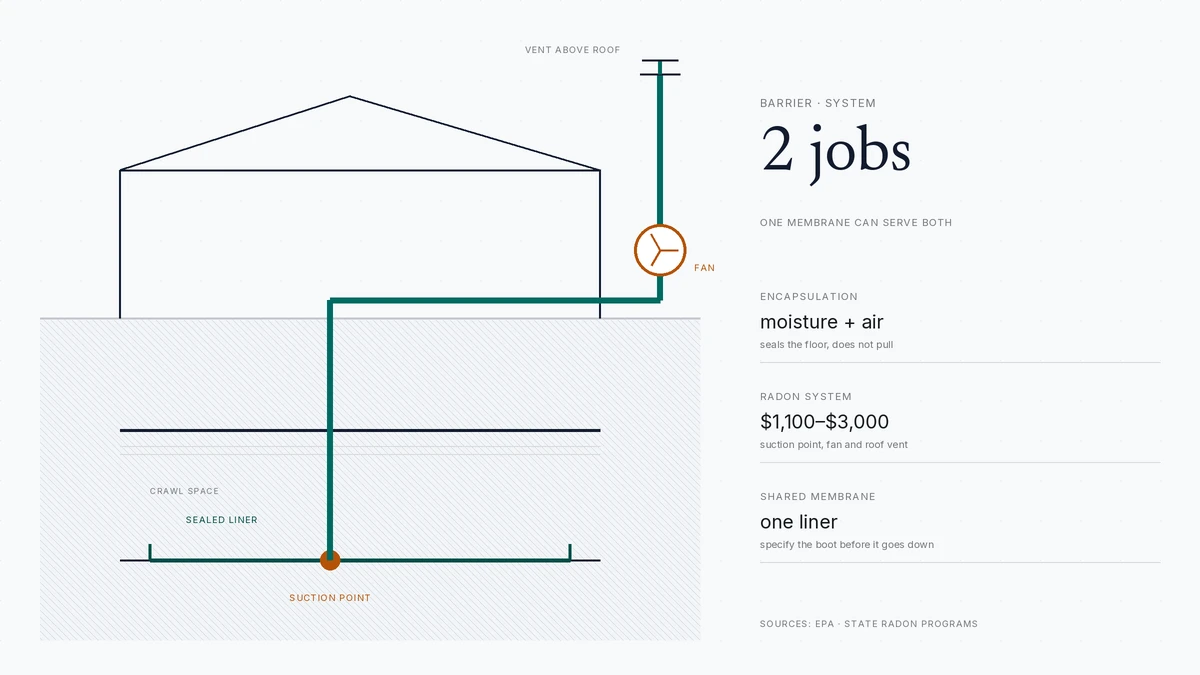
Encapsulation is a moisture and air barrier. It seals a crawl-space floor and walls but does not depressurize the soil or remove radon. Sub-membrane depressurization adds a suction point, fan and roof vent at $1,100–$3,000. One membrane serves both, but the fan is not optional.
- Encapsulation does
- Seals moisture and air paths
- It does not
- Remove radon gas
- Radon system installed
- $1,100–$3,000
- Shared membrane
- Yes, if specified up front
Some links on this page are affiliate links.If you buy through them we may earn a commission at no extra cost to you. We do not accept payment for rankings. Read the full disclosure.
| Encapsulation | Sub-membrane radon system | |
|---|---|---|
| Job it does | Moisture, mold and air movement | Radon gas in the soil |
| What it installs | Sealed liner on floor, walls and piers | Same liner plus suction point, pipe and fan |
| Effect on the soil | Covers it, but does not change its pressure | Holds it under negative pressure |
| Installed cost | Quoted per square foot; not in EPA's radon table | $1,100–$3,000 |
| Proof it worked | Humidity readings and no musty smell | Post-install radon test below 2 pCi/L |
Radon mitigation and crawl space encapsulation are two different jobs that get sold in the same conversation. Mitigation moves radon-bearing soil gas out from under a house and vents it above the roofline. Encapsulation covers a crawl-space floor and walls with a sealed plastic liner to control moisture, mold and air movement. The liner can be the same material and the two jobs can share it, but encapsulation on its own is not a radon system.
What encapsulation actually does
A crawl space encapsulation is a moisture-control job. The crew lays a reinforced liner over the dirt, runs it up the foundation walls and around the piers, tapes the seams, and either vents the space or conditions it with a supply register. The barrier stops soil moisture from evaporating into the house, cuts the stack effect that pulls humid air upward, and keeps the space cleaner.
The barrier also closes the largest opening between the soil and the living space, so it reduces how much soil gas reaches the house. What it does not do is remove radon from the soil or put the space under negative pressure relative to the ground. A liner lying on dirt with no fan is a lid on a pot, and the pot still has gas in it.
What sub-membrane depressurization does
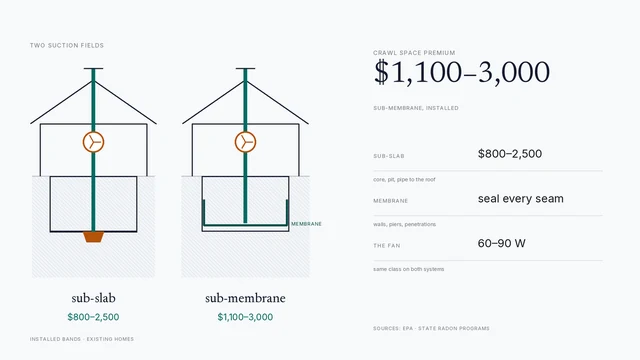
Sub-membrane depressurization is the radon system for a crawl space. The installer seals a membrane of the same type, cuts a suction point through it into a small pit in the soil, runs PVC to a fan, and discharges above the roofline. The fan holds the sealed volume between membrane and dirt at a lower pressure than the crawl space, so soil gas flows to the pipe instead of through the barrier.
EPA’s published band for the system is $1,100–$3,000 installed, against $800–$2,500 for sub-slab work in a basement. The difference is the membrane, the seam tape, the edge sealing and the labor of doing all of it on hands and knees. The crawl space cost guide breaks those lines out one at a time.
Where the two jobs share a membrane
When a homeowner wants both, the sequence matters more than the invoice. The radon system needs a sealed membrane to draw against, and encapsulation needs a sealed membrane to keep moisture down, so one liner can serve both if it is specified for it from the start.
Three details decide whether sharing works. The liner has to be thick enough and reinforced where the suction point passes through it. The seams have to be taped and the edges sealed to the wall, not stapled and folded. And the suction point has to be built in, with a stub of pipe and a sealed boot, rather than cut later through a finished floor.
A radon contractor who arrives after encapsulation can still cut in a suction point. The seal is then only as good as the liner the other crew installed, which is why the specification should be agreed before either job begins.
What each one costs
| Item | Encapsulation | Sub-membrane radon system |
|---|---|---|
| Purpose | Moisture, mold, air quality | Radon reduction |
| Barrier | Sealed liner | Sealed liner plus suction point |
| Moving part | Dehumidifier or vent fan | Radon fan on a roof vent |
| EPA cost band | Not published | $1,100–$3,000 |
| Proof of result | Humidity readings | Post-install radon test |
The radon side has a published band, and the moisture side does not. Encapsulation is priced per square foot by crawl-space contractors and never appears in EPA’s radon cost table, so a dollar-for-dollar comparison is not honest. For the same footprint, a full encapsulation generally costs more than the radon system alone because it covers walls and piers as well as the floor.
The important difference is what the money buys. One purchase buys a dry crawl space. The other buys a lower radon number, and only the second one arrives with a test that proves it. Here is how the system types compare when you are pricing the radon half.
Why encapsulation alone leaves the radon
Radon moves from soil into a house because the house sits at a slightly lower pressure than the ground. Warm indoor air rises, exhaust fans push air out, and that difference is made up by soil gas seeping through cracks, sump pits and the bare dirt of a crawl space.
A liner interrupts the path through the floor. It does not change the pressure difference, and it does not stop gas from collecting in the shallow gravel and soil directly beneath it. Gas that cannot pass through the plastic still migrates sideways to the perimeter, the wall joint or the next opening. That is why an encapsulated crawl space can still measure high on a test.
Changing the pressure requires pulling on the soil with a fan and exhausting the gas where it cannot re-enter the house. That is mitigation, and it is the part a liner cannot do at any thickness.
Why the fan is not optional
Some encapsulation quotes include a small vent fan, and it is easy to assume that fan is doing radon work. It usually is not. A crawl-space vent fan moves air through the space to control humidity, does not depressurize the soil, and can pull soil gas into the crawl space on its way through.
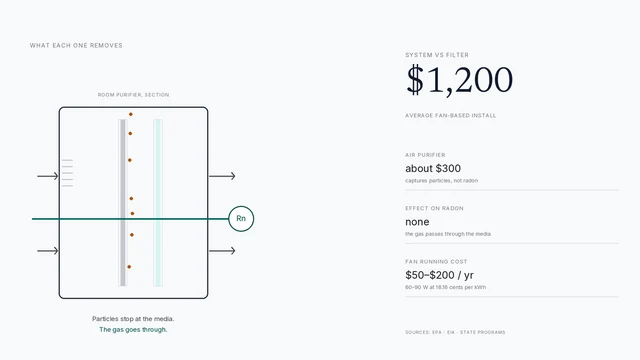
A radon fan is a different piece of equipment: sealed housing, continuous-duty rating, sized to hold a pressure difference against a specific suction field, mounted on a pipe that terminates above the roof, with a U-tube manometer so anyone can see whether it is pulling. Residential units draw 60–90 W, which costs about $127 a year at the August 2026 US average of 18.16 cents per kWh.
Skipping the radon fan to save money leaves a sealed box with gas underneath it. The foundation-type guide shows where the fan and the suction point sit on a crawl space, a basement and a slab.
How to sequence the two jobs
If both jobs are happening, do the liner first and the radon system with it, not months later. A crew that knows a suction point is coming leaves a boot, a stub and a clear route out through the rim joist. A crew that does not will seal the floor, and the radon contractor will open it again.
On a crawl space that is already encapsulated, the radon work is still straightforward: the liner is the suction field, and the suction point goes through it into the soil. What changes is the cost of a mistake, because a torn liner under a sealed perimeter is expensive to repair after the fact.
Test before either job. A short-term kit at $15–$45 tells you whether the crawl space has a radon problem worth a system, and the answer decides whether the second invoice needs to exist at all.
How to verify the result
Neither job proves itself by looking finished. The radon system proves itself with a test run after at least 24 hours of operation, targeting below 2 pCi/L, then a retest every two years or after a major renovation or HVAC change. Encapsulation proves itself with humidity readings and the absence of the smell that sent you under the house in the first place.
If a contractor offers encapsulation as a radon fix, ask for the post-install radon test in writing. If the answer is that the liner takes care of it, the quote is for moisture control, whatever the brochure says.
Encapsulation and mitigation belong in the same project when both problems are real. They are not substitutes, and the membrane is the only part they genuinely share. Buy the barrier for the water, the fan for the gas, and one test to prove the second one worked.
How to do it
- Test the crawl space firstRun a short-term kit at $15–$45 or a certified measurement at $150–$250 before pricing either job. A reading under 2 pCi/L does not call for a radon system, whatever the encapsulation quote suggests.
- Decide the scope in one documentWrite down whether you are buying moisture control, radon control or both. A single scope statement stops the two trades from each assuming the other is handling the fan and the suction point.
- Specify a radon-ready linerAsk for a reinforced liner, taped seams, edge sealing to the wall and a factory boot at the planned suction point. Staples and folded edges cannot hold vacuum and cannot hold moisture either.
- Install the fan with the liner, not afterA crew that knows the suction point is coming leaves a stub and a clear pipe route. Cutting into a finished, sealed crawl space later costs more and produces a weaker seal.
- Prove the radon result with a testRun a short-term test after at least 24 hours of fan operation, targeting below 2 pCi/L, then retest every two years or after a major renovation or HVAC change.
Frequently asked questions
Does crawl space encapsulation remove radon?
No. Encapsulation closes the largest opening between the soil and the house, which reduces how much soil gas gets in, but it leaves the space at the same pressure as the ground. Gas still collects under the liner and migrates to the perimeter and wall joints. Removing radon requires a fan pulling from beneath the membrane and venting above the roof.
Can encapsulation and a radon system share the same membrane?
Yes, and that is usually the cheapest way to do both. The radon system needs a sealed membrane to draw against, and encapsulation needs a sealed membrane to control moisture, so one reinforced liner can serve both. Specify the suction point and its boot before the liner goes down, because cutting it in later weakens the seal.
Which one costs more?
Encapsulation is quoted per square foot and does not appear in EPA's radon cost table, so the two numbers are not directly comparable. For the same crawl space, a full encapsulation generally costs more than the radon system alone at $1,100–$3,000, because it covers walls and piers as well as the floor. The radon system is also the only one of the two that comes with a test proving it worked.
Is a crawl space vent fan the same as a radon fan?
No. A vent fan moves air through the crawl space to control humidity and can pull soil gas inside with it. A radon fan has a sealed housing, is rated for continuous duty, is sized to hold pressure against a specific suction field, and discharges above the roofline through its own pipe with a U-tube manometer on it.
What radon level calls for a system in a crawl space?
EPA's action level is 4 pCi/L, and EPA says consider fixing between 2 and 4 pCi/L. Test first with a short-term kit at $15–$45. A crawl space under a living area matters even at moderate readings, because the space is connected to the house through the floor above it and through any ductwork that runs there.
Can I encapsulate first and add the radon system later?
Yes, but tell the encapsulation crew. Ask them to leave a sealed boot and a pipe stub at the planned suction point and to tape every seam rather than staple the liner at the rim. A radon contractor can still cut into a finished liner, but a torn edge under a sealed perimeter is expensive to repair and easy to avoid.
Sources
Some links are affiliate links.If you buy through them we may earn a commission at no extra cost to you. We do not accept payment for rankings. Read the full disclosure.