Active vs passive radon system: cost and when each works
A passive system costs $500–$1,500 at construction, an active retrofit $800–$2,500, and adding a fan to an existing pipe $300–$900. Which one you need.
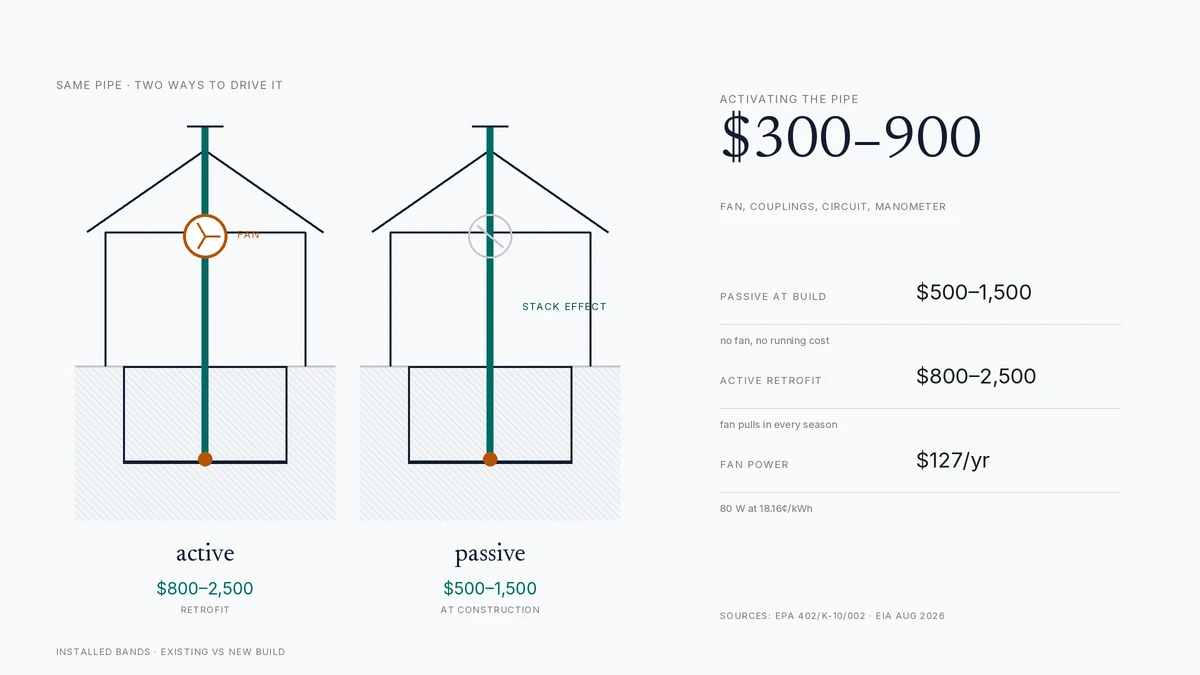
A passive radon system uses a pipe and stack effect with no fan and costs $500–$1,500 during construction. An active system adds a fan, either as an $800–$2,500 retrofit or by activating an existing pipe for $300–$900. A test after occupancy decides which one the house needs.
- Passive, at build
- $500–$1,500
- Active retrofit
- $800–$2,500
- Activating a passive pipe
- $300–$900
- Fan running cost
- about $127 a year
Some links on this page are affiliate links.If you buy through them we may earn a commission at no extra cost to you. We do not accept payment for rankings. Read the full disclosure.
| Passive | Active | |
|---|---|---|
| Cost | $500–$1,500 at construction | $800–$2,500 retrofit, or $300–$900 to activate a passive pipe |
| Moving parts | None | One fan, expected life 5–15 years |
| How it moves air | Stack effect and wind, no mechanical assist | Continuous suction from a fan |
| Running cost | Zero | About $127 a year at 18.16¢/kWh |
| Maintenance | Inspect the pipe and roof penetration | Watch the U-tube, replace the fan every 5–15 years at $150–$450 |
| Best fit | New construction, verified low by a test | Any home confirmed at or above 4 pCi/L |
An active radon system moves soil gas with a fan; a passive radon system moves it with a pipe and the stack effect, with no fan. Passive systems are built into new construction at $500–$1,500. An active system costs $800–$2,500 as a retrofit in an existing home, or $300–$900 when a fan is added to a passive pipe that is already in place.
What separates active from passive
Both designs start the same way: a gas-permeable layer or collection point under the foundation, a sealed connection, and a pipe that runs up and out above the roofline. Both rely on the same principle — keep the soil under the house at a lower pressure than the house, so soil gas goes up the pipe instead of through the floor.
The active version adds an inline fan near the top of the pipe. The fan creates a consistent pressure difference regardless of weather, house tightness or wind. The passive version has no fan, so the pressure difference comes from the house itself: warm indoor air rising, and wind moving across the vent.
A passive stack works because the air in the pipe is warmer and lighter than outdoor air in heating season, and because the vent termination sees wind. It is weaker and less predictable than a fan.
Passive at construction: $500–$1,500
A passive radon-resistant system is built into the house, which is why it is cheap. The work happens while the foundation is open: a layer of gas-permeable material under the slab, a collection point, a sealed route through the slab, and a pipe run inside the framing to a roof penetration. EPA-linked figures put the whole detail at $500–$1,500 as part of new construction.
Retrofitting the same house later means coring a finished slab, finding a route through finished space and cutting a new roof penetration. Doing it during the build avoids all three.
Massachusetts requires passive radon-resistant construction in designated counties, and Zone 1 designations are usually the reason a builder offers it elsewhere. If you are building in a high-risk county, this is the cheapest radon decision you will ever make. The foundation guide shows how the detail changes across a basement, a slab and a crawl space.
How a passive stack works without a fan
Three conditions have to hold for a passive system to do useful work.
The collection point has to be sealed to the soil and open to the pipe. If the slab connection leaks, the stack pulls indoor air from the basement instead of soil gas from beneath it.
The pipe has to run continuously to a termination above the roofline, with no low spot that collects water and no long horizontal run that kills the draft. A passive pipe that dips or dead-ends is a decoration.
The house has to be tight enough for stack effect to matter. A leaky house equalizes pressure with outdoors and the pipe loses its drive. A well-sealed house gives the stack something to work with.
When those hold, a passive system can hold a house below 2 pCi/L. When they do not, the house reads higher and the pipe waits for a fan.
Active retrofit: $800–$2,500
An active system in an existing house is EPA’s $800–$2,500 band, averaging near $1,200. It includes the suction point, the pipe, the fan, the manometer, the electrical connection and the roof or wall penetration. The full cost breakdown covers what moves a job within the band: foundation type, suction-point count, pipe route and electrical work.
The active system is the answer when a test confirms a problem. It produces a pressure difference the house cannot produce on its own, and it does so in July as well as January. The trade is a fan that runs continuously, a small electricity bill and a part that wears out.
Activating an existing passive pipe: $300–$900
This is the cheapest path in radon mitigation, and it is underused. If a house already has a passive pipe, activation adds a fan, two flexible couplings, a circuit, a U-tube manometer and the system label. The expensive components — the sub-slab collection point and the pipe to the roof — are already paid for.
The fan goes in line, the couplings clamp, the manometer mounts on the pipe, and the circuit gets a disconnect. Then the gauge should show an offset within a minute or two.
Two conditions matter: the pipe is continuous and correctly sized, and the collection point under the slab is intact. A badly installed passive system turns activation into a repair, and the price reflects it.
When passive is enough
Passive is enough when a test says it is. That is the only honest criterion, which is why a passive system needs a post-occupancy test rather than a promise.
A passive system holds best on a tight new house with a well-sealed collection point, a short vertical pipe run and a cold climate that gives the stack a strong temperature difference. A leaky house, a long horizontal run or a warm climate all weaken the draft.
If a passive house tests below 2 pCi/L, leave it alone and retest every two years. If it tests between 2 and 4, run a long-term test through a heating season and decide. If it tests at or above 4, activate the pipe.
Testing after occupancy
The test is the quality control step. Run a short-term kit at the lowest lived-in level in the first heating season, with the house closed for 12 hours before and during. Stack effect is strongest in cold weather, and a summer test can flatter a marginal passive system.
Use a lab-based kit at $15–$45 or a certified measurement at $150–$250. A consumer monitor at $100–$200 tracks trends but should not anchor a real estate or mitigation decision. The testing section covers placement, and the kit comparison explains what each device measures.
If the result is high, do not assume the passive system failed. Check the pipe for a blockage, a disconnected section or water in a low spot first. A passive stack with a broken connection is not a passive stack.
Running cost and service life
The active system’s running cost is the fan. A residential fan draws 60–90 W; an 80 W unit running continuously uses about 701 kWh a year, roughly $127 at the August 2026 US average of 18.16 cents per kWh. EPA budgets $50–$200 a year across fan sizes and rates, and the calculator converts your own rate.
Service life is 5–15 years for the fan, per EPA. A replacement fan costs $150–$450 installed, and a failed fan is not cosmetic: the pipe stays, the suction stops, and the radon level climbs. Keep the model number and install date on the system label.
The passive system has no running cost and no fan to replace, so its ten-year cost is essentially its install cost. The active system’s ten-year cost is the install plus roughly $1,270 in electricity and one fan replacement.
The decision in one page
If you are building, install passive now. It costs $500–$1,500 while the foundation is open, and activation later is $300–$900 if you need it.
If you own an existing house and a test says 4 pCi/L or above, install active. EPA’s band is $800–$2,500, and the fan is what makes the system work in every season.
If you own a house with a passive pipe, test it. Below 2 pCi/L, do nothing. Above 4, activate the pipe for $300–$900. Between 2 and 4, run a long-term test and use the number.
The comparison section puts these against the other system types, and the systems section covers the components in detail. What decides it is whether the house has been tested, because that is the only thing that tells you which system you are living with.
How to do it
- Decide at the right stageA passive system has to go in before the slab is poured. An active system can be installed any time. If you are building, price passive now; retrofitting later costs more for the same result.
- Confirm the pipe and collection pointA passive system needs a gas-permeable layer, a sealed collection point under the slab and a continuous pipe to the roof. Ask for the detail drawing, not a verbal promise.
- Test after the house is occupiedRun a short-term test at the lowest lived-in level in the first heating season, with the house closed for 12 hours before and during. Stack effect is strongest when it is cold.
- Activate if the number is highAt or above 4 pCi/L, add a fan to the existing pipe for $300–$900. The pipe and suction point stay; the fan, couplings, circuit and manometer are added.
- Retest and diarizeAfter activation, test once the fan has run at least 24 hours, targeting below 2 pCi/L. Then retest every two years or after a major renovation or HVAC change.
Frequently asked questions
What is the difference between an active and a passive radon system?
An active system has a fan that pulls soil gas from under the foundation and pushes it above the roofline. A passive system has the same pipe and collection point but no fan, relying on stack effect and wind to move air. Passive systems are built into new construction; active systems are retrofits or activated passives.
How much does a passive radon system cost?
EPA-linked figures put a passive radon-resistant system at $500–$1,500 as part of new construction. That covers a gas-permeable layer under the slab, a sealed collection point and a pipe routed through the roof. There is no fan, so the running cost is zero.
Can I add a fan to a passive system later?
Yes, and it is the cheapest upgrade in radon work. Activating an existing passive pipe typically costs $300–$900: a fan, two couplings, a circuit, a U-tube manometer and a label. The expensive part of the system, the pipe and the sub-slab collection point, is already in place.
Is a passive system enough to keep radon low?
Sometimes. Stack effect is weaker than a fan and depends on the house being reasonably tight and the pipe running high enough. Many passive homes test below 2 pCi/L without a fan. Others test above 4 and need activation. Only a test after occupancy can tell you which house you have.
How much does an active system cost to run?
A residential mitigation fan draws 60–90 W. An 80 W fan running continuously uses about 701 kWh a year, roughly $127 at the August 2026 US average of 18.16 cents per kWh. EPA budgets $50–$200 a year for operating cost across fan sizes and electricity rates.
When should I test after moving into a new passive home?
Within the first heating season, and again after any major change. A passive system's performance depends on stack effect, which is strongest in cold weather. If the result is at or above 4 pCi/L, activate the pipe with a fan rather than waiting for the next owner to deal with it.
Sources
Some links are affiliate links.If you buy through them we may earn a commission at no extra cost to you. We do not accept payment for rankings. Read the full disclosure.