Radon mitigation vs air purifier: what works
An air purifier filters particles; radon is a gas that passes straight through. What HEPA and carbon media catch, and why a $1,200 system beats a $300 unit.
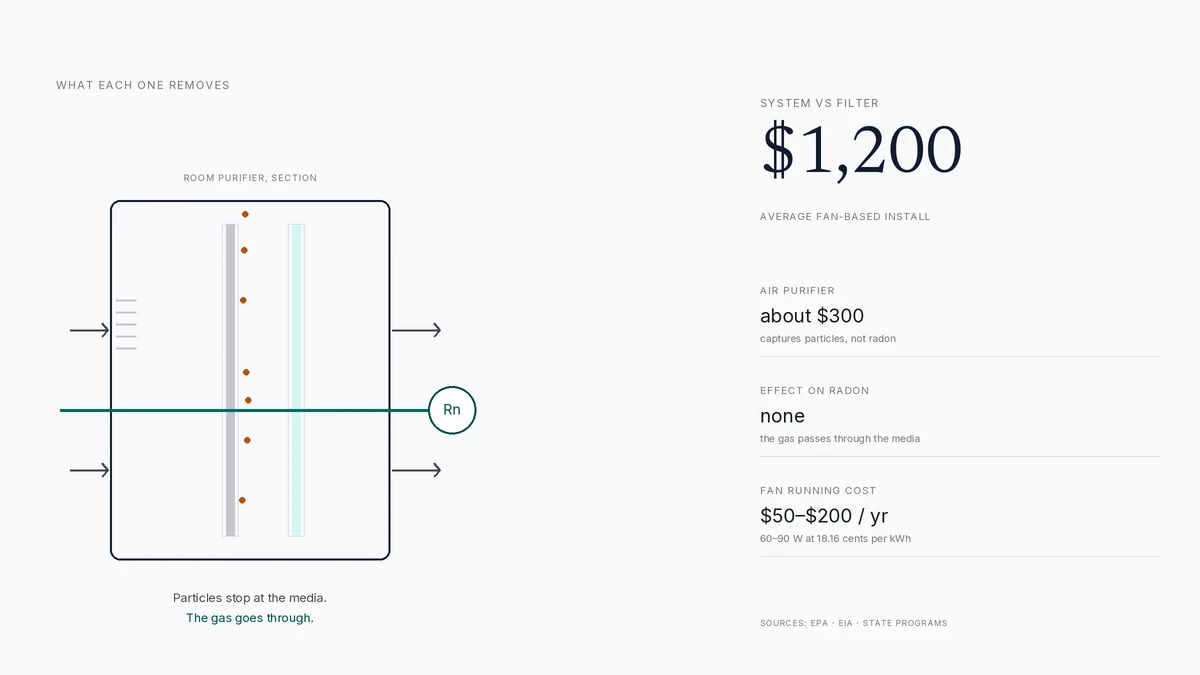
An air purifier cannot remove radon. HEPA media captures particles, and radon is a single-atom gas that passes straight through the filter. A mitigation system at $1,200 average stops the gas entering and vents it above the roof. A purifier still helps with dust.
- Purifier effect on radon
- None measurable
- What it does remove
- Particles and some odours
- Mitigation installed
- $800–$2,500
- Fan running cost
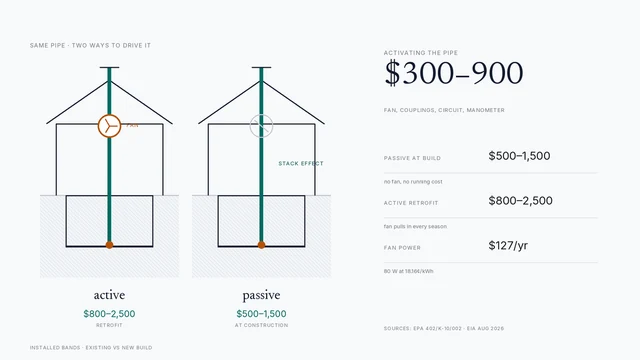
- about $127 a year
Some links on this page are affiliate links.If you buy through them we may earn a commission at no extra cost to you. We do not accept payment for rankings. Read the full disclosure.
| Air purifier | Radon mitigation | |
|---|---|---|
| What it targets | Particles, smoke, pollen, some odours | Radon gas in the soil under the house |
| Mechanism | Moves room air through filter media | Reverses the pressure gradient and vents above the roof |
| Effect on radon | None measurable; the gas passes through | Typically below 2 pCi/L after a working install |
| Purchase price | Around $300 for a room unit | $800–$2,500, near $1,200 typical |
| Running cost | Filters and a small fan motor | About $127 a year for a 60–90 W fan |
| Proof it worked | Particle counts and symptom relief | Post-install radon test |
An air purifier and a radon mitigation system both promise cleaner indoor air, and only one of them addresses radon. A purifier pulls room air through a filter and returns it to the room. Radon is a chemically inert gas whose atoms are single and uncharged, so there is no surface for a filter to capture and nothing for carbon to bond to the way it bonds to many solvents and odours. Mitigation stops the gas from entering at all.
Why a filter cannot catch radon
HEPA media works by interception, impaction and diffusion. Particles are trapped in the fibre mat because they are large enough to hit a fibre or too slow to follow the airstream around one. A radon atom is a fraction of a nanometre across, far below the finest particle a HEPA filter is rated for, and it behaves like a gas molecule rather than a particle. It travels through the media with the air.
Activated carbon is the second stage in most purifiers, and it does adsorb some gases. Radon is a noble gas: it does not react, it does not bond, and whatever clings to carbon is displaced as more air passes through. A carbon filter that has been in a room for a month has already taken up what it is going to take. What comes out the other side is the same concentration that went in.
What HEPA and carbon media actually remove
A purifier earns its price on particles: fine dust from cooking and traffic, pollen, pet dander, mold spores and some odours. Carbon adds a stage for volatile organic compounds and smells. None of that is wasted in a house with a wood stove, a cat and a road outside the window.
It is a different list from radon. EPA’s guidance is built around keeping soil gas out of the house and venting it above the roofline, not around treating the air once it is inside. That is the design premise of a mitigation system, and no filter stage in a portable unit reproduces it.
Dilution is not removal
Opening windows or running a ventilation fan lowers a radon reading by mixing indoor air with outdoor air, which averages about 0.4 pCi/L against an indoor average near 1.3 pCi/L. The effect is real and temporary. Close the windows and the concentration climbs back to whatever the soil is delivering, because the entry path was never closed.
A heat-recovery ventilator is the serious version of the same idea. EPA lists HRV systems at $1,200–$3,500 installed for tight houses where dilution is the available strategy. Even there it appears as a limited case, not a replacement for depressurization in a house with a normal foundation.
The money comparison
| Item | Air purifier | Radon system |
|---|---|---|
| Purchase | around $300 for a room unit | $800–$2,500, near $1,200 |
| Target | particles and odours | soil gas under the house |
| Effect on radon | none measurable | typically below 2 pCi/L |
| Running cost | filters and a small motor | about $127 a year |
| Proof | particle counts | post-install radon test |
A fan-based system runs $800–$2,500 installed, averaging near $1,200 by EPA’s published band, and a mid-range room purifier sells for a few hundred dollars. The cheaper device is cheaper because it does a smaller job, not because it is a bargain.
Then add the running cost. A mitigation fan draws 60–90 W and costs about $127 a year at the August 2026 US average of 18.16 cents per kWh, comfortably inside EPA’s $50–$200 budget line. A purifier adds filter replacements and its own electricity, and it still leaves the radon where it was. If the goal is a lower number on a test, the $300 unit is the expensive mistake, because you pay for it and then pay again for the system.
Where a purifier still earns its place
A purifier is a reasonable purchase for the problems it was built for: wildfire smoke, a damp basement smell, a bedroom shared with a cat, a workshop with fine dust. In a house that also has a radon system, the two run side by side without interfering, because one moves soil gas and the other moves room air.
Placement is the only caution. A purifier next to a suction point does nothing for radon, and a unit with an ozone generator adds an irritant rather than removing one. Size the unit to the room, check the filter cost per year, and treat it as an air-quality appliance rather than a radon device.
That also means the purifier belongs where the particles are. A unit in a basement bedroom does nothing for a kitchen full of cooking smoke, and a single unit rarely covers a whole floor. Match the room, the airflow rating and the filter class to the problem, and leave the radon question to the equipment that addresses pressure rather than air.
What the mitigation system does differently
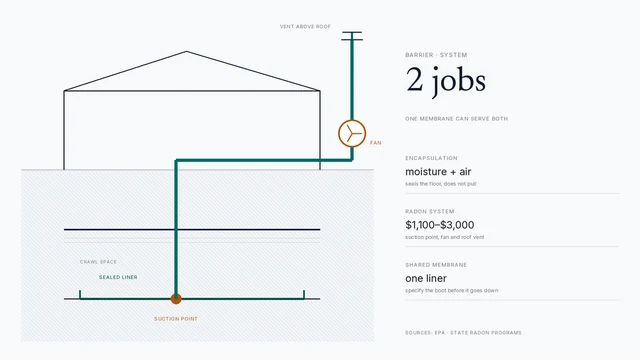
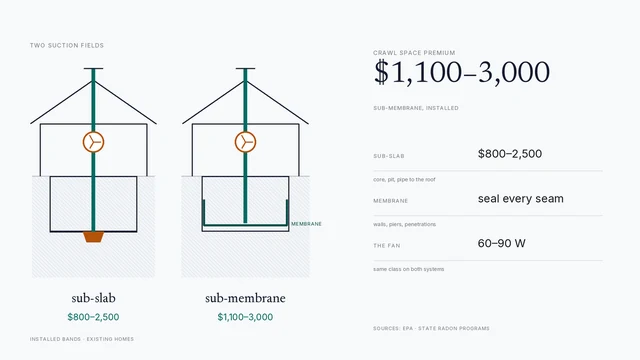
Radon mitigation changes the pressure under the house. A pipe runs from a suction point beneath the slab or the crawl-space membrane to a fan mounted outside or in the attic, and the fan exhausts above the roofline. Because the soil now sits at a lower pressure than the basement, soil gas flows toward the pipe instead of through the floor.
The result is measured, not assumed. A post-install test after at least 24 hours of operation shows whether the level fell, with below 2 pCi/L as the usual target. No purifier comes with that kind of evidence, because there is no mechanism inside it that could produce the result. The systems guide explains what the hardware contains and how the suction field is sized.
Test first, then choose
You cannot choose between the two until you know the number. A short-term kit costs $15–$45 with lab analysis, and a certified measurement runs $150–$250. A result under 2 pCi/L means neither purchase is about radon. A result at 4 pCi/L or above means a system, and the purifier becomes a separate decision about dust.
The one mistake that costs real money is treating a purifier purchase as a way to postpone testing. It is not a cheaper first step. It is a purchase that answers a question nobody asked.
The order to spend
Test, mitigate if the number calls for it, then handle the other air problems with tools built for them. That order keeps each dollar attached to the problem it solves.
The cost breakdown shows where the $1,200 goes and which lines vary by house. The comparison section sets this choice against the other decisions homeowners face. If someone is selling a purifier as a radon solution, the honest question is which test will show it worked. There is no answer, because a filter cannot remove a gas it cannot catch.
How to do it
- Test the house before buying anythingA short-term kit costs $15–$45 with lab analysis and a certified measurement runs $150–$250. Without a number, you cannot tell which device addresses your actual problem.
- Read the result against the action levelEPA sets the action level at 4 pCi/L and says consider fixing between 2 and 4. Below 2 pCi/L, neither a system nor a purifier is a radon purchase.
- Price the mitigation system properlyAsk for the fan model, the suction-point count, the pipe route and whether the permit and post-install test are included. A bid that names none of those is not comparable.
- Choose a purifier for the air problem it solvesBuy for smoke, dust, pollen or odour, size it to the room, and skip ozone generators. Do not expect it to change a radon reading in either direction.
- Verify the system with a post-install testRun a short-term test after at least 24 hours of fan operation, targeting below 2 pCi/L, then retest every two years or after a major renovation or HVAC change.
Frequently asked questions
Do HEPA air purifiers remove radon gas?
No. HEPA media traps particles by interception and impaction, and a radon atom is smaller than any particle the filter is rated to catch. It travels through the media with the airstream and returns to the room. A HEPA filter is excellent at smoke and pollen and has no mechanism for a noble gas.
Does the carbon filter in a purifier absorb radon?
Only weakly and briefly. Activated carbon adsorbs many gases well, but radon is chemically inert, so it does not bond to the media the way solvents and odours do. Whatever small amount clings to the carbon is displaced as more air passes through, and the room concentration does not change in any way a test would register.
Will opening windows lower a radon reading?
Yes, temporarily. Ventilation dilutes indoor air with outdoor air, which averages about 0.4 pCi/L against an indoor average near 1.3 pCi/L. Close the windows and the level returns to whatever the soil is delivering, because the entry path was never closed. Dilution changes the reading, not the source.
How much does a radon system cost compared with a purifier?
EPA puts a fan-based system at $800–$2,500 installed, averaging near $1,200, and a mid-range room purifier sells for a few hundred dollars. The purifier is cheaper because it does a smaller job. If the goal is a lower radon number, the purifier is money spent before the system you still need.
Is a heat-recovery ventilator a better option than a purifier?
An HRV is a genuine ventilation system, not a filter, and EPA lists it at $1,200–$3,500 installed for tight houses where dilution is the available strategy. It is still a limited case rather than a substitute for depressurization, and it moves more air than any room purifier.
Can I run a purifier and a radon system together?
Yes. They do different jobs and do not interfere. The radon system holds the soil at a lower pressure and vents above the roof; the purifier moves room air through a filter. Keep the purifier away from the suction point, and avoid ozone-generating models, which add an irritant rather than removing one.
Sources
Some links are affiliate links.If you buy through them we may earn a commission at no extra cost to you. We do not accept payment for rankings. Read the full disclosure.