Sub-slab vs sub-membrane depressurization
Sub-slab covers basements and slabs at $800–$2,500; sub-membrane covers crawl spaces at $1,100–$3,000. Suction fields, sealing and the failure modes.
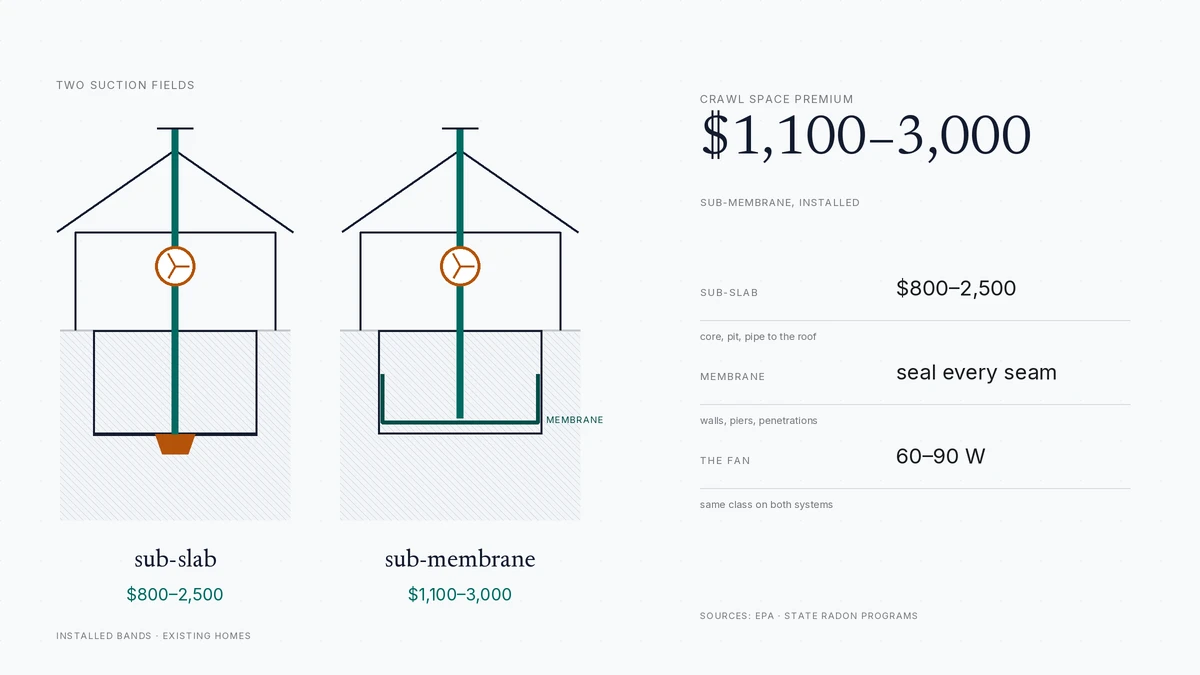
Sub-slab depressurization pulls soil gas through a core in a basement or slab floor and costs $800–$2,500. Sub-membrane depressurization seals a crawl space under a membrane and draws from beneath it, at $1,100–$3,000. The foundation decides which one you need.
- Sub-slab installed
- $800–$2,500
- Sub-membrane installed
- $1,100–$3,000
- Sub-slab fits
- basement, slab-on-grade
- Sub-membrane fits
- crawl space
Some links on this page are affiliate links.If you buy through them we may earn a commission at no extra cost to you. We do not accept payment for rankings. Read the full disclosure.
| Sub-slab (SSD) | Sub-membrane (SMD) | |
|---|---|---|
| Foundation | Basement or slab-on-grade with a concrete floor | Crawl space with a dirt or gravel floor |
| Installed band | $800–$2,500, near $1,200 typical | $1,100–$3,000 |
| Suction field | Soil and gravel directly under the slab | The sealed volume between membrane and soil |
| Critical seal | Slab cracks, sump lid, pipe and floor penetrations | Membrane seams, wall and pier edges, all penetrations |
| Typical failure | Short-circuit through an open sump or a divided slab | Torn or unsealed membrane, or membrane pulled flat against the dirt |
| Best fit | Most basements and slab floors | Vented or unconditioned crawl spaces |
Sub-slab and sub-membrane depressurization are the two ways to pull radon-bearing soil gas out from under a house. Sub-slab depressurization cores through a concrete floor and draws from the soil beneath it, and covers basements and slab-on-grade homes at $800–$2,500 installed. Sub-membrane depressurization seals a crawl-space dirt floor under a plastic membrane and draws from the sealed volume below it, at $1,100–$3,000. The physics is identical; the suction field and the sealing are not.
The same physics, two foundations
Both systems do one thing: put the soil under the house at a lower pressure than the house itself, so soil gas flows toward a pipe instead of through the floor. A fan at the top of the pipe exhausts above the roofline, and a U-tube manometer on the pipe shows the pressure difference.
What changes is what the fan is pulling against. A slab is a rigid lid with a finite set of holes. A crawl space is an open volume with a dirt floor — effectively no lid at all until one is installed. That single difference drives the design, the price and the failure modes.
Sub-slab depressurization
The installation is a core through the slab, a small suction pit excavated under it, a pipe rising through the house or up an exterior wall, and a fan near the top. The pit is connected to the gravel or soil under the slab, and the fan draws the whole field down.
For the field to hold, the slab has to be reasonably intact and the openings have to be closed. Cracks get sealed, the sump gets an airtight lid, and pipe and floor penetrations get caulked. A slab divided by a footing or a separate pour for an addition may need a second suction point, because pressure does not travel across the break.
Sub-slab is the default because it fits the most common foundation and uses the least material. EPA’s band is $800–$2,500 installed, averaging near $1,200, and the cost guide explains the spread. The foundation guide covers the variants: slab-on-grade usually ties to a sump or a drain tile, hollow-block walls often use the wall cavities as the field.
Sub-membrane depressurization
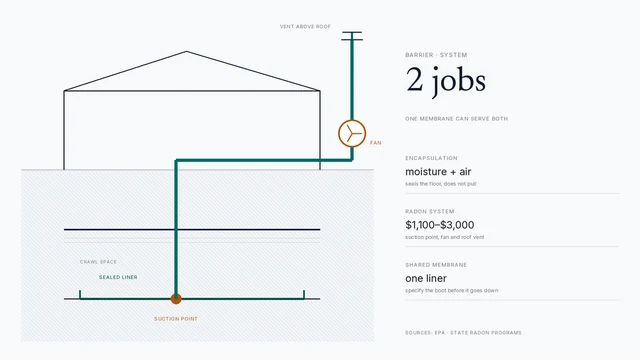
A crawl space has no slab to pull against, so the installer creates the lid. A reinforced plastic membrane is laid over the dirt, run up the walls and around piers, and sealed at every seam and penetration. The fan then draws from the void between membrane and soil.
That void is the plenum, and its quality decides the system. A membrane that is sealed at the edges but loose in the middle works. A membrane that is stapled at the rim and torn at a pier does not: the fan pulls room air through the tear and the soil stays at atmospheric pressure.
The band is $1,100–$3,000 installed. The extra over sub-slab is membrane, seam tape, edge sealing and the labor to crawl around a low space doing all of it. Some installs also add a small amount of gravel or a drainage mat under the membrane to keep the plastic from being sucked flat against wet dirt, which would choke the field.
Cost against cost
| Item | Sub-slab | Sub-membrane |
|---|---|---|
| EPA-linked band | $800–$2,500 | $1,100–$3,000 |
| Typical landing point | near $1,200 | upper half of the band |
| Extra material | core, pit, sealant | membrane, tape, edge seal |
| Extra labor | one core, one route | sealing a whole floor |
| Fan and pipe | same class | same class |
The fan is not the difference. Both systems use a residential fan in the 60–90 W class, and both cost roughly $127 a year to run at the August 2026 US average of 18.16 cents per kWh. What you are paying for in the higher band is the membrane work.
The suction field is the real difference
A sub-slab field is three-dimensional and bounded by the slab. Pressure radiates from the suction pit through gravel or permeable soil until it meets a footing, a grade beam or the edge of the pour. The practical reach depends on soil permeability: sand and gravel communicate well, tight clay does not, and a second point is often the answer.
A sub-membrane field is a thin horizontal void with a large area and a lot of perimeter. It communicates easily in the middle and badly at the edges, which is why edge sealing matters more than the fan size. It also has a failure mode sub-slab does not: the membrane can be pulled down against the dirt and block its own airflow.
That is the mechanism behind most “the system is running but the number did not drop” calls on a crawl space. The gauge shows suction because the fan is working, but the field is restricted. The fix is usually re-lifting and re-sealing the membrane, not a bigger fan.
Sealing is where these systems fail
On a sub-slab job, the leaks that matter are the obvious ones: an open sump pit, a floor drain, a crack along the wall, a pipe penetration, a redundant radon stub. Each is a short circuit that lets the fan pull conditioned air instead of soil gas.
On a sub-membrane job, the leaks are the whole perimeter. Every seam, every pier wrap, every pipe and every wall junction is a potential short circuit, and a single failed seam can carry most of the airflow.
Both cases have the same diagnostic: a smoke test or a pressure-field check at commissioning, plus the U-tube reading. A contractor who installs, watches the gauge and leaves without testing the field has skipped the step that separates a working system from a fan in a pipe.
Mixed foundations
A house with a basement plus a crawl-space wing is the common hard case. The two areas have different fields, different leakage and often a wall between them. One suction point in the basement will not depressurize the crawl space, and one membrane in the crawl space will not help the slab.
The usual answers are two suction points on two runs, or one fan with a deliberate transfer that connects the two fields and a damper to balance them. Both are legitimate; both cost more than a single-zone install, and both need to be described in the bid. If a quote for a mixed foundation names one suction point and no transfer, ask what it expects the second area to do.
Choosing and verifying
Choose by floor, not by price. A basement or slab gets sub-slab. A crawl space gets sub-membrane. A mixed foundation gets a plan for each area, priced honestly.
Then verify. The U-tube should show an offset within a minute or two of startup. After at least 24 hours of operation, run a short-term radon test; below 2 pCi/L is the target. If the number stays at or above 4, the system has a field problem to diagnose, and the answer is rarely a larger fan.
The comparison section sets these two against the other system types, and the systems section covers fans, pipe routing and indicators. The decision itself is simple: find out what is under the floor, then seal it and pull.
How to do it
- Identify the floor you actually haveA concrete slab over soil takes sub-slab. A dirt crawl space takes sub-membrane. A house with both needs a plan for each area, not one system stretched across two.
- Seal before you suckFor sub-slab, seal cracks, the sump lid and penetrations. For sub-membrane, seam and edge-seal the membrane and wrap every pier. Suction through an unsealed field just moves indoor air.
- Size the field to the footprintOne suction point suits a simple slab or a compact crawl space. Divided slabs, additions on their own pour and long crawl spaces often need a second point or a transfer opening.
- Watch the gauge at startupA U-tube offset within a minute or two shows the fan is pulling. No offset points to a leak, a blocked pipe or a fan running the wrong way, not to a bad fan.
- Test after 24 hours and log itRun a short-term test once the system has operated for at least 24 hours. Below 2 pCi/L is the target; retest every two years or after a major renovation or HVAC change.
Frequently asked questions
What is the difference between sub-slab and sub-membrane depressurization?
Sub-slab depressurization cores through a concrete slab and draws soil gas from the gravel or soil beneath it. Sub-membrane depressurization covers a crawl-space dirt floor with a sealed membrane and draws from the space between the membrane and the soil. The fan and pipe are similar; the suction field and the sealing are not.
Which system costs more?
Sub-membrane runs higher, at $1,100–$3,000 installed against $800–$2,500 for sub-slab. The difference is the membrane and the labor to seal it to the walls, piers and penetrations before suction can work. The fan, pipe and electrical work are broadly the same on both.
Can a crawl space use a sub-slab system?
No. Sub-slab suction needs a continuous slab to pull against and to keep the field under negative pressure. A crawl space has a dirt floor and open volume, so the air short-circuits through the space itself. You either pour a slab or seal the dirt under a membrane, and the membrane is almost always cheaper.
Why does a crawl space need a membrane before suction?
Without a membrane the fan pulls indoor air through the crawl space instead of soil gas from beneath it. The membrane creates a plenum: a sealed volume between the plastic and the dirt that the fan can depressurize. Every seam, edge and pipe penetration has to be sealed, or the field leaks.
What happens when a house has both a basement and a crawl space?
It usually gets two suction points or a deliberate transfer between zones. A basement slab and a crawl-space membrane are different fields with different leakage, so one fan may not depressurize both. The bid should name how many suction points and how the two areas are separated.
How do I know the system is working?
The U-tube manometer on the pipe shows an offset while the fan runs; level fluid means no suction. The proof is a post-install radon test after at least 24 hours of operation, targeting below 2 pCi/L. Then retest every two years or after a major renovation or HVAC change.
Sources
Some links are affiliate links.If you buy through them we may earn a commission at no extra cost to you. We do not accept payment for rankings. Read the full disclosure.