Why radon mitigation quotes vary from $1,200 to $3,400
Same house, three bids, a $2,000 spread. The line items that actually move a radon quote, and how to compare bids without guessing.
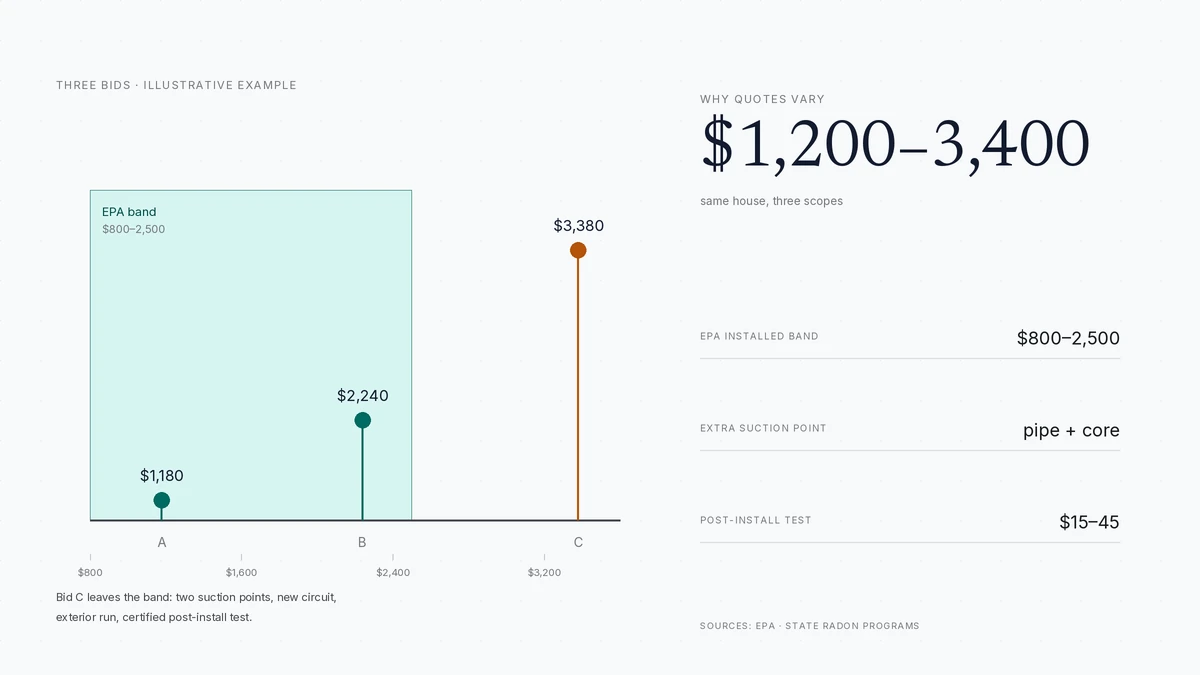
EPA's band for a fan-based system is $800–$2,500, but quotes on comparable houses commonly spread from about $1,200 to $3,400. The gap is suction-point count, foundation type, pipe routing, permit and electrical work, and whether the post-install test sits inside the price.
- EPA installed band
- $800–$2,500
- Real quote spread
- about $1,200–$3,400
- Extra suction point
- pipe, core, labor
- Post-install test
- $15–$45 kit
Some links on this page are affiliate links.If you buy through them we may earn a commission at no extra cost to you. We do not accept payment for rankings. Read the full disclosure.
| Low bid, $1,300 | High bid, $2,900 | |
|---|---|---|
| Suction points | One, through the slab | Two, front and rear of the footprint |
| Fan | Standard model, often unnamed | Named model sized to the pipe run |
| Permit | Not mentioned | Pulled and inspected |
| Electrical | Taps an existing circuit | Dedicated circuit with disconnect |
| Post-install test | Left to the homeowner | Included, with a written target |
A radon mitigation quote prices a specific piece of work — this many suction points, this pipe route, this fan — not the radon level itself. Contractors look at the same basement and see different jobs. Bids on comparable houses commonly spread from about $1,200 to $3,400, and the total alone tells you nothing about which one is right. An illustrative three-bid example shows the shape: $1,180 for a single-point basement, $2,240 once a second point and an exterior run are added, and $3,380 when a new circuit and a certified post-test join the scope.
What the EPA band covers, and what it does not
EPA’s Consumer’s Guide to Radon Reduction (402/K-10/002, January 2010) puts a fan-based sub-slab system in an existing home at $800–$2,500 installed, with a national average near $1,200. The band describes the ordinary case: one suction point, a standard fan, a short pipe run, a slab foundation, no electrical upgrade.
Everything a house adds beyond that case pushes toward the top of the band or past it: a crawl-space membrane, a second suction point, a new circuit, a roof penetration over a finished ceiling. The band is a calibration point, not a ceiling. The full cost breakdown sets out the system bands by foundation type.
The seven lines that move the number
Almost all of the spread between two bids sits in seven items, and each one is a decision the contractor made before writing the number.
Suction points. One is standard. Two or three appear when footings divide the slab, when an addition sits on its own pour, or when tight soil will not transmit pressure across the footprint.
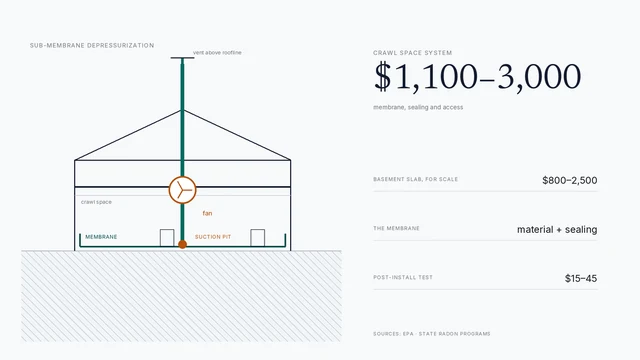
Foundation type. A slab is a core, a seal and a pipe. A crawl space is a membrane over the dirt, a field of sealed seams and penetrations, and often digging before any of that starts.
Pipe routing. An interior run hides the pipe but crosses framing, closets and a ceiling. An exterior run is faster but needs weatherproofing, paint and a clean wall or roof penetration.
Permit. Some jurisdictions require one and inspect the work; others issue nothing. The fee is small, usually $0–$150, but the inspection changes the schedule.
Electrical. A dedicated circuit, a service disconnect, or a run from a distant panel puts an electrician on the job alongside the mitigator.
Post-install test. A short-term kit with lab analysis costs $15–$45; a certified measurement runs $150–$250. Either belongs in the contract, because it is the only evidence the system works.
Warranty and guarantee. A written target level with a remedy if the test misses costs the contractor something real, and that cost lands in the price.
The suction-point line deserves its own explanation, because it is the biggest single multiplier. Pressure travels through soil in a rough radius, not across an entire footprint. A footing, a grade beam or a foundation wall interrupts that field, which is why a divided slab or a house with an addition often needs its own point. Two points are not twice the price of one, but they are routinely several hundred dollars apart once pipe, a manifold, a larger fan and the extra labor are counted.
Foundation, access and routing
A crawl space is the single most common reason a quote leaves the EPA band. The membrane itself is material cost; the labor is the sealing, and the sealing is where jobs go long. Every seam, every penetration, every pier, every access hatch has to be closed before the fan can pull a pressure field under the floor.
Access matters as much as area. A crawl space you can kneel in, with a hatch wide enough for a roll of membrane, is a different afternoon from one you enter on your stomach through a tight opening, with standing water and a duct at knee height. The foundation-type guide covers how each foundation changes the method and the band.
Routing is the other variable. An interior run crosses framing, closets and a ceiling that may need drywall repair; it is out of the weather and out of sight, and slower to install. An exterior run is quicker but faces freeze-thaw and sun, and needs a weatherproof penetration plus a termination that clears windows and doors by the distance local code sets. When two bids differ by several hundred dollars on the same house, routing is usually why.
Permit, electrical and the post-install test
These three lines are the ones most often quietly left out, and together they can explain a few hundred dollars of a gap.
A permit means an inspector looks at the label, the fan disconnect, the vent termination and the manometer before the job is closed. Electrical work may need its own permit and its own trade. A post-install test means a return visit or a kit plus a lab fee, and it produces the number that goes into the file at resale.
None of these is optional in a system you intend to rely on. A bid that omits all three is not cheaper; it is a bid for less work.
Why bids spread from $1,200 to $3,400
Picture three bids on a 1960s ranch with a basement and a crawl-space addition.
The low bid covers one suction point in the basement slab, a standard fan, an interior run, no permit and no test, and lands near the EPA average. The middle bid adds the crawl-space membrane and its sealing, pulls the permit, includes a short-term test, and states a target of below 2 pCi/L. The high bid covers two suction points, a dedicated circuit, an exterior run with a chase, a certified measurement and a multi-year guarantee, and lands near $3,400.
All three are honest. Only one matches what the house needs, and the way to find out which is to compare the scopes rather than the totals.
How to normalize three bids line by line
Build a one-page grid with a row per line item and a column per bidder, then fill it in before you discuss price.
- Suction points: how many, and where.
- Fan: make and model number, or nothing.
- Pipe route: interior or exterior, and where it terminates.
- Membrane and sealing: included, excluded, or not applicable.
- Permit: pulled by the contractor, by you, or not at all.
- Electrical: existing circuit, new circuit, disconnect.
- Post-install test: kit, certified measurement, or absent.
- Guarantee: target level, remedy, duration.
- Exclusions: drywall, paint, landscaping, sump lid.
Any row where one column is blank is a row where that bid is not comparable. Ask the bidder to fill it, in writing, before you decide. A contractor who will not put the fan model and the target level on paper is telling you something about the rest of the job.
Red flags in a cheap bid
No model number. A fan is selected by flow at a given pressure. “Standard fan” means the bidder has not chosen one, or does not want you to check the price.
Cash only, no permit. Unpermitted work becomes a disclosure problem when you sell, and an inspector who never saw the job cannot vouch for the vent termination or the disconnect.
An oversized fan. More power is not more suction. An oversized fan pulls harder than the slab needs, runs louder, draws more current and does not lower the number further.
No certification number. NRPP certification, or a state license where the state issues one, is the credential to ask for. It should be on the contract, not just the truck.
The number to compare last
Price is the last column, not the first. Normalize the scope, confirm the permit and the test are inside it, then compare totals. After that, add the running cost: a mitigation fan draws 60–90 W, and at the August 2026 US average of 18.16 cents per kWh an 80 W fan costs about $127 a year. The calculator runs that arithmetic with your own rate.
Then hold the winner to the sequence that makes the money worth spending: install, run the system for at least 24 hours, test, and keep the result with the fan model and the warranty. A $2,900 system with a passing test and a paper trail is cheaper than a $1,300 system nobody can verify.
How to do it
- Ask for the same scope in writingSend every bidder the same request: suction-point count, fan model, pipe route, permit, electrical, post-install test, warranty. Identical requests produce comparable numbers.
- Separate the system from the extrasPut the core system on one line and everything optional on another. A bid that bundles the test, the permit and the warranty into one total cannot be compared with one that does not.
- Price the second suction pointIf one bidder proposes two points and another one, ask the single-point bidder what a second would add. That single question explains most of the gap between the two totals.
- Check what the test actually isA short-term kit with lab analysis is not the same as a certified measurement. Ask which one is included, who pays the lab, and whether the result goes into the contract.
- Read the guarantee, not the warrantyA fan warranty covers a part. A performance guarantee states the level the system should reach and what the contractor does if a post-install test misses it.
- Compare the ten-year numberAdd the install, the fan electricity at roughly $127 a year, and one fan replacement at $150–$450. A cheap system that needs a second visit is rarely the cheaper system.
Frequently asked questions
Why do radon mitigation quotes vary so much for the same house?
Because the bids usually describe different systems. One contractor prices a single suction point with a standard fan and no test; another prices two points, an exterior run, a new circuit and a certified post-install test. The totals differ by the scope, not by the radon level, which every bidder measured the same way.
Is the cheapest radon quote usually the worst one?
Not automatically, but a bid far below the EPA band deserves questions. Common reasons for a low number are a missing permit, a fan with no model number, no post-install test, or a single suction point on a foundation that needs two. Ask what each of those would add, then compare the corrected totals.
How many suction points does a house need?
Most houses need one. A second appears when footings divide the slab, when an addition sits on its own pour, or when tight soil stops pressure from traveling across the footprint. The count should follow the foundation, not the price the contractor wants to reach.
Should the post-install test be in the quote?
Yes. A short-term test after at least 24 hours of operation is the only proof the system reached its target, usually below 2 pCi/L. A kit with lab analysis costs $15–$45 and a certified measurement runs $150–$250, so either is a small line. If it is missing, ask for it in writing.
What does a radon permit cost?
Usually $0–$150 depending on the jurisdiction, and some jurisdictions issue no radon permit at all. Electrical work may need a separate permit from the same office. The fee is minor; the inspection and the paper trail are the reason to want it.
Can two contractors both be right about the price?
Yes, if they are pricing different work. A $1,300 bid and a $2,900 bid can both be honest when one covers a slab with one point and the other covers a crawl space with a sealed membrane and two points. Normalize the line items before you decide which is expensive.
Sources
Some links are affiliate links.If you buy through them we may earn a commission at no extra cost to you. We do not accept payment for rankings. Read the full disclosure.