What to do after a high radon test result
A high reading is a starting point, not an emergency. Confirm the number, treat 2–4 pCi/L differently from 4+, get three bids, then retest after the install.
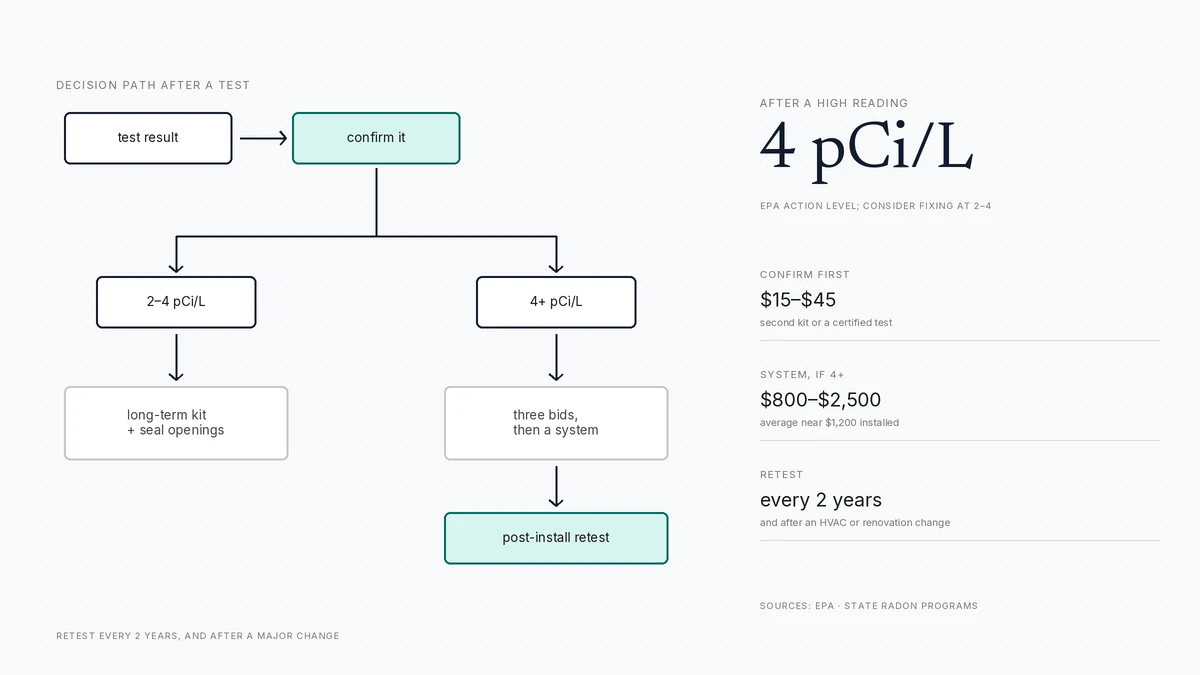
Confirm the reading before you spend anything: a second kit at $15–$45 or a certified test at $150–$250. Between 2 and 4 pCi/L, EPA says consider fixing. At 4 or above, get three bids on a system at $800–$2,500, then test again after it runs.
- EPA action level
- 4 pCi/L
- Consider fixing
- 2–4 pCi/L
- Confirming test
- $15–$45 kit
- System installed
- $800–$2,500
Some links on this page are affiliate links.If you buy through them we may earn a commission at no extra cost to you. We do not accept payment for rankings. Read the full disclosure.
| 2–4 pCi/L | 4 pCi/L and above | |
|---|---|---|
| What EPA says | Consider fixing | Fix the home |
| First move | Long-term test or a repeat short-term test | Confirm, then start collecting bids |
| Typical spend now | $20–$50 for a long-term kit | $800–$2,500 for a system |
| Sealing openings | Worth doing; may be enough with monitoring | Worth doing, but not a substitute for a system |
| Timeline | Weeks to months, with a retest | Weeks, with the post-install test booked |
A high radon test result means the air in the tested room held more radon than EPA’s action level of 4 picocuries per liter, or landed in the 2–4 band where EPA says consider fixing. It does not mean the house is unsafe to enter today. The next steps are orderly: check that the test was valid, confirm the number, and then spend money in proportion to what the number actually says.
Read the number before you react
Radon risk is cumulative. It comes from years of breathing elevated concentrations, not from one week of them, which is why a reading of 6 pCi/L is a reason to act within weeks rather than to move out tonight. EPA estimates about 1 in 15 US homes sits at or above the action level, so the result is common rather than exotic.
The number also needs context. A short-term kit measures 2–4 days. A long-term kit at $20–$50 measures 90 days or more, and its average is the better basis for a decision near the line. A continuous monitor at $100–$200 shows how the level moves hour by hour, which is useful for understanding the house but not for a real-estate decision.
Where the kit sat matters as much as what it read. A result from a basement family room describes a room people use every evening. The same result from a sealed crawl space describes a space nobody occupies, and calls for less urgency. The lowest lived-in level is the one that governs exposure, which is why the kit belongs there and not wherever the shelf was free.
Confirm the result
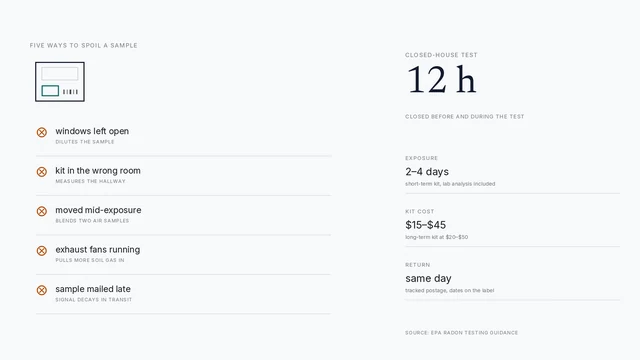
Before any contractor visits, check two things: whether the test conditions were valid, and whether the number reproduces. The first is a matter of record. EPA’s closed-house rule is 12 hours before and during the exposure, with windows and exterior doors shut, so a test taken with a slider open is a reason to retest rather than to mitigate.
The second is cheap. A second short-term kit costs $15–$45, and a certified measurement runs $150–$250. If the first reading was 12 pCi/L, the confirmation will not change the plan. If it was 4.4 pCi/L in a drafty week, the confirmation may save the entire project.
If the reading is between 2 and 4 pCi/L
EPA’s guidance in this band is to consider fixing, which is deliberately a judgment rather than an instruction. Three inputs make the decision easier: a long-term average, the lowest lived-in level, and whether anyone sleeps or works there.
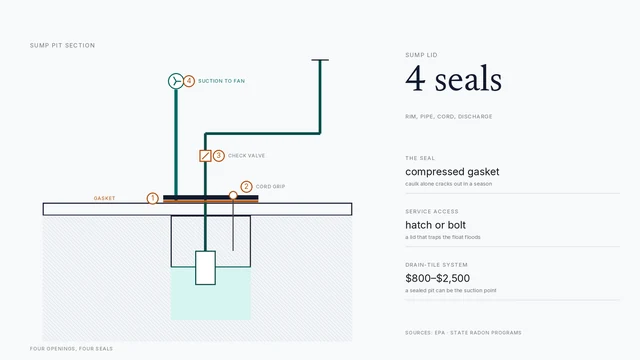
A long-term kit gives the year-round number and removes the seasonal question, since a sealed January house and an open June house are not measuring the same thing. Sealing obvious openings — an airtight sump lid, caulk at slab cracks, gaskets on floor drains — is cheap, reversible and useful in either case. If the average sits near 4 and the house has a basement that gets used, a system is usually the reasonable call.
If the reading is 4 pCi/L or above
At or above the action level, EPA’s advice is to fix the home. That means a fan-based depressurization system, priced at $800–$2,500 installed with a national average near $1,200. The cost guide explains what moves the number, and the cost section covers the bands by system type.
Do not sign the first quote. The spread between bids in the same market is wider than the EPA band suggests, and the differences are usually visible in the line items: the fan model, the suction-point count, whether the permit is included, and whether the post-install test is included.
There is also no reason to air the house out while you wait. Opening windows lowers a reading, but the number that matters is the one the house produces when it is closed, which is how it spends the winter. A contractor who tests a ventilated house is measuring your open windows rather than your foundation.
Get three bids and compare the lines
Three quotes give you the local range and a sense of which contractor is explaining the house rather than selling a package. The foundation-type guide tells you what your foundation should require, which is the benchmark for judging whether a bid is describing your house.
| Line to check | Why it matters |
|---|---|
| Fan model | Determines airflow, noise and warranty |
| Suction points | Should match the foundation, not the price |
| Pipe route | Interior and exterior runs fail differently |
| Permit | Protects you at resale |
| Post-install test | The only proof the system works |
| Written guarantee | Should name the target level and the remedy |
A bid that names a “standard fan” and one suction point for a house with a crawl space and a basement is not a bid yet. It is an estimate of what the contractor hopes to find.
Sealing is not mitigation
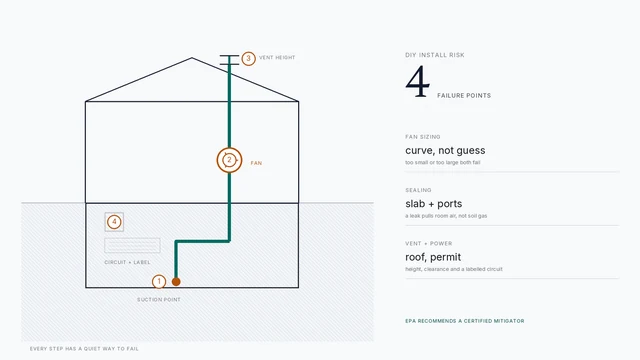
Caulking cracks and fitting a sump lid reduces entry, and it is worth doing. It does not put the soil under negative pressure, and in a house reading well above the action level it will not bring the number under 2 pCi/L on its own.
The distinction matters because sealing is the cheapest-looking option on the list, and a homeowner with a 9 pCi/L result can spend a weekend on it and still need the system. Do the sealing as part of the project, not as a substitute for it.
The post-install test
The system is not finished when the fan starts. EPA calls for a test after the system has operated for at least 24 hours, with the house closed as it was for the original test. Below 2 pCi/L is the usual target, and a contractor who guarantees a level should put it in writing with a remedy if the test misses.
If the retest stays at or above 4 pCi/L, the answer is diagnosis, not a second system. The usual causes are an unsealed opening, a short-circuited suction field, a fan that is too small for the field, or a blocked pipe. All of them are cheaper to fix than a new install, and all of them are the installer’s responsibility under a competent guarantee.
Retest every two years
Radon levels move with the house: a new furnace, a finished basement, a changed exhaust fan or a renovated crawl space can all shift the pressure balance. EPA’s schedule is a retest every two years, and after any major renovation or HVAC change.
Keep the results together with the system label and the install paperwork. The testing section covers the conditions for a valid retest, and the comparison section explains what the alternatives to a full system actually do. A high reading is a fact about the house, not a verdict on it, and the sequence above turns it into a decision you can defend.
How to do it
- Check the test conditions firstConfirm the house was closed for 12 hours before and during a 2–4 day test. A reading taken with windows open is a reason to retest, not a reason to call a contractor.
- Run a confirming testA second short-term kit at $15–$45 or a certified measurement at $150–$250. Same level of the house, same season if possible, same closed-house conditions.
- Match the action to the numberBetween 2 and 4 pCi/L, EPA says consider fixing: long-term test, seal openings, monitor. At 4 or above, plan a system and budget from the $800–$2,500 band.
- Get three itemised bidsAsk for the fan model, suction-point count, pipe route, permit status and whether the post-install test is included. Compare the line items, not the totals.
- Book the post-install testThe system proves itself only with a test after at least 24 hours of operation. Put it in the contract and target below 2 pCi/L.
- Log the result and retest in two yearsWrite the date, fan model and result on the system label or in the paperwork folder. Retest every two years and after any major renovation or HVAC change.
Frequently asked questions
Is a high radon result an emergency?
No. Radon risk comes from years of exposure, not from a single week, so a reading of 6 or 10 pCi/L is a reason to act within weeks rather than hours. Use the time to run a confirming test and get real bids instead of signing the first quote that arrives.
Should I retest before mitigating?
Yes, when the first result is close to the action level or the test conditions were imperfect. A second short-term kit at $15–$45 costs little and prevents a $1,200 system installed for a reading that was a draft away from 3 pCi/L. At very high readings the confirmation matters less than the installation.
What should I do at 2 to 4 pCi/L?
EPA says consider fixing in that band, which is a judgment call rather than a rule. A long-term kit at $20–$50 gives a year-round average, and sealing obvious openings is cheap. If the number sits at the top of the band and the house has a basement, a system is often the reasonable choice.
How many bids should I get for radon mitigation?
Three. Each bid should name the fan model, the suction-point count, the pipe route, whether the permit is included and whether the post-install test is included. Three quotes also show you the local spread, which is usually wider than the EPA band suggests.
What happens if the level is still high after installation?
The contractor should return and diagnose the system rather than sell a second one. Common causes are an unsealed sump or slab opening, a short-circuited suction field, a fan that is too small or a pipe that is blocked. A retest at or above 4 pCi/L with a new fan is a system problem.
How often should I retest after mitigation?
Every two years, and after any major renovation or HVAC change that alters how the house breathes. EPA also calls for a test after at least 24 hours of system operation at installation. Keep the results with the system paperwork so the next owner has a record.
Sources
Some links are affiliate links.If you buy through them we may earn a commission at no extra cost to you. We do not accept payment for rankings. Read the full disclosure.