DIY radon testing mistakes that skew results
Windows left open, a kit in the wrong room, a test moved mid-week, a late mail drop. The mistakes that turn a $30 kit into a number you cannot trust.
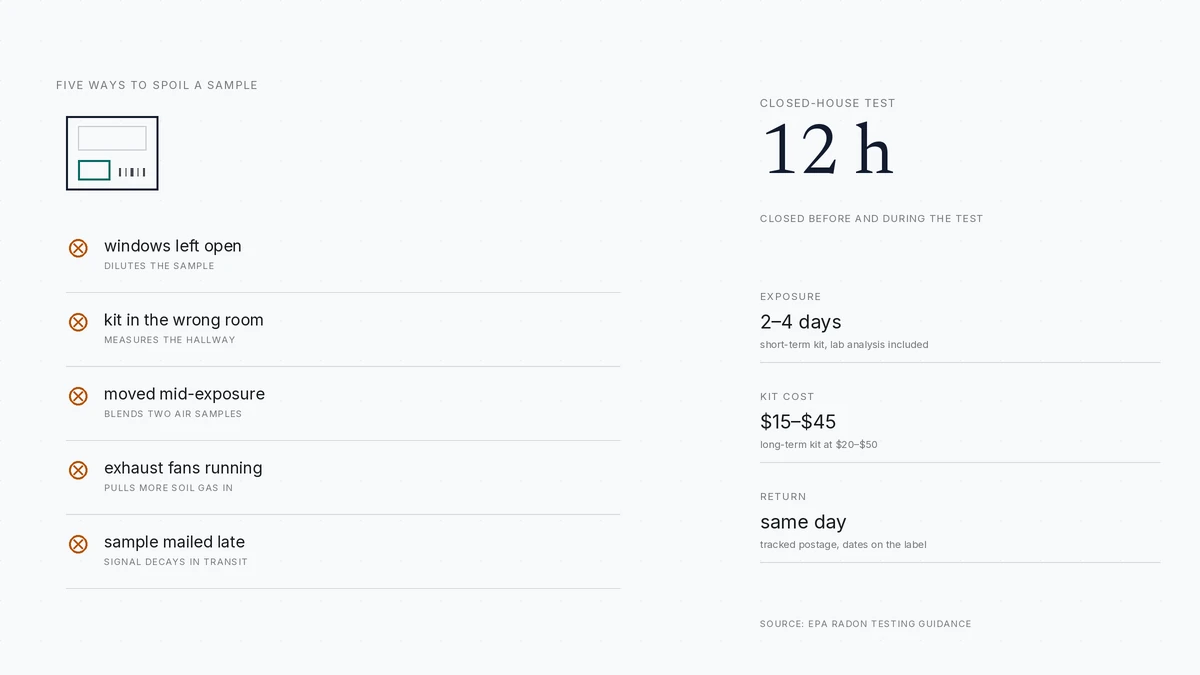
Most bad radon results come from test conditions, not the kit. Windows open, exhaust fans running, the device in a hallway or kitchen, a kit moved mid-exposure, or a sample mailed late all bias the number. EPA's closed-house rule is 12 hours before and during a 2–4 day test.
- Short-term kit
- $15–$45 with lab analysis
- Closed-house period
- 12 hours before and during
- Exposure window
- 2–4 days short-term
- Certified measurement
- $150–$250
Some links on this page are affiliate links.If you buy through them we may earn a commission at no extra cost to you. We do not accept payment for rankings. Read the full disclosure.
| Closed-house test | Windows-open test | |
|---|---|---|
| Windows and doors | Closed 12 hours before and throughout | Open, or opened for an hour a day |
| Exhaust fans | Off, apart from normal bathroom use | Running continuously or during cleaning |
| What the kit measures | The house as it normally operates | A diluted mixture of indoor and outdoor air |
| Typical bias | None from ventilation | Result reads low, sometimes far below the real level |
| Use for a decision | Yes, if placement and timing hold | No; retest under closed-house conditions |
DIY radon testing mistakes are usually mistakes of condition rather than equipment. A $15–$45 short-term kit with lab analysis is accurate enough to base a $1,200 decision on, provided the house is closed, the device sits in the right room, and the sample reaches the lab on time. Change any one of those and the number describes something other than the house you live in.
Testing with the windows open
This is the mistake that produces the most misleading results, because the bias always runs one way. Outdoor air averages about 0.4 pCi/L against an indoor average near 1.3 pCi/L, so a window left cracked for an afternoon dilutes the sample. A house that would read 5 pCi/L on a normal winter day can read 2 on a spring day with the slider open.
EPA’s answer is the closed-house condition: windows and exterior doors closed for 12 hours before the test begins and throughout the exposure. Normal coming and going through a door is fine. Propping one open for the dog is not. The point is to measure the house as it actually operates in the season when radon is highest, which is when it is sealed up.
Placing the kit in the wrong room
A kit in a hallway measures the hallway. A kit in a bathroom measures a small, ventilated, often damp room that nobody occupies. A kit on a kitchen counter measures cooking fumes and the airflow of a range hood.
The device belongs in the lowest level of the house that is regularly used, at breathing height, off the floor, away from exterior walls, drafts and direct sun. A basement family room qualifies. A sealed crawl space does not, because nobody breathes it. The result is supposed to describe the air a person spends hours in, and placement decides whether it does.
Moving the kit during the exposure
Every kit has a start time and a stop time, and the exposure in between is one sample. Moving the device a day in restarts that sample at a new location and blends two different concentrations into one average that describes neither. The lab has no way to know.
Kits get moved for ordinary reasons: a cleaner, a child, a cat, a decision to rearrange a room. Put it somewhere it will not be touched, on a high shelf or behind a picture frame, and tell everyone in the house not to move it. If it does get knocked over, write that on the form. A suspect sample is still useful information; a silent one is not.
Running exhaust fans, dryers and bath fans
Exhaust devices lower the pressure inside a house. A bath fan, a range hood, a clothes dryer and a central vacuum all push air outside, and the makeup air has to come from somewhere. A tight house pulls it partly from the soil, which is exactly the path radon uses.
That is not a reason to live without a bath fan for four days. It is a reason to skip the long dryer cycles, the continuous kitchen fan and the workshop dust collector until the window closes. Ordinary bathroom use is part of normal operation. A dryer running for two hours while the kit is open is not.
Mailing the kit late
Charcoal-based kits collect radon on the media, and that radon decays with a half-life measured in days. A sample that sits in a hot mailbox over a long weekend loses a meaningful share of its signal before the lab can count it. The result reads low, and nothing on the report tells you why.
The fix is boring: seal the kit the way the instructions say, fill in the dates and times, and get it to the post office the same day. Use tracked shipping so you know when it arrived. Photograph the label before it goes in the envelope. If the lab reports that the sample arrived outside its accepted window, treat the result as void rather than as a low reading.
One kit for a multi-level house
Radon enters low and dilutes as it rises, so a basement, a first floor and a second floor can read very differently. One kit in the basement tells you about the basement. It does not tell you what the bedroom above the garage reads.
The practical rule is to test the lowest lived-in level, because that is where exposure is highest and where a system would be designed. If a lower level is occupied regularly — a basement office, a guest room — test it on its own kit rather than averaging. Two kits at $15–$45 each cost less than one unnecessary system, and less than missing a real problem upstairs.
Reading the kit after the exposure window
Some kits are read at home, and that is where a good sample can still be ruined. A detector left open on a counter for a week keeps integrating, so the number climbs past the exposure you intended. A kit stored in a hot car or a damp garage can be damaged before it is read.
Follow the instructions for the specific device. The comparison of kits and monitors explains which types are read at home, which go to a lab, and what each one actually measures. Consumer continuous monitors at $100–$200 are useful for watching trends, but the Minnesota Department of Health does not recommend them for real-estate decisions, and a lab-based kit remains the reference.
Season changes the number as well. A house in January is sealed, heated and running a stack effect that pulls soil gas upward; the same house in June is open and mixed. A winter reading and a summer reading are not evidence that the level changed. They are evidence that the conditions did, which is why a long-term kit or a repeat test in the same season is the fairer comparison.
Running a test that holds up
A valid short-term test has five properties: the right level, breathing height, a closed house for 12 hours before and during, no unusual exhaust, and a prompt return to the lab. A long-term kit at $20–$50 runs 90 days or more and gives a year-round average, which is the better basis for deciding whether a borderline reading is real.
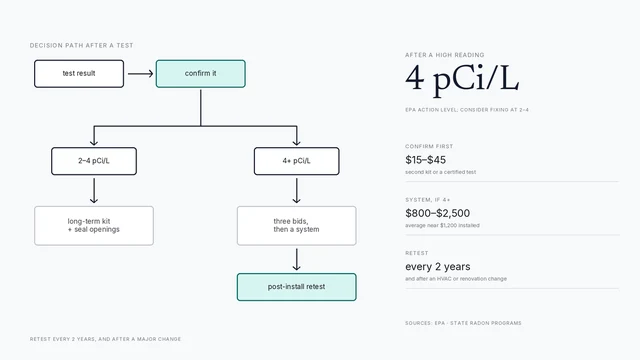
If the result comes back at 4 pCi/L or above, do not mitigate on one sample alone. Run a second short-term test under the same conditions, or pay $150–$250 for a certified measurement. The testing section covers the sequence, and the DIY section covers the sealing work that is worth doing before any of it.
The kit is not the weak point. The week around the kit usually is. Close the house, put the device where you breathe, leave it alone, and mail it on the day the window closes. That is the whole method, and it is enough to make a $30 test worth trusting.
How to do it
- Pick the right levelChoose the lowest lived-in level of the house. A basement bedroom counts; a sealed crawl space does not. Test where someone actually breathes the air for hours at a time.
- Close the house for 12 hoursShut windows and exterior doors 12 hours before the kit is opened and keep them shut for the whole exposure. Normal entry and exit is fine; propping a door open is not.
- Place the kit at breathing heightSet it on a shelf or table, off the floor, away from exterior walls, drafts, sunlight and any heat source. Keep it out of bathrooms, kitchens and laundry rooms.
- Leave it alone for 2–4 daysDo not move it, cover it, dust around it or check on it. Turn off continuous exhaust fans and skip the long dryer cycles until the window closes.
- Seal and mail it the same dayClose the kit exactly as the instructions say, write the start and stop times on the label, and get it into the mail that day. Tracked postage is worth the few dollars.
- Read the result against the action level4 pCi/L is EPA's action level, and 2–4 pCi/L is the consider-fixing band. A result at or above 4 calls for a second test or a contractor, not a third kit in a drawer.
Frequently asked questions
Does opening windows lower a radon test result?
Yes, sometimes by a large margin. Ventilation replaces indoor air with outdoor air, which averages about 0.4 pCi/L against an indoor average near 1.3 pCi/L, so the kit measures a diluted mixture rather than the house as it normally operates. EPA's closed-house condition exists to remove that variable.
Where should a radon test kit be placed?
In the lowest level of the house that is regularly used, at breathing height, off the floor and away from exterior walls, drafts and direct sunlight. Not in a bathroom, kitchen, laundry room or hallway. The kit should sit where a person actually spends time, because that is the air the result is supposed to describe.
Can I move a radon kit during the test?
No. Moving it restarts the exposure at a new location and mixes two different air samples into one result. Once the kit is open and the clock starts, it stays where it is until the window closes. If it is knocked over or disturbed, note it on the form and treat the result as suspect.
Do bathroom fans and dryers affect a short-term test?
They can. Exhaust fans, a clothes dryer and a range hood all push indoor air outside, which lowers the pressure inside the house and pulls more soil gas in through the foundation. Running them during the test can raise the number above what the house does in normal use.
How quickly must a radon kit be returned to the lab?
As fast as the mail allows, and inside the lab's stated window. Charcoal-based kits collect radon that decays with a half-life measured in days, so a sample that sits in a mailbox over a long weekend reads lower than the air it came from. Photograph the label and use tracked postage.
Do I need more than one kit for a multi-level house?
Usually. Radon concentration differs by level because the soil gas enters low and dilutes as it rises. One kit in the lowest lived-in level answers the question that matters most for exposure. If a lower level is occupied, test it separately rather than averaging a basement and a bedroom into a single number.
Sources
Some links are affiliate links.If you buy through them we may earn a commission at no extra cost to you. We do not accept payment for rankings. Read the full disclosure.