Radon test after mitigation: what to expect
Wait 24 hours, then run a short-term test under closed-house conditions. The target is below 2 pCi/L; at or above 4 means diagnosis, not a new system.
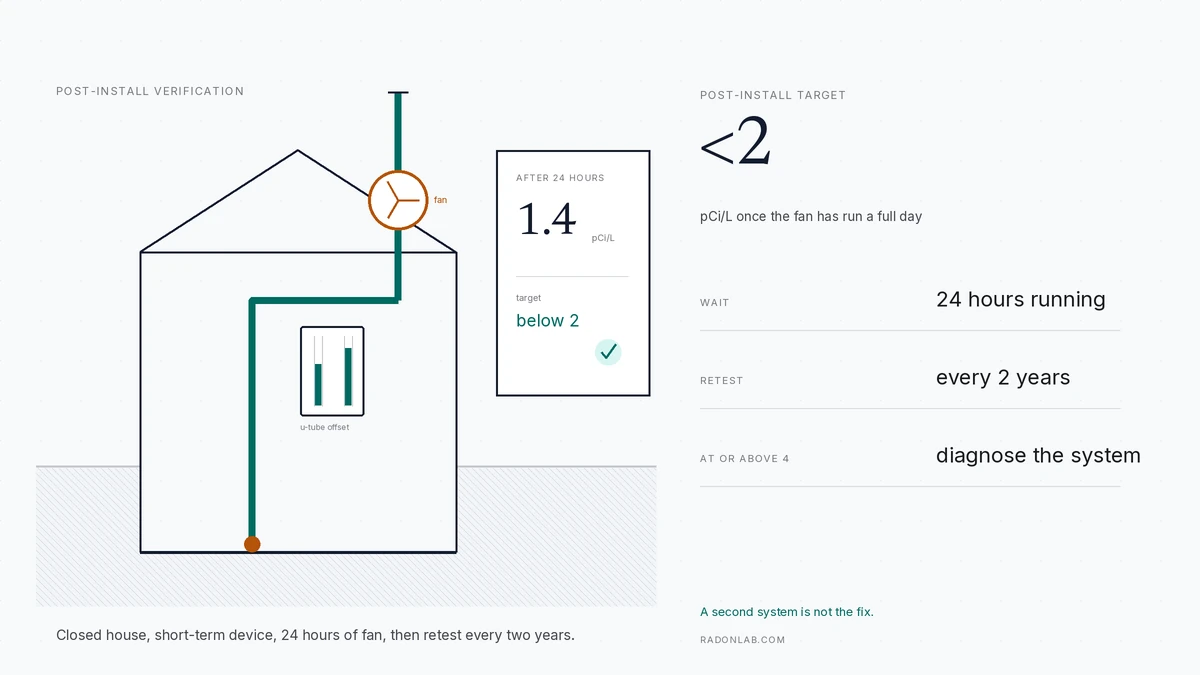
Run a short-term test after the system has operated for at least 24 hours, with the house closed for 12 hours before and throughout. The target is below 2 pCi/L. At or above 4, the system needs diagnosis — check suction at the U-tube and the suction points — not a second system.
- Wait before testing
- at least 24 hours running
- Test type
- short-term, 2–4 days
- Target after install
- below 2 pCi/L
- Routine retest
- every 2 years
Some links on this page are affiliate links.If you buy through them we may earn a commission at no extra cost to you. We do not accept payment for rankings. Read the full disclosure.
| Below 2 pCi/L | At or above 4 pCi/L | |
|---|---|---|
| What it means | The system is doing its job | Suction is not reaching the soil, or the soil is not responding |
| U-tube reading | Steady offset between the columns | Level fluid, or an offset that has dropped |
| Next step | File the report, retest in two years | Call the installer for a diagnostic visit |
| What gets checked | Nothing, unless the fan stops | Fan operation, pipe blockages, suction point seals, slab cracks |
| Typical cost | Nothing beyond the original install | A service visit, not a second system |
A radon test after mitigation is the short-term measurement that proves a newly installed system actually lowered the concentration in the house. It runs after the fan has operated for at least 24 hours, under the same closed-house conditions as the original test, and it is judged against a target of below 2 pCi/L. Without it, you have bought hardware and assumed a result.
Why the 24-hour wait
A sub-slab system works by reversing the pressure relationship between the soil and the house. The fan has to establish a suction field under the slab, draw it through the suction point, and hold it against the stack effect that is trying to pull soil gas the other way.
That field takes time to stabilize. In a tight clay soil it can take longer than in gravel, and in a house with two suction points the two fields have to meet. Testing an hour after startup measures the transient, not the system. A day is the minimum EPA’s guidance supports; a week is more conservative and costs nothing extra.
Booking the short-term test
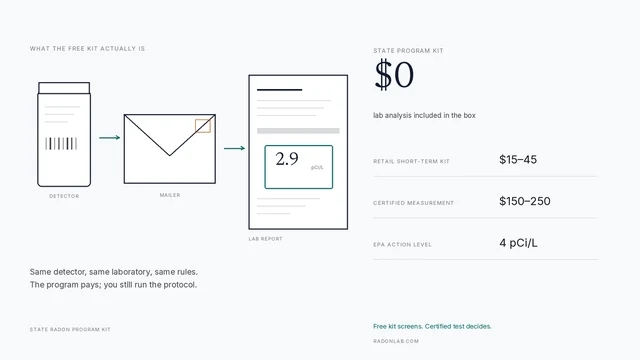
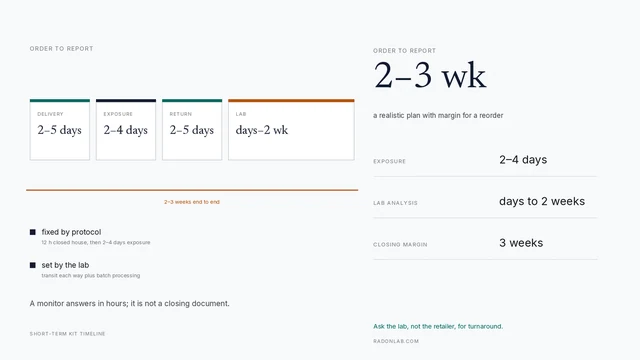
A short-term kit at $15–$45 is the right instrument. It integrates over two to four days, which is long enough to average out the furnace cycling and short enough that you get an answer while the installer’s warranty conversation is still fresh.
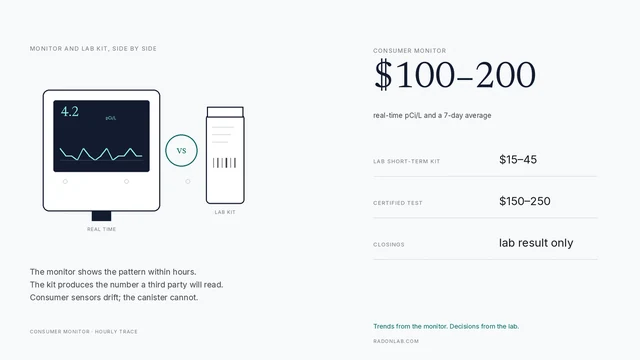
A continuous monitor can show the level falling within hours, and that is useful for an immediate sanity check. It is not the document. The kit and monitor comparison explains why the lab result is the one that counts.
Where the guarantee matters, a certified measurement at $150–$250 is worth the difference. It comes from someone with no stake in the answer, which is exactly the property a warranty claim needs.
Closed-house conditions apply again
The protocol does not relax because a fan is running. Windows and exterior doors stay shut for 12 hours before the test and throughout it. Exhaust fans and whole-house fans stay off. Normal heating and cooling continues.
This is the step that gets skipped after an install, because the house has just been full of contractors and everyone wants to air it out. Opening the windows for an afternoon drops the reading and hides a system that is only marginally working. Close the house, run the full window, and treat the result as the system’s grade.
Reading the result against 2 and 4
| Result | What it means | Next step |
|---|---|---|
| Below 2 pCi/L | System working as designed | File the report, retest in two years |
| 2 to 3.9 pCi/L | Working, but not at target | Ask the installer what the guarantee covers |
| 4 pCi/L or above | Not achieving the target | Diagnostic visit, not a new system |
Below 2 is the number to want. It is also the number a reputable installer will put in writing before the work starts, because it is achievable in most houses and it gives both sides a definition of success.
If it is still at or above 4
Call the contractor. Do not call a second contractor for a second system. A system that fails its post-install test has a diagnosable cause, and the causes are short in number.
No suction. The U-tube is level. The fan may be dead, wired backwards, or blocked by ice or debris at the vent. Check the breaker, then the pipe, then the fan.
Suction but no communication. The U-tube shows an offset and the radon is still high. The suction field is not reaching the soil under the living space: a footing, a foundation wall, a sealed crawl-space membrane, or a slab that is divided into separate pours. The usual fix is an additional suction point, not a bigger fan.
Leaks in the system. A disconnected coupling, a cracked pipe joint, or a suction point that was never sealed lets the fan pull basement air instead of soil gas. The U-tube still reads, which is why this one fools people.
The house, not the system. A new HVAC system, a new dryer, or a wood stove can change the pressure balance enough to overwhelm a marginal design.
One more possibility deserves a mention because it costs nothing to rule out: the season. A system tested in July and retested in January can read a full picocurie higher in January, because the stack effect is doing more of the work against the fan. If a post-install test lands at 4.2 in mid-February, ask whether the same test in a shoulder month would land at 3. That does not excuse a system that misses its target, but it changes how much hardware the fix needs.
The systems guide explains how suction points and pipe diameter interact, which helps you follow the contractor’s diagnosis instead of taking it on faith.
What the contractor should check
A proper diagnostic visit measures the pressure field extension at the suction point, inspects the pipe for blockages and disconnected joints, confirms the fan’s airflow direction, checks the manometer fluid level, and looks at the slab and foundation for unsealed penetrations.
What it should not do is propose a second system before those checks. A second fan on the same undersized pipe solves nothing. A second suction point on a slab that needs one is a legitimate fix and costs far less than a full reinstall.
Ask for the pressure-field measurement in writing. It is the one number that separates “the fan is running” from “the soil under the living space is being drawn on,” and a contractor who cannot produce it is guessing. The install cost guide covers what a diagnostic visit or an added suction point should cost.
Keep the report and the label
File three things together: the original pre-mitigation test, the post-install test, and the system label with the fan model, install date and contractor name. Add the report to the house paperwork.
That file does two jobs. It is the proof a buyer will ask for at resale, and it is the baseline the next test is compared against. A post-install result of 1.4 is a useful thing to have on paper five years later when a retest comes back at 1.9 and nobody remembers what the house started at.
The two-year retest
EPA recommends retesting every two years, and after any major renovation or HVAC change. A finished basement, a new furnace, added insulation or a heat-recovery ventilator can all shift the pressure balance the system was designed around.
Put the retest on a calendar rather than in your memory. Order the kit in the same month as the original test, use the same room and height, and compare like with like. The testing section has the placement and closed-house detail, and the install cost guide covers what a diagnostic visit or an added suction point should cost if the number ever climbs back.
How to do it
- Confirm the fan has run 24 hoursCheck the U-tube first. The fluid in the two columns should sit at different heights, and that offset should hold. Note the date the system went into service.
- Close the house for 12 hoursWindows and exterior doors shut, exhaust fans and whole-house fans off, normal heating and cooling running. EPA's closed-house condition starts 12 hours before the device is opened.
- Place the device in the lowest lived-in levelAt least 20 inches off the floor, away from exterior walls, drafts, heat and moisture. Use the same room and height as the pre-mitigation test so the comparison is fair.
- Run the full short-term windowTwo to four days, with a minimum of 48 hours for most devices. Do not air the house out mid-test, and do not leave the basement door open to show the system to a neighbour.
- Read the result against 2 and 4Below 2 pCi/L is the target. Between 2 and 4 the system is working but not fully; ask the installer what the guarantee covers. At or above 4, the system needs diagnosis before anything is replaced.
- File the report and set a reminderKeep the lab report or signed measurement with the install paperwork and the fan model number. Retest every two years or after a major renovation or HVAC change.
Frequently asked questions
How soon can I test for radon after mitigation?
After the system has operated for at least 24 hours. That gives the fan time to establish and hold suction across the suction field. Run a short-term test of two to four days under closed-house conditions, then judge the system on that result rather than on a single overnight reading.
What radon level should I expect after a mitigation system?
Below 2 pCi/L is the usual target, and a working sub-slab system routinely reaches it. EPA frames the goal as as-low-as-reasonably-achievable, which is why a credible installer writes a target level into the contract rather than promising zero.
My post-mitigation test is still above 4. What now?
Call the contractor who installed it. The system should be diagnosed, not duplicated: check the U-tube for suction, confirm the fan is running and turning the right way, look for a blocked or disconnected pipe, and verify the suction points are still sealed. Buying a second system before that diagnosis is wasted money.
Do I need closed-house conditions for a post-mitigation test?
Yes. The protocol does not change because a system is installed. Windows and exterior doors stay closed for 12 hours before the test and throughout it, and exhaust fans stay off. Testing with the house open can produce a low number that hides a system problem.
Should the contractor's test or mine count?
An independent test is worth more than one performed by the party that sold the system. If the installer offers a post-install test, accept it, but consider a second short-term kit you place yourself, or a certified measurement if the guarantee matters.
How often should I retest after mitigation?
Every two years, and after any major renovation or HVAC change. A new furnace, a new HRV, added insulation or a finished basement can change how the house breathes and how much suction reaches the slab. Also retest any time the U-tube goes level.
Sources
Some links are affiliate links.If you buy through them we may earn a commission at no extra cost to you. We do not accept payment for rankings. Read the full disclosure.