Radon mitigation financing: when a loan makes sense
Cash, a contractor plan, a home-improvement loan or a card. Why a $1,200 job rarely justifies interest, and how to compare total cost.
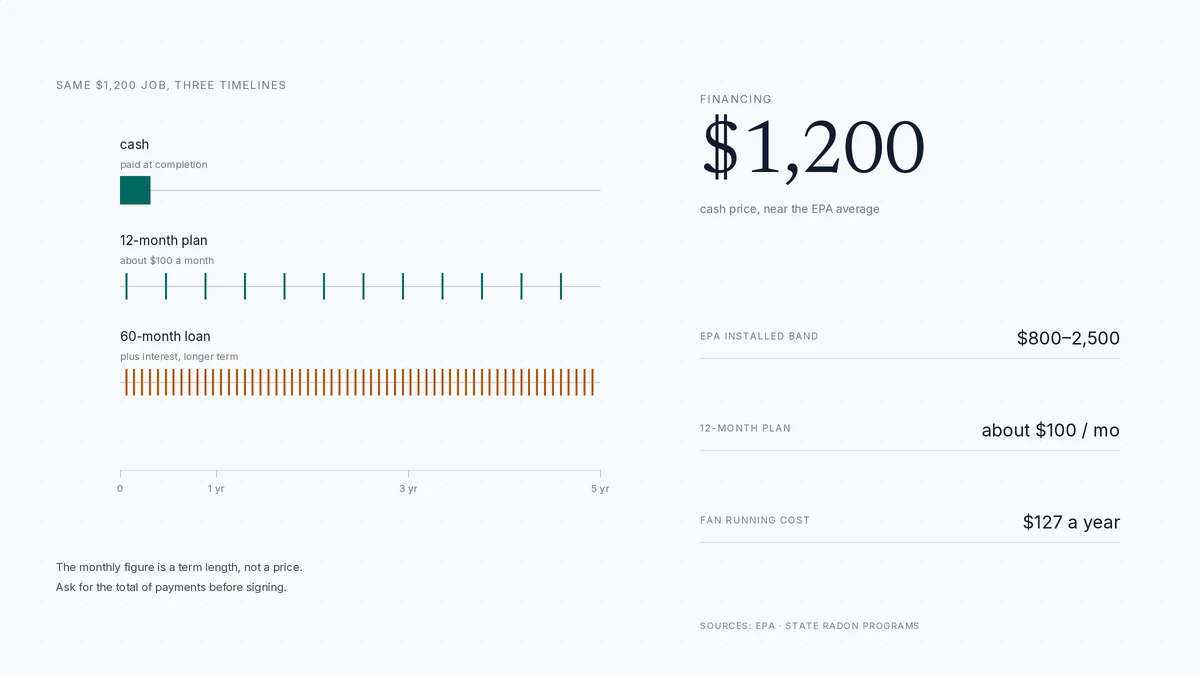
Systems run $800–$2,500 installed, averaging near $1,200, small enough that financing usually costs more in interest than waiting a few months would. Compare total cost, not the monthly payment: cash first, then a plan, then a loan for top-of-band jobs with a deadline.
- EPA installed band
- $800–$2,500
- Typical install
- about $1,200
- Fan running cost
- about $127 a year
- 12-month plan on $1,200
- about $100 a month
Some links on this page are affiliate links.If you buy through them we may earn a commission at no extra cost to you. We do not accept payment for rankings. Read the full disclosure.
| Cash | Financed | |
|---|---|---|
| Total paid | $1,200 | $1,200 plus interest, fees or a raised price |
| Time to start | Immediate | Approval, then scheduling |
| Ongoing obligation | Fan electricity only | Fan electricity plus a payment |
| Effect at resale | None | A secured loan must be cleared at closing |
| Best fit | Any reading at or above 4 pCi/L | Top-of-band jobs with a deadline |
Radon mitigation financing is any arrangement that spreads the cost of a system over time instead of paying it at completion. The question worth asking is not which plan has the lowest monthly payment. It is whether the total you pay exceeds the cash price by more than the delay is worth.
What financing actually costs
Every financing arrangement has a price, and it appears in one of three places: an interest rate, a fee, or a contract price that is higher than the cash price. Sometimes it appears in all three.
That matters because the radon numbers are small. EPA puts a fan-based system at $800–$2,500 installed, with a national average near $1,200. At that scale, the cost of borrowing is not a rounding error relative to the job; it can be a meaningful fraction of it. A five-year loan on $1,200 pays interest for years on a system whose fan may need replacing inside that window.
There is also a cheaper lever than any lender. A second and third bid, normalized on scope, regularly moves a quote by more than a financing term costs. The quote comparison guide explains how to line three bids up on the same page. That work takes an afternoon and costs nothing.
The four ways people pay
Cash. The baseline. You pay the contract price at completion and the only ongoing cost is electricity, about $127 a year for an 80 W fan at the August 2026 US average.
A contractor payment plan. Some installers offer in-house terms or a third-party financing link at the point of sale. Convenient, and worth comparing against the cash price from the same company.
A home-improvement loan or secured line of credit. Usually the lowest-cost borrowing for a homeowner with equity, and usually the slowest to arrange. A secured line may attach to the property.
A credit card. Fastest and most expensive if the balance runs past a promotional period. Reasonable for a one-month bridge, poor for a year.
Compare total cost, not the monthly payment
A monthly payment is a design decision, not a price. The same $1,200 job can be advertised as $100 a month or as $25 a month, and the second number usually means a longer term and a larger total.
Build a two-column comparison for each offer: what you pay in total, and when the obligation ends. Then add the running cost, because it continues regardless. A system financed over five years at $1,200 plus interest, plus $127 a year in electricity, is a different object from a system paid for in cash with the same electricity bill.
The calculator handles the electricity side. The financing side is arithmetic you can do on paper: total of payments minus cash price equals the cost of borrowing, whatever the paperwork calls it.
The arithmetic on a $1,200 job
A twelve-month plan at the cash price divides into twelve payments of about $100. That is a reasonable way to pay if the cash is not on hand and the term is genuinely free.
Stretch the same job over five years and the payment looks small, but the total includes interest for sixty months on a system that may need a $150–$450 fan replacement before the loan is retired. That is the trap in the monthly framing: the smallest payment belongs to the longest term, which is the most expensive way to buy the cheapest part of the project.
If a contractor quotes a monthly figure, ask for the total of payments. If they will not provide it, that is the answer.
When a payment plan is reasonable
Financing earns its place in three situations.
The number is at the top of the band. A crawl space at $3,000, or a system with two suction points and electrical work, is a larger commitment than a $1,200 basement job. Spreading that over a short term is defensible.
The timeline is fixed. A sale closing, a daycare license, a rental certificate. When the work has to happen by a date, paying for convenience can be cheaper than losing the transaction.
The reading is high and the season is wrong. Winter is when radon reads highest and when contractors are busiest. If the number is well above 4 pCi/L, the exposure argument favors acting now rather than saving for spring.
Outside those cases, waiting a few months costs nothing but time, and the system does not get more expensive while you wait.
One practical note on timing: a contractor with a slow month may discount a cash job in a way that beats any financing offer. Ask what the schedule looks like and whether a date in the next few weeks changes the price. It sometimes does, and the discount is worth more than the interest saved.
What to ask before you sign
- What is the total of all payments?
- Is the contract price the same as the cash price?
- What is the term, and is there a prepayment penalty?
- Is the loan secured by the house or unsecured?
- Who services the loan, and who do I call if the install is wrong?
- Does the warranty transfer if I sell?
The last two matter more than they look. A financing company is not the installer, and a dispute about a fan that failed in year two belongs with the contractor, not the lender. Get the warranty terms in writing, separate from the loan documents.
Red flags in contractor financing
A price that changes when you mention cash. If the cash price is lower than the financed price, the difference is the financing cost. That is legal and worth knowing, but it should be disclosed, not discovered.
Pressure to sign the loan before the scope is settled. The scope should be fixed first: suction points, fan model, permit, post-install test. Financing an undefined job is how second visits get billed.
A term longer than the equipment life. A fan lasts 5–15 years. A ten-year loan on a fan is a bet that the equipment outlives the payments.
No post-install test in the contract. You would be financing an unverified outcome. A kit costs $15–$45; insist on it whether you pay cash or not.
A lien you did not expect. Ask directly whether the lender records anything against the property, and get the answer before closing.
The sequence that avoids the loan
Test first. A short-term kit with lab analysis costs $15–$45, and a result below 4 pCi/L means there is nothing to finance. If the result is at or above 4, get three itemized bids and compare scope, not totals. The cost breakdown shows what each system type should run, and the cost section covers the add-ons that inflate a quote.
Then decide how to pay. If the cash is available, pay it and put the difference toward the post-install test and a spare fan budget. If it is not, choose the shortest term you can service and confirm the total before you sign anything. The system will still be there in three months, and the fan will still cost about $127 a year to run.
How to do it
- Get the cash price firstAsk every bidder for the price if paid in full at completion. That number is the baseline every financing offer has to beat.
- Ask what the plan costs in totalNot the monthly figure. Ask for the total of all payments, the fees, and whether the contract price changes when financing is used.
- Check the term against the jobA twelve-month plan on $1,200 is about $100 a month. A five-year term on the same job means paying for a fan long after the fan is installed.
- Confirm secured or unsecuredAn unsecured loan follows you. A secured loan or credit line may attach to the house and has to be resolved when you sell. Know which one you are signing.
- Price the alternativeA short delay plus a smaller scope often beats a loan. Ask what the system would cost without the second suction point, then decide whether the extra work can wait.
Frequently asked questions
Should I finance a radon mitigation system?
Usually not. The EPA band for a fan-based system is $800–$2,500 and the average is near $1,200, which is within reach of most emergency funds and small enough that interest on a multi-year loan can approach the cost of a fan replacement. Finance only when the number is at the top of the band and waiting is not an option.
What financing options exist for radon mitigation?
Four in practice: cash, a contractor payment plan, a home-improvement loan or secured line of credit, and a credit card. Each has a different total cost. The monthly figure tells you nothing until you know the term, the fees and whether the price was raised to cover the financing.
Is zero-percent contractor financing really free?
Sometimes it is a genuine promotional term, and sometimes the cost is built into the contract price. Compare the financed total with the cash price from the same contractor and from a second bidder. If the cash price is lower, the difference is the financing cost, whatever the paperwork calls it.
Will financing affect my ability to sell the house?
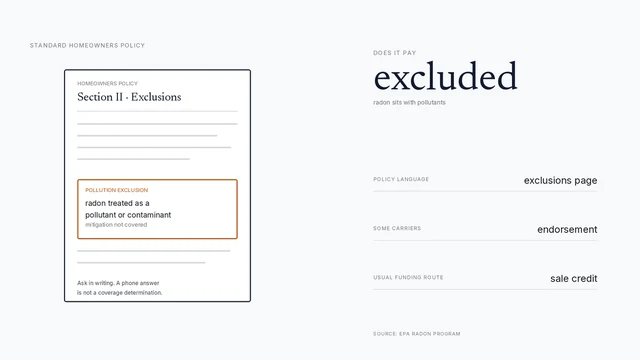
The loan, not the system, is the issue. An unsecured home-improvement loan stays with you and does not attach to the property. A secured loan or line of credit may be tied to the house, which means it has to be resolved at closing. Ask which type you are signing.
How much does the fan add to my monthly costs?
About $127 a year at the August 2026 US average of 18.16 cents per kWh for an 80 W fan, or roughly $11 a month. That is the ongoing cost of the system, and it continues after any loan is paid off, so budget for it separately from the installation.
Can I get a payment plan for a crawl space system?
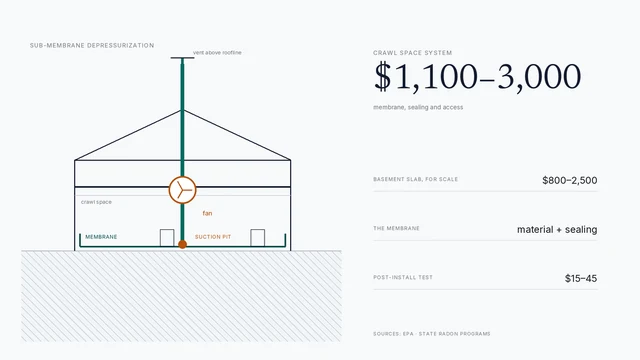
Crawl-space work sits at $1,100–$3,000, so a plan is more defensible there than on a basement job. Even so, compare the financed total against the cash price with a second contractor. A $3,000 job financed over several years can cost more than the same job paid for in two installments.
Sources
Some links are affiliate links.If you buy through them we may earn a commission at no extra cost to you. We do not accept payment for rankings. Read the full disclosure.