Winter radon levels explained
Why radon reads higher in winter: stack effect, a sealed house, frozen ground and snow. What a heating-season test proves, and why summer results still count.
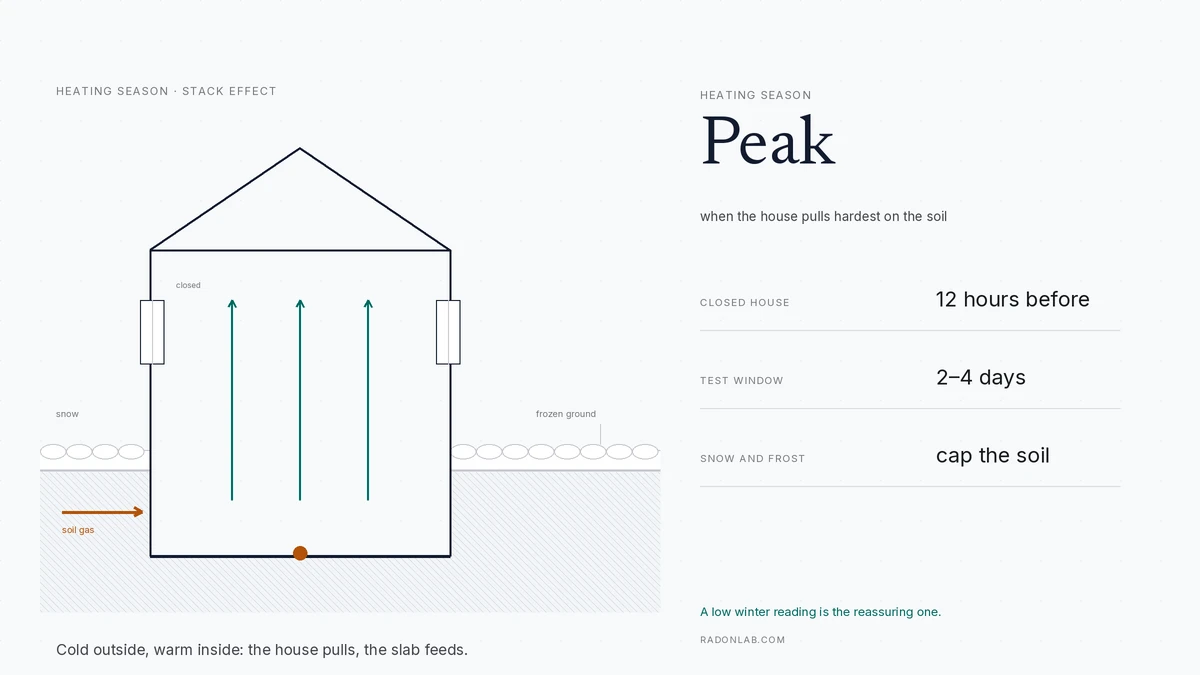
Radon usually reads highest in winter. Cold air turns the house into a chimney, sealed windows stop the dilution, and frozen ground or snow caps the soil. A January test is conservative: a low winter reading means summer is unlikely to be worse.
- Season of peak readings
- heating season
- Main mechanism
- stack effect
- Closed-house test
- 12 hours before, through
- Short-term duration
- 2–4 days
Some links on this page are affiliate links.If you buy through them we may earn a commission at no extra cost to you. We do not accept payment for rankings. Read the full disclosure.
| Winter short-term test | Summer short-term test | |
|---|---|---|
| Stack effect | Strong: cold air, warm house | Weak: small indoor-outdoor difference |
| House envelope | Sealed, windows shut, no dilution | Often open, diluted by outdoor air |
| Soil surface | Frozen or snow-covered, gas pushed inward | Open, gas escapes before it reaches the slab |
| What the number represents | Close to the annual peak | Close to the annual low |
| How to use it | A low reading is reassuring | A high reading is meaningful; a low one is not conclusive |
Winter radon levels are the concentrations a house reaches during the heating season, when the indoor-outdoor temperature difference is largest, the windows are shut, and the ground is frozen or covered. In most houses that produces the highest readings of the year. The mechanism is physical and predictable, which is why a winter test is the one to trust when the question is whether to spend money on a system.
The stack effect in one paragraph
Warm air is less dense than cold air. In winter, the air inside a heated house is much lighter than the air outside, so it rises through the house and leaks out at the upper levels — attic hatches, recessed lights, the top of the chimney chase. That outflow has to be replaced, and the replacement air comes in at the bottom, through the path of least resistance. A basement slab with a crack, a sump pit and a slab-to-wall seam is a very easy path.
The result is a small, continuous suction on the soil beneath the house. Radon in that soil is drawn toward the foundation instead of diffusing away. The bigger the indoor-outdoor temperature difference, the harder the pull.
The height of the house sets the strength. A two-storey house with a basement has a taller column of warm air than a single-storey slab, so it generates more of the pressure difference that drives soil gas inward. That is one reason the same soil under two neighbouring houses produces two different readings, and why a ranch and a colonial on the same lot cannot be compared.
A sealed house stops diluting the gas
The second effect is simpler. In July, windows are open, doors are open, and outdoor air at roughly 0.4 pCi/L mixes freely with indoor air. Whatever enters from the soil gets diluted.
In January, the same house is a closed box. Every cubic foot of soil gas that enters stays. A house that reads 1.8 pCi/L with the windows open can read 4.5 with them shut, without a single change to the foundation or the soil. This is why the test protocol insists on closed-house conditions year-round: it is trying to measure the house as it actually operates in winter.
Frozen ground and snow cover
Soil is normally leaky at the surface. Radon that escapes the top foot of soil disperses into the atmosphere and never reaches the house. Frost and snow change that. Frozen ground has much lower permeability, and a snowpack adds an insulating lid on top of it.
With the surface capped, soil gas has fewer places to go, and the pressure field under the house pushes more of it toward the foundation. A cold snap with a foot of snow on the ground is close to a worst case for a short-term radon test. A January thaw with rain is closer to a best case, which is one reason two winter tests a few weeks apart can disagree.
Heating season changes the pressure balance
Furnaces and boilers do not produce radon. What they produce is a house that is being heated, and heating is what drives the stack effect. Add a dryer, a range hood and a bath fan and you have three more exhaust devices pulling air out of the house and, indirectly, pulling soil gas in.
The counterweight matters too. A tight, well-sealed house with a balanced HVAC system pulls less than a leaky one with a powerful range hood. That is why two identical houses on the same street can differ by a factor of three, and why the EPA zone map can only tell you about the area, never about the house.
Why a winter test is the conservative choice
If you test in January and the result is under 2 pCi/L, you have measured the house near its annual peak. The summer level will almost certainly be lower. That is a genuinely reassuring result, and it is the cheapest kind of good news you can buy.
Run the same test in July and get 1.4, and you have learned much less. The number might reflect a house that is fine, or a house that reads 5 in February and 1.4 with the windows open. The measurement is not wrong. It is just taken in the season that suppresses the signal.
Summer results are not wrong
A summer reading is a real measurement of the house as it operates in summer, and summer exposure counts. If a July test comes back at 6 pCi/L with the windows open, that is a high number in the least favourable conditions, and it deserves immediate attention.
The asymmetry is about what a low number can support. A low winter number rules out a winter problem. A low summer number does not rule out a winter problem. Treat the seasons as different instruments rather than one instrument with a bad day.
Where the winter effect is weakest
Not every house follows the pattern to the same degree. A house with a sealed crawl-space membrane, a tight basement lid and no combustion appliances pulling air has less of a stack effect to begin with, and its winter and summer readings can land close together.
A house with a heat-recovery ventilator is the clearest case. An HRV supplies and exhausts air in balance, so it does not depressurize the house the way a bath fan does, and the fresh-air supply dilutes what enters from the soil. Radon still comes in through the slab; it just is not being pulled in harder because the house is running negative in January.
The other weak case is a house with no basement. A slab-on-grade home still sees the stack effect, because the warm interior is above the soil, but the suction path is shorter and often better sealed at the perimeter.
If you already tested in summer
Three paths, depending on the number.
Under 2 pCi/L. Optional retest in winter. Nothing is at stake, and a second data point is cheap.
2 to 4 pCi/L. Retest in the heating season, and consider a long-term kit at $20–$50 that spans the winter months. This is the band where seasonal timing changes the decision.
At or above 4 pCi/L in summer. Act now. A summer reading above the action level in an open house means the closed-house, frozen-ground number is likely higher, not lower.
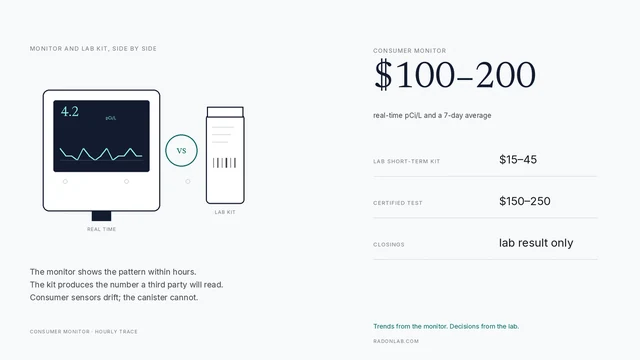
The kit and monitor guide explains which devices suit a seasonal comparison and which only give you a snapshot.
Reading a winter number
Take the result at face value and place it in EPA’s bands: at or above 4 pCi/L, fix; 2 to 4, consider fixing; below 2, low. Then note the season beside it, because a winter 3.1 and a summer 3.1 are not the same finding.
A winter number at or above 4 is the strongest case for mitigation you can build from a short-term test, since the season is already working against you. A winter number under 2 is the strongest case for waiting. Everything in between is what the long-term test was invented for, and the testing section walks through that decision with the cost of each option attached.
How to do it
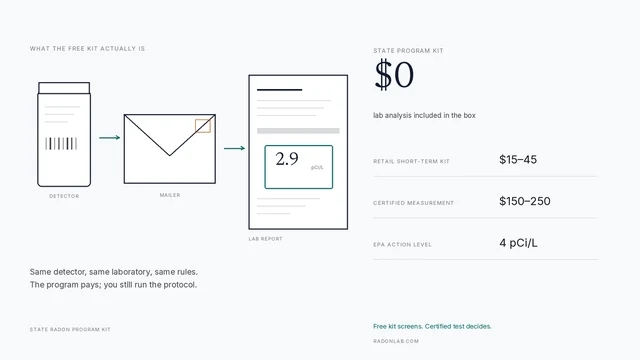
- Pick the heating season deliberatelyRun a short-term test between November and March if you can. January doubles as National Radon Action Month, when many state programs distribute free or discounted kits.
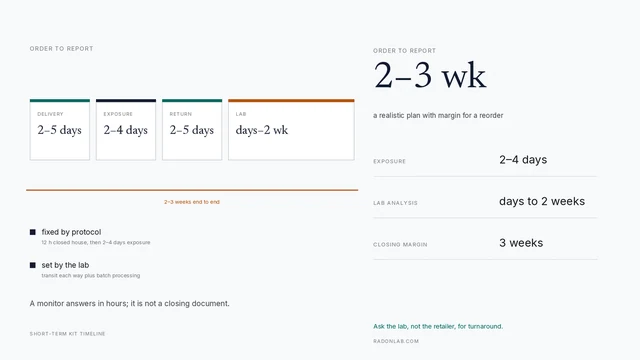
- Hold the house closedEPA protocols call for closed-house conditions for 12 hours before the test and throughout it. In winter that is closer to how the house already runs, which makes compliance easier.
- Watch the weather during the windowNote the outdoor temperature and whether snow fell. A cold snap with snow cover is the most conservative test window; a thaw with rain is the least. Write it down for the file.
- Keep normal heat, skip the ventingRun the furnace as usual. Do not run a whole-house fan, a bath fan for hours, or a dryer that vents outdoors, and do not crack a window to clear cooking smoke mid-test.
- Repeat in the same season if you retestComparing a February result with a July result tells you about the seasons, not the house. If you are confirming a number, test in the same month and the same room.
- File the season with the resultWrite the month, the outdoor conditions and the closed-house dates on the report. The next owner, lender or contractor will read the number differently depending on when it was taken.
Frequently asked questions
Why are radon levels higher in winter?
Three effects stack up. Cold outdoor air is denser, so the house pulls soil gas harder through the stack effect. Windows and doors stay shut, so nothing dilutes what enters. Frozen ground and snow cover cap the soil surface, forcing more of the gas toward the foundation instead of letting it escape outdoors.
Should I test for radon in winter or summer?
Winter is the more conservative season. A short-term test run in January under closed-house conditions captures the pattern that produces annual peaks. A summer result is not wrong, but a low summer number says less, because open windows and a weaker stack effect suppress the reading.
Does snow on the ground raise radon levels?
It can. Snow and frozen soil act as a low-permeability lid on the ground surface, so soil gas that would otherwise vent through the top few feet of soil is pushed toward the foundation. A heavy snowpack with a sealed house is close to a worst case for a short-term test.
My radon test was low in July. Do I need to retest?
If the number was well under 2 pCi/L, retesting in winter is optional but informative. If it landed between 2 and 4 pCi/L, a winter test is the right follow-up, because the summer reading may have understated the annual average. The decision to mitigate should rest on the heating-season number.
Does heating my house increase radon?
The furnace is not the source. What matters is the pressure difference between the house and the soil. Warm indoor air rising through the house lowers pressure at the basement slab, which pulls soil gas in. A house heated to 70°F in January can pull harder than the same house at 74°F in July with the windows open.
How much higher is radon in winter?
There is no single multiplier, and any claim of a fixed percentage is unreliable. Direction is dependable: most houses read higher in the heating season. Magnitude depends on the soil, the foundation and how tight the house is, which is why a test of your own house beats any seasonal rule of thumb.
Sources
Some links are affiliate links.If you buy through them we may earn a commission at no extra cost to you. We do not accept payment for rankings. Read the full disclosure.