Radon test placement mistakes
Twenty inches off the floor, lowest lived-in level, away from exterior walls, drafts, heat and sun. The placement errors that quietly change a pCi/L result.
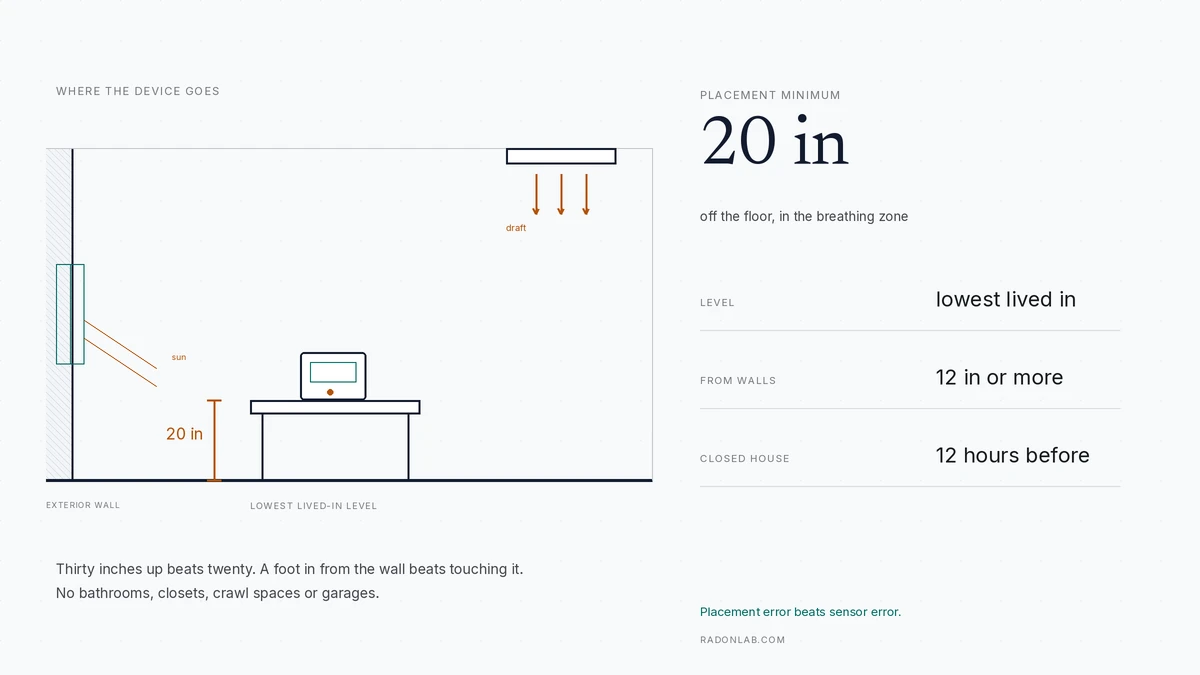
Place the device in the lowest lived-in level, at least 20 inches off the floor and a foot from exterior walls, away from drafts, heat, moisture and sun. Avoid bathrooms, closets, crawl spaces and garages. Placement error exceeds sensor error.
- Height off floor
- at least 20 inches
- Room
- lowest lived-in level
- Exposure window
- 2–4 days short-term
- Closed-house lead time
- 12 hours before
Some links on this page are affiliate links.If you buy through them we may earn a commission at no extra cost to you. We do not accept payment for rankings. Read the full disclosure.
| Correct | Mistake | |
|---|---|---|
| Level | Lowest level regularly used | Unfinished basement nobody enters, or an upstairs bedroom |
| Height | 20 inches or more off the floor | On the floor, or on a high shelf |
| Distance from walls | At least a foot from exterior walls | Taped to an exterior wall or window frame |
| Air movement | Interior room, away from drafts and vents | Next to a supply register or an open door |
| Room type | Living space | Bathroom, closet, crawl space, garage |
| House state | Closed for 12 hours before and during | Window cracked to clear smoke on day two |
Radon test placement is the set of rules that decide where a detector sits while it samples: which floor, how high, how far from walls and air movement, and which rooms are excluded. Placement matters because radon is not evenly mixed through a house. A device in the wrong spot produces a number that is precise, reproducible and wrong, and no laboratory can tell from the canister what the room looked like.
The lowest lived-in level
The first decision is the floor, and the rule is the lowest level the house is regularly used at. For a finished basement, that is the basement. For a house where the basement is storage and the ground floor is the living space, it is the ground floor.
The mistake is treating the basement as automatically correct. An unfinished cellar that is entered twice a month is not where the household breathes, and a device there can produce a high number that does not describe anyone’s exposure. The opposite mistake is skipping a basement that has been converted into a bedroom, office or playroom — that is now living space, and it is usually the highest-reading room in the house.
When the house has two candidate levels, run two devices. The cost is $15–$45 each, and the comparison tells you which level needs suction if you do end up mitigating.
Twenty inches off the floor
The protocol samples the breathing zone, and 20 inches is the working floor of that zone. Radon is denser than air and tends to stratify, so a canister sitting directly on a slab can read noticeably higher than one at waist height. A device on top of a bookcase can read lower, because the air up there exchanges more slowly with the room.
Twenty inches is a minimum, not an ideal. A side table at 30 to 40 inches is easier to leave undisturbed and closer to where a seated person’s head sits. What matters is that the height is repeatable: if you retest in two years, put it back at the same height.
Distance from exterior walls and drafts
An exterior wall is a thermal boundary. In winter it runs cold, air moves along it, and the boundary layer next to it is not the same as the air in the middle of the room. Taping a device to a basement wall or propping it on a window sill is a common shortcut and a common source of a number that does not match the next test.
The working rule is at least a foot from an exterior wall, and further from window frames, sliding doors and any gap where outdoor air enters. Drafts do the opposite of what people expect: they dilute the sample, so the reading comes out low, and the house gets a clean result it did not earn.
Supply registers, portable fans and dehumidifier outlets are the same problem in a different form. A device in front of a register measures conditioned air, not room air.
The basement adds its own version of this. A basement window, a dryer vent or the gap under an exterior door all feed a stream of outdoor air into the lowest level, and a device sitting in that stream reads the dilution rather than the room. Put it on the far side of the space, on an interior wall, well away from the stairwell up. The stairwell matters because it is the path the stack effect uses, and air moves through it continuously in winter.
Heat, moisture and sunlight
Charcoal adsorbs radon, and its capacity depends on temperature and humidity. A device above a radiator, beside a dryer vent or in a sunbeam through a south-facing window is sampling under conditions the lab’s calibration never covered.
Moisture matters more than most people realize. A bathroom, a laundry room, a damp crawl space and a basement corner that floods each spring all change how the collector performs. The kit’s instruction sheet usually states a humidity limit; a device that exceeds it can be flagged or invalidated at the lab.
Direct sunlight also degrades some detector types. Keep the device out of the window band, which is another reason not to put it on a sill.
Rooms that are not sampling rooms
Four rooms are excluded unless the protocol says otherwise.
Bathrooms. High humidity, an exhaust fan, and a small volume of air that turns over fast.
Closets. Restricted air exchange. The device measures the closet, not the house.
Crawl spaces. A separate protocol with its own device placement. A crawl-space reading is not a substitute for a living-area test, and it is not comparable to one.
Garages. Different air exchange, different pressure relationship to the house, often a different slab. A garage reading says nothing useful about the bedroom above it.
The DIY guide covers the parts of testing a homeowner can legitimately do and where the protocol stops being optional.
One device per level when the protocol calls for it
A single canister in a two-level house answers one question: what is the concentration at that point. If the finished basement reads 5.2 and the first floor was never tested, you do not know whether the problem is the slab or the whole stack.
Protocols for real-estate and post-mitigation testing often require a device on each level, or in each separately ventilated zone. The practical version for a homeowner is one device in the lowest lived-in level and a second on the floor above when the difference matters — for example, when a basement bedroom is being added, or when a mitigation quote proposes a single suction point.
Two devices also answer a question a single device cannot: whether the system will need one suction point or two. If the basement reads 6.4 and the first floor reads 2.1, the slab under the basement is the source and a single point may carry it. If both levels read high, the whole stack is involved and the design gets harder.
The closed-house precondition people break
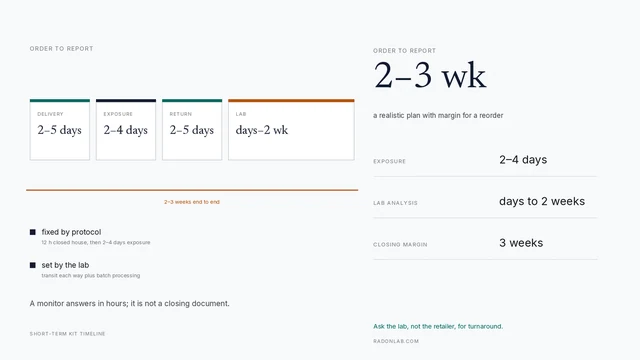
Closed-house conditions run for 12 hours before the test and continue through it. Windows and exterior doors stay shut. Exhaust fans, whole-house fans and outdoor-venting dryers stay off. Normal heating and cooling continues.
The break is almost always social, not technical. Someone cooks fish and opens a window. Guests arrive and the front door stands open for an hour. A bathroom fan runs all night because someone forgot it. The canister records none of this. It simply integrates a diluted sample, and the report comes back lower than the house deserves.
If the house does get opened, the honest move is to restart the clock rather than pretend the exposure was valid. A wasted $20 kit is cheaper than a mitigation decision built on a number that was never real.
A placement checklist
Lowest lived-in level, finished basement included. Twenty inches off the floor, ideally 30 to 40. A foot from exterior walls, further from windows and doors. Out of the path of registers, fans and dehumidifiers. Away from radiators, dryers, bathrooms and sun. Not a closet, crawl space or garage. House closed for 12 hours before and throughout, with the start and end times written on the device.
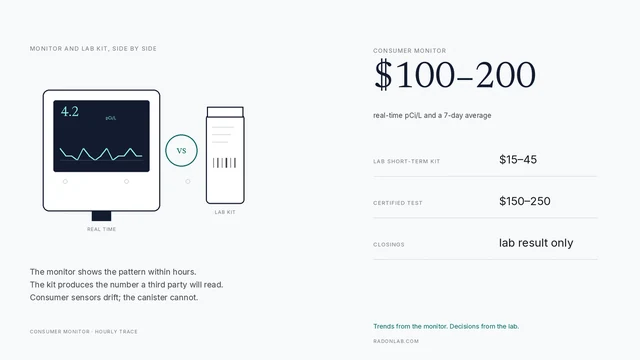
Compare that against the three device types before you buy anything, since a continuous monitor wants the same placement and will punish a bad spot with a week of visibly strange data. Get the placement right and the result means something; get it wrong and the only thing the number measures is the room you chose.
How to do it
- Choose the level before the roomWalk the house and decide which level is actually lived in. A finished basement counts. A storage basement does not, on its own. Write the choice down so a retest can match it.
- Set the height with a tape measureTwenty inches off the floor is the floor of the range, not the target. A small table in the middle of the room at 30 to 48 inches is closer to the breathing zone and easier to leave undisturbed.
- Clear a foot from exterior wallsExterior walls run cold in winter, and the boundary layer next to them reads differently from room air. Move the device inward and away from window frames and sliding doors.
- Kill the local air moversTurn off portable fans, close supply registers near the device, and keep the door to the room in its normal position. A device in the direct path of a vent measures the vent.
- Avoid heat, moisture and sunNot above a radiator, not beside a dryer, not in a sunbeam through a south window. Heat drives convection and moisture changes how charcoal collects; both bias the number without leaving a trace.
- Seal the house and leave it aloneClose windows and exterior doors 12 hours before the test and keep them closed. Do not move the device, dust around it, or open the house to air it out mid-window.
Frequently asked questions
Where should I place a radon test kit?
In the lowest level of the house that is regularly used, which is usually the basement if it is finished and otherwise the first floor. Put it at breathing height, at least 20 inches off the floor, and at least a foot from exterior walls. Keep it away from drafts, heat sources, moisture and direct sunlight.
Why does a radon test have to be 20 inches off the floor?
The protocol samples the air people actually breathe. Radon is slightly denser than air and stratifies, so a device on the floor can read higher than the breathing zone, and one on a high shelf can read lower. Twenty inches is the working compromise EPA's protocols use.
Can I put a radon test in a closet or bathroom?
Not unless the protocol says so. A closet has restricted air exchange, so the reading describes the closet. A bathroom adds humidity and an exhaust fan, both of which disturb the sample. Crawl spaces and garages are separate protocols and are not substitutes for a living-area test.
Should I test the basement or the first floor?
Test the lowest level that is regularly occupied. A finished basement is a living space and belongs in the test. An unfinished basement used for storage is not the right sampling point on its own, though some protocols call for a device there plus one on the floor above.
Do I need more than one test device?
Sometimes. Some protocols require one device per level, or one in each separately ventilated area. A house with a finished basement and a first floor often warrants two devices so you know which level is the problem and where a system would need to draw from.
What is a closed-house condition?
Windows and exterior doors stay shut for 12 hours before the test and throughout it. Exhaust fans, whole-house fans and dryers that vent outdoors stay off. Normal heating and cooling continues. Opening a window mid-test resets the measurement without resetting the clock.
Sources
Some links are affiliate links.If you buy through them we may earn a commission at no extra cost to you. We do not accept payment for rankings. Read the full disclosure.