Radon in well water treatment cost
Aeration runs $3,500–$6,500, GAC $1,000–$3,000. When water treatment is warranted, and why the air system usually comes first.
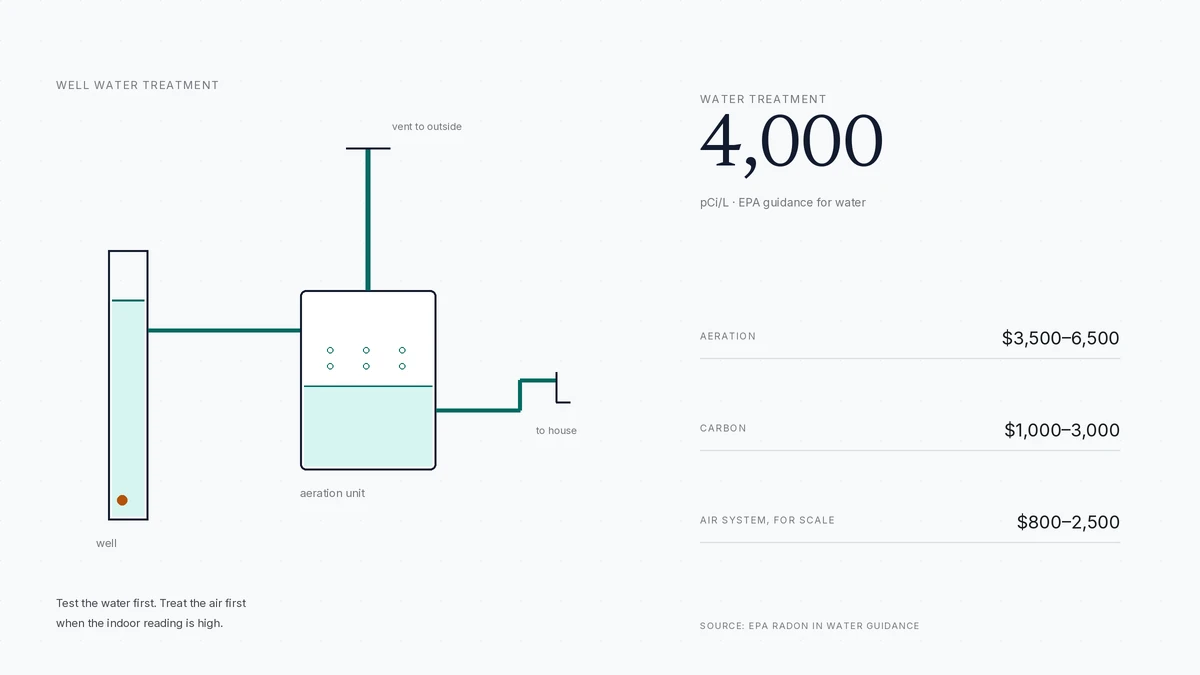
Water aeration runs $3,500–$6,500 installed and granular activated carbon $1,000–$3,000. EPA's guidance for radon in water is 4,000 pCi/L. Test the water first, and fix the air first when the indoor reading is high.
- Water aeration
- $3,500–$6,500
- Granular activated carbon
- $1,000–$3,000
- EPA water guidance
- 4,000 pCi/L
- Air system, for scale
- $800–$2,500
Some links on this page are affiliate links.If you buy through them we may earn a commission at no extra cost to you. We do not accept payment for rankings. Read the full disclosure.
| Aeration | Granular activated carbon | |
|---|---|---|
| Installed band | $3,500–$6,500 | $1,000–$3,000 |
| How it works | Air strips the gas, a vent carries it outside | Carbon adsorbs the gas as water passes through |
| Best fit | Higher concentrations, whole-house flow | Lower concentrations, point-of-use or modest flow |
| Waste stream | Gas vented above the roof | Spent carbon holds decay products |
| Maintenance | Blower service, periodic inspection | Media replacement on a schedule |
Radon in well water treatment is the removal of dissolved radon gas from a private water supply before it reaches a tap. Aeration costs $3,500–$6,500 installed; granular activated carbon costs $1,000–$3,000. Both are more expensive than the air system that usually matters more, which is why the order of work is worth getting right.
What the two methods cost
The bands are wide because the equipment is sized to the house. A treatment unit has to handle peak flow — every fixture running at once — and the price moves with that number, with the pump and pressure tank arrangement, and with how hard the unit is to fit into an existing mechanical room.
| System | Installed band | What it does |
|---|---|---|
| Water aeration | $3,500–$6,500 | Strips gas with air, vents it outside |
| Granular activated carbon | $1,000–$3,000 | Adsorbs gas onto carbon media |
| Air mitigation, for scale | $800–$2,500 | Pulls soil gas from under the foundation |
For comparison, the air system that addresses the main exposure usually costs less than either water option. That asymmetry is the reason to test both and sequence the work.
Aeration versus carbon
Aeration and carbon do different things, and the choice is not purely about price.
An aeration unit sprays or cascades water through air inside a vented tank. The radon leaves the water and is carried out a vent above the roof, and the treated water drops to the bottom and is repressurized. Removal is efficient, the unit does not accumulate radioactive decay products in a consumable, and it handles higher concentrations. The costs are the equipment, a blower, often a repump, and a vent penetration.
A carbon vessel passes water through a bed of granular activated carbon. Radon adsorbs onto the media as the water moves through. It is simpler, has no blower, and costs less. The tradeoff is the media: it accumulates the radon’s decay products and becomes a low-level radioactive waste stream when it is spent, so replacement has to be done deliberately rather than tossed in the trash.
A common pattern is carbon on a modest flow or a single point of use, and aeration where the whole house is supplied from a well with a high concentration. Your state health department and the lab that ran the water test are the right places to check which fits.
EPA’s guidance is 4,000 pCi/L
EPA’s guidance level for radon in drinking water is 4,000 pCi/L. EPA also describes water at that concentration as contributing roughly 0.4 pCi/L to the air in a home, which is the number that decides how the two systems rank. It is guidance rather than an enforceable federal standard for private wells, and state programs differ in what they recommend.
Two things follow. First, get a number before you buy anything. A water test is a lab analysis, and it produces a concentration you can compare with the guidance. Second, ask the state health department what it advises for a private well, because the federal guidance is a reference point rather than a local rule.
For context on the air side, EPA’s action level is 4 pCi/L, and about 1 in 15 US homes sits at or above it. Water generally contributes a smaller share of indoor radon than soil gas, and the 0.4 pCi/L figure at the guidance level is the scale of that contribution. In a house with a much higher water concentration and heavy water use, the share is larger.
Test the water before you treat it
A water test is not the same as an air test, and the sampling matters as much as the analysis. Take the sample from the raw well side, before any softener or filter, unless the lab tells you otherwise. Follow the lab’s instructions on containers, headspace and turnaround, because dissolved gas is easy to lose in a badly handled sample.
Then read the result against the guidance and against your own water use. A household with a high flow and a high concentration is a different case from a seasonal property with low use.
If the number comes back below the guidance, the usual advice is to leave the water alone and spend the money on the air test instead. Treating water that does not need treatment is the most common wasted purchase in this category.
Fix the air first when the air number is high
Soil gas entering through the foundation is normally the dominant source of indoor radon. Water contributes when it is agitated — a shower, a running tap, a washing machine — and that contribution is generally smaller than the soil path, though it can be meaningful in a house with a high water concentration.
The practical rule: test the air. If it is at or above 4 pCi/L, install an air system first, at $800–$2,500. Retest the air afterward. If the level is still elevated and the water number is high, then treat the water. That sequence avoids spending $3,500 on aeration to fix a problem the $1,200 system would have solved.
The cost breakdown covers the air bands, and the testing section explains the closed-house conditions that make an air result defensible.
Maintenance and media replacement
Neither water system is install-and-forget, and the ownership cost is where quotes are hard to compare.
For carbon, ask for the media replacement interval, the cost of a media change, and who disposes of the spent carbon. A vessel that is never changed stops removing radon and starts passing it. For aeration, ask about the blower, the most common failure point, and whether the contractor stocks a replacement locally.
For both, ask what the annual service visit includes and what it costs. A unit that needs a paid service call every year carries a different ten-year cost from one that needs attention occasionally, and the quote should let you see which one you are buying.
What the quote should include
A complete water treatment quote should list the unit make and model, the rated flow, the pump and pressure tank interface, the vent and its termination point for aeration, the electrical supply, the bypass valves, the commissioning test, and the media replacement schedule with prices.
Ask specifically where the aeration vent terminates. It has to discharge outside, above the roofline or at a point where the gas will not re-enter the house or collect near a window. That detail is easy to leave vague and expensive to fix.
Ask, too, whether the price includes a post-install water test. It should, because the only proof the unit works is a second lab result from treated water.
Sequencing the two systems
The order that wastes the least money is: test the air, test the water, fix the air if needed, retest, then decide on water. Each step is cheap relative to the systems, and each one narrows the next decision.
Keep every result. A file with an air test, a water test, the system designs and the post-install results answers the questions a buyer, a lender or a state program will ask. The cost section puts the water bands against every other system type, and the numbers are easier to live with when they are spent in the right order.
How to do it
- Test the air before the waterA short-term air kit costs $15–$45. If the air is at or above 4 pCi/L, that is the exposure to fix first, and the air system is the cheaper of the two.
- Test the water properlyUse a lab that handles radon in water and follow its sampling instructions exactly. A sample taken from a softener or after a filter does not represent the raw well.
- Compare the number with the guidanceEPA's guidance is 4,000 pCi/L. Ask your state health department what it recommends, because state programs differ on private wells.
- Size the system to the flowA treatment unit is sized by the house's peak flow, not by the number of bathrooms. Give the contractor the pump and pressure tank details.
- Ask about the vent and the dischargeAn aeration unit vents gas outside, and the termination has to be placed so it does not re-enter the house. Confirm where it goes before the unit is installed.
- Price the media over ten yearsAsk for the media replacement interval and cost, plus the service visit price. The install is the entry fee; the media is the ownership cost.
Frequently asked questions
How much does it cost to remove radon from well water?
Aeration runs $3,500–$6,500 installed and granular activated carbon runs $1,000–$3,000. Aeration is the more effective method at higher concentrations and the more expensive one, because it needs a vented unit, a blower and often a repump. GAC is simpler and cheaper but the carbon accumulates the radon's decay products.
What level of radon in water requires treatment?
EPA's guidance for radon in drinking water is 4,000 pCi/L. That is a guidance level rather than an enforceable federal standard for private wells, and state programs vary. Test the water to get a number, then compare it with the guidance and with your state health department's advice.
Should I treat the water or the air first?
Treat the air first when the indoor air reading is at or above 4 pCi/L. The air system costs $800–$2,500, well below either water option, and it addresses the exposure that matters most. Water generally contributes a smaller share of indoor radon, though it can matter in a house with a high water concentration.
Does a water softener remove radon?
No. A softener exchanges hardness minerals and does not remove dissolved gas. Neither does a sediment filter, a carbon pitcher or a refrigerator filter in any reliable way. Radon in water needs aeration or a dedicated carbon vessel sized for the flow rate.
How long does the treatment media last?
Carbon has a service life measured in years and is replaced, not cleaned, when it is spent. Aeration media and units need periodic service, and the blower is the part most likely to need attention. Ask for the replacement interval, the media cost and whether the contractor services the unit locally.
Will water treatment lower the radon in my air?
Partly. Water releases radon into the air when it is agitated, at a shower or a tap, so removing it from the water reduces that contribution. It does not fix soil gas entering through the foundation, which is usually the dominant source. That is why the air test comes first and the air system usually comes first too.
Sources
Some links are affiliate links.If you buy through them we may earn a commission at no extra cost to you. We do not accept payment for rankings. Read the full disclosure.