Radon mitigation and home value at resale
A documented system is an asset a buyer can verify. What buyers discount, which states require disclosure, and the file to keep.
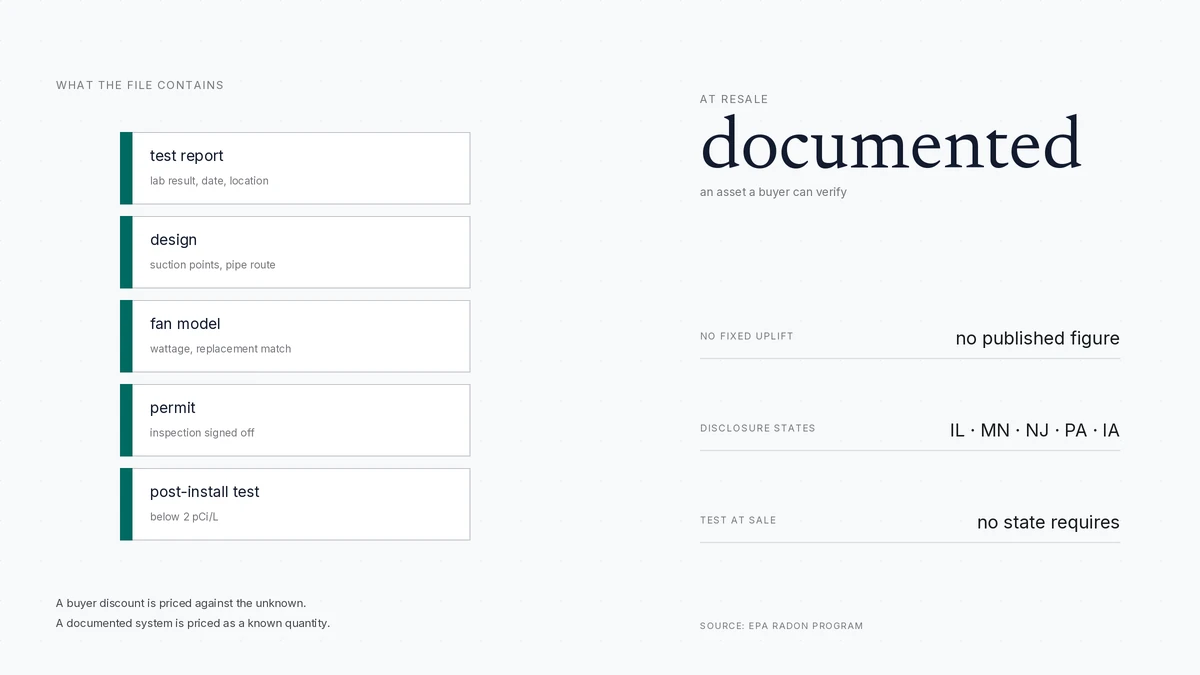
A working system does not add a fixed percentage to a sale price, and no reliable figure exists. It removes a discount: a buyer facing an unmitigated high reading prices in the unknown, while a documented system with a passing post-install test is a settled fact.
- Documented system
- verifiable asset
- No system, high reading
- priced as risk
- Disclosure states
- IL, MN, NJ, PA, IA
- Test at sale required
- no state requires it
Some links on this page are affiliate links.If you buy through them we may earn a commission at no extra cost to you. We do not accept payment for rankings. Read the full disclosure.
| System with records | High reading, no system | |
|---|---|---|
| What the buyer sees | A labeled system, a fan, a post-install result | A lab report at or above 4 pCi/L |
| What it costs them | About $127 a year in electricity | An unknown install, quoted after closing |
| Negotiating position | The issue is closed with evidence | The buyer names a number, often high |
| Inspection outcome | Fan runs, manometer shows suction | A recommendation to mitigate, in writing |
| Warranty question | Answerable from the file | Nothing to transfer |
Radon mitigation home value is the effect a working system has on what a house sells for. There is no published percentage, and any site quoting one is guessing. What can be described precisely is the mechanism: a documented system removes an uncertainty a buyer would otherwise price into an offer, and an undocumented or absent system leaves that uncertainty in place.
What a system is worth at resale
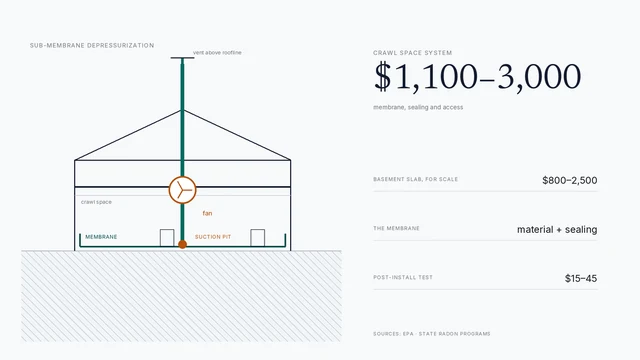
Start with what the buyer is actually buying. A mitigation system is a piece of building equipment with a known install cost, a known operating cost and a measurable output. EPA puts the installed band for a fan-based system at $800–$2,500, with an average near $1,200, and the fan adds roughly $127 a year at the August 2026 US average electricity price.
A buyer who receives that package is receiving something they can verify: the fan runs, the manometer shows suction, a lab report shows a number below the action level, and a warranty covers the parts. That is a settled fact. It is worth at least the cost of doing the same work themselves, minus the hassle, and it is worth more than that to a buyer who does not want a construction project after closing.
Why buyers discount uncertainty
A high radon reading without a system is not a fixed cost to a buyer. It is a range. The low end is one contractor’s bid on the easiest possible interpretation. The high end includes a crawl space nobody has inspected, a possible second suction point, electrical work, and a delay before they can move in.
Buyers resolve that range pessimistically, and realtors advise them to. The result is a credit request that often exceeds the honest cost of the work, because the credit is priced against the worst case plus inconvenience. A completed system collapses the range to one number: the electricity bill.
That is the whole mechanism. The system does not add a premium. It prevents a discount that would otherwise be larger than the system cost.
The arithmetic is visible in a typical credit request. A buyer who reads a lab report at 6 pCi/L asks for more than the cost of a system, because the request also covers the uncertainty, the schedule and the risk of discovering a crawl space mid-job. A seller who installs first pays the real cost, once, on their own timeline.
Disclosure states and what they ask
Five states require disclosure or a pamphlet at sale: Illinois, Minnesota, New Jersey, Pennsylvania and Iowa. The requirement is about telling the buyer what is known, not about producing a system or a particular result.
No state requires a radon test at sale. That matters for how you plan. In a disclosure state, a known result has to be passed along, so testing early gives you time to mitigate on your own schedule rather than under a closing deadline. In a state with no requirement, the test usually arrives anyway, because a buyer’s inspector recommends one.
Massachusetts is a separate case: it requires passive radon-resistant construction in new homes in designated counties, which is a construction rule rather than a disclosure one. The zones section explains how state and county mapping relates to the predicted average, and why a zone map never substitutes for a test of the specific house.
The records that carry the value
The system is only an asset if it is documented. Six items do most of the work.
- The original test report. A lab result with a date, a location and confirmation of closed-house conditions.
- The design and proposal. Suction-point count, pipe route and the target level the contractor committed to.
- The fan make and model. So the next owner can match a replacement and check the wattage.
- The permit, where one was required. An inspected job is a different conversation from an unpermitted one.
- The warranty. Parts and labor, with start dates and what transfers.
- The post-install test, plus later retests. The proof the system reached its target, and evidence it still does.
Keep them in one folder, paper and digital. At closing, hand the folder over. A buyer who receives a complete packet tends not to reopen the issue.
What does not move the number
A few claims circulate that the evidence does not support, and repeating them weakens your position with a buyer who checks.
There is no standard percentage uplift for a radon system, and no appraisal line for one. Appraisers work from comparable sales; a mitigation system is not a feature that appears in that comparison the way a garage or a second bathroom does. Its effect shows up through marketability and through the absence of a negotiated credit.
A system also does not make a house “radon free.” It lowers the concentration, usually below 2 pCi/L, and it needs to keep running. A buyer who is told the number is zero and later reads a manometer will trust nothing else you said.
And a passive system in new construction is not the same as an active one. A passive system with no fan has a band of $500–$1,500, and activating it later costs $300–$900. If the house has a passive pipe with no fan, say so, and say what activation would cost.
How a buyer, inspector and appraiser each see it
Three people look at the system and each looks for something different.
The inspector runs the fan, checks the manometer for an offset, follows the pipe to its termination, and reads the label. What the inspector writes down is either “system present and operating” or a recommendation to evaluate further. A labeled, permitted system produces the first sentence.
The buyer wants the number and the running cost. A post-install report answers the first; the fan wattage answers the second. The testing section explains what a defensible test looks like if they ask to see one.
The appraiser is not looking at the system at all unless it affects marketability. Do not expect a line item, and do not represent one to a buyer.
Marketing it honestly
Describe the system in the listing the way you would describe a furnace: present, age, model, serviced, and documented. “Radon mitigation system installed, post-install test below 2 pCi/L, records available” is a complete sentence. “Radon free” is not, and it invites a retest that may not support it.
If the system is old, say the age. A fan has a service life of 5–15 years, and a replacement runs $150–$450. A buyer who learns the age from the label rather than from you will wonder what else was left out.
The file to hand over
The handover packet is the deliverable: the test that started the project, the design, the fan model, the permit, the warranty, the post-install result and every retest since. Add the install date and the installer’s contact.
If any of it is missing, replace it before you list. A short-term test costs $15–$45 and settles the number. The cost section covers what a replacement fan or a service visit should run if the system needs attention first. A $40 test and a $300 fan are cheap against a credit negotiated in the last week before closing.
How to do it
- Test before any listing decisionA short-term kit with lab analysis costs $15–$45. A result below 4 pCi/L changes the conversation, and a result at or above it gives you time to mitigate on your own schedule.
- Install before you list, if you canA completed install with a passing post-install test is a stronger position than a credit negotiated under deadline, because the buyer is not pricing an unknown.
- Run the post-install testAfter at least 24 hours of operation, test again. The result is the document that turns a pipe and a fan into a verified system.
- Assemble the fileTest report, design, fan model, permit, warranty, post-install result and retests. One folder, paper and digital, handed over at closing.
- Label the systemThe pipe label should carry the installer, a contact number and the install date. An unlabeled system reads as anonymous work to an inspector.
Frequently asked questions
Does a radon mitigation system increase home value?
Not by a percentage anyone can quote reliably. What a system does is remove a reason for a buyer to discount. An unmitigated house with a high reading invites a guess at the worst case; a documented system with a passing post-install test turns the same issue into a settled fact with a known operating cost.
Which states require radon disclosure when selling a house?
Illinois, Minnesota, New Jersey, Pennsylvania and Iowa require disclosure or a pamphlet at sale. No state requires a radon test at sale. The disclosure requirement is about telling the buyer what is known, not about producing a system or a specific result.
Should I disclose a radon system when I sell?
If your state requires disclosure, yes, and in practice yes everywhere. A buyer's inspector will find the fan and the pipe, and an undisclosed system looks worse than a documented one. Disclose it with the paperwork that shows what it does.
What records should I keep after an install?
The original test report with its lab result, the contractor's design and proposal, the fan make and model, the permit if one was pulled, the warranty, the post-install test result and any later retests. That packet is what a buyer, an inspector and a warranty claim all ask for.
Does a radon system raise a home appraisal?
Appraisers compare a house with comparable sales, and a mitigation system is not a line item in that comparison the way a bathroom or a garage is. Its effect shows up indirectly, through marketability and through the absence of a negotiated credit, rather than as an added value line.
Is a house with a radon system harder to sell?
The opposite is more common. A system that is labeled, permitted where required, and backed by a passing test answers a question buyers now ask. A house with a high reading and no system leaves the buyer to price the uncertainty themselves, and buyers tend to price uncertainty high.
Sources
Some links are affiliate links.If you buy through them we may earn a commission at no extra cost to you. We do not accept payment for rankings. Read the full disclosure.